

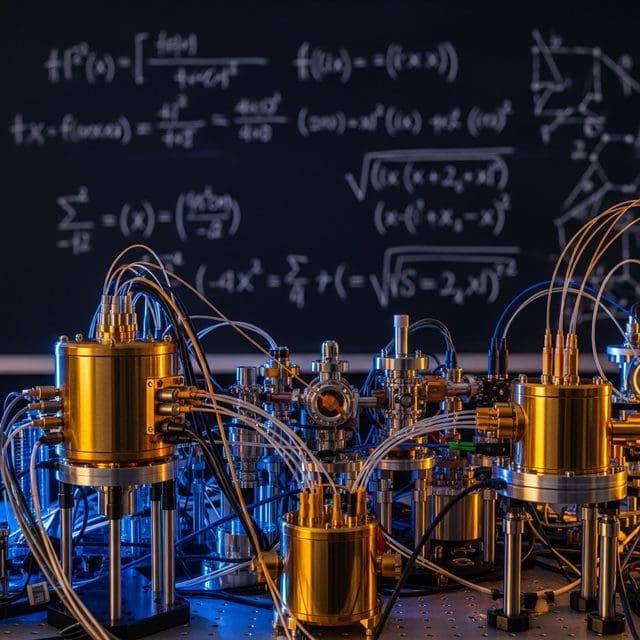
Researchers at Los Alamos and CERN are redefining the limits of physics, demonstrating time-reversal protocols and detecting particle anomalies that suggest the Standard Model may be incomplete.
The boundaries of modern physics are being redrawn this week as researchers from Los Alamos National Laboratory and CERN report breakthroughs that challenge fundamental assumptions about time and the building blocks of the universe. These developments, ranging from the manipulation of quantum trajectories to the discovery of rare particle behaviors, suggest that the next generation of technology will be built on a more fluid understanding of physical laws than previously imagined.
At Los Alamos National Laboratory, a team led by García-Pintos and Liu published a study in Physical Review X demonstrating that the “arrow of time” is not as immutable as once thought. By utilizing advanced quantum measurement and feedback control, the team designed Hamiltonians that drive monitored quantum systems along time-reversed stochastic paths. This is not science fiction style time travel, but a sophisticated form of quantum thermodynamics. By precisely managing how a system is observed, researchers can harvest energy from the measurement process itself, effectively turning information into a tangible fuel source.
This discovery has immediate implications for the development of quantum batteries and high-efficiency engines. In a world increasingly reliant on decentralized energy solutions, the ability to extract work from the act of monitoring a quantum state represents a shift toward a new frontier of sovereign energy technology. It moves quantum computing from abstract calculation into the realm of practical, microscopic power generation. The Los Alamos team is now positioning this work as a foundation for “Maxwell’s demon” engines, where information is used to bypass traditional thermodynamic losses, potentially securing a future of self-sustaining quantum devices.
Simultaneously, at the Large Hadron Collider (LHC) in Switzerland, the LHCb experiment reported a significant “tension” in the Standard Model of physics. After analyzing 650 billion B-meson decays, scientists found that the angles at which particles emerge during rare “penguin” decays do not align with established predictions. Specifically, the decay of a B meson into a kaon and two muons showed an angular distribution that disagrees with the Standard Model at a significance of four sigma. This means there is only a 1-in-16,000 chance that the result is a random fluctuation, strongly suggesting the presence of unobserved forces or particles, such as leptoquarks, which could rewrite the laws of matter.
Further solidifying this era of discovery, the University of Vienna has made strides in condensed matter physics by extending the life of “magnons”—tiny magnetic waves—by nearly 100 times. By using ultra-pure yttrium iron garnet, researchers pushed magnon lifetimes to 18 microseconds. This breakthrough identifies material purity, rather than fundamental physics, as the primary hurdle for creating penny-sized quantum processors. This shift from theoretical barriers to engineering challenges suggests that compact, localized quantum devices may arrive sooner than skeptics anticipated, as these long-lived magnons can now serve as “quantum buses” linking different qubit technologies.
Finally, the LHCb team identified a new heavy “cousin of the proton,” a doubly charmed baryon known as the Xi-cc-plus. Consisting of two charm quarks and one down quark, this particle is nearly four times the mass of a proton. With over 900 signal events recorded, this discovery completes a long-predicted family of baryons and provides a new laboratory for probing the strong force. Together, these findings represent a triumph of rigorous inquiry over settled science. Whether it is the discovery of heavy quarks at CERN or the reversal of quantum trajectories in New Mexico, these milestones defend the necessity of continued investment in high-frontier research to ensure national technological sovereignty.

Mason Reed serves as a Staff Writer for Just Right News, where he spearheads the Future Frontiers & Special Projects desk. In an era defined by rapid technological shifts and evolving social landscapes, Mason provides a steady, principled voice, examining the innovations of tomorrow through the lens of traditional American values. His work is most prominently featured in his signature series, “The Next Horizon,” where he explores the intersection of emerging technology, national sovereignty, and the preservation of individual liberty.
A native of San Diego, California, Mason’s worldview was shaped by the unique culture of his hometown. Growing up in a region defined by its strong military presence and its history of maritime industry, he developed a deep-seated respect for the institutions that provide national stability and the entrepreneurial spirit that drives the American economy. This upbringing instilled in him a belief that true progress is not found in discarding the past, but in building upon a foundation of proven principles. His reporting often reflects this San Diego influence, emphasizing the importance of a robust national defense and the necessity of maintaining a competitive edge in the global marketplace.
Now based in San Francisco, Mason operates from the heart of the world’s technological engine. Living and working in the Bay Area provides him with a front-row seat to the advancements—and the ideological challenges—emanating from Silicon Valley. While many in the region embrace a “move fast and break things” mentality, Mason’s reporting serves as a vital counterweight. He offers Just Right News readers a “boots on the ground” perspective, documenting how radical local policies and the concentration of tech power impact the everyday lives of citizens. His proximity to the industry allows him to cut through the marketing jargon of big tech to uncover the real-world implications for privacy, free speech, and the nuclear family.
In his “Future Frontiers” beat, Mason tackles complex subjects ranging from the ethics of artificial intelligence to the burgeoning private space race. He approaches these topics with a healthy skepticism toward centralized bureaucracy, championing instead the decentralized innovations that empower individuals. Through “The Next Horizon,” he highlights the pioneers and thinkers who are working to ensure that the future remains a place where human dignity and constitutional rights are protected. He believes that the rapid pace of change requires more than just technical expertise; it requires a moral compass rooted in the Western tradition.
Throughout his tenure at Just Right News, Mason has remained committed to the idea that the future is something to be shaped, not merely accepted. His writing is characterized by a rigorous defense of American exceptionalism and a belief that the country’s best days lie ahead, provided it remains true to its founding ideals. Whether he is investigating the impact of automation on the American workforce or profiling the next generation of aerospace engineers, Mason Reed ensures that his readers are equipped with the insights they need to navigate a changing world with confidence and clarity.