

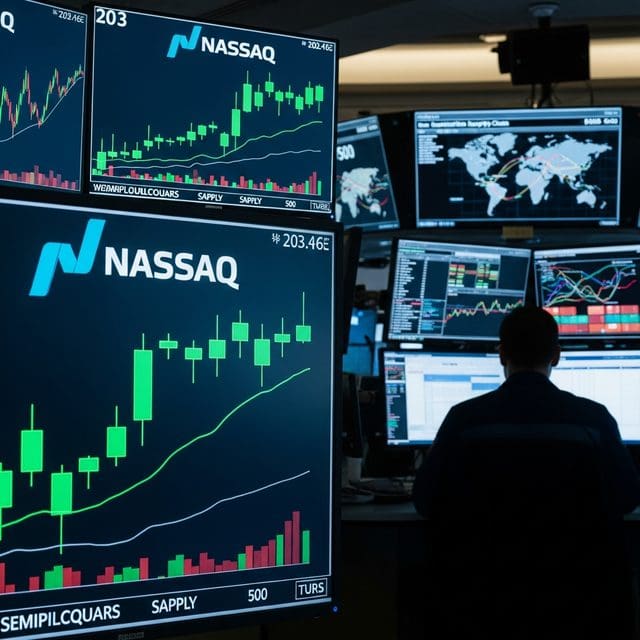
The Nasdaq and S&P 500 climbed on Monday as robust quarterly reports from global chipmakers revitalized the artificial intelligence trade despite a slight dip in the Dow.
The American equity markets demonstrated a clear divergence on Monday as the technology sector reclaimed its role as the primary engine of growth. The Nasdaq Composite surged 1.1%, while the S&P 500 gained 0.6%. This upward momentum suggests a restoration of investor confidence in the artificial intelligence narrative, which had faced skepticism during a late-June volatility spike in semiconductor valuations. While the Dow Jones Industrial Average dipped slightly below the flat line following a record-setting holiday week, the underlying strength in tech provided a necessary counterbalance for the session.
Driving this shift were significant performance indicators from the global hardware supply chain. Hon Hai, known as Foxconn, reported a second-quarter revenue increase of nearly 40% year-on-year, totaling approximately $78.71 billion. This surge in sales for the primary Nvidia supplier serves as a tangible data point for those tracking the invisible economy of infrastructure spending. Furthermore, Samsung Electronics is projected to report an 18-fold increase in operating profit, bolstered by a memory chip shortage that saw average selling prices for DRAM and NAND rise by 44% and 53% respectively in the second quarter. Samsung has already proposed raising DRAM prices by another 20%, citing persistent industry bottlenecks.
For the American taxpayer and working household, these figures represent a complex economic reality. While the appreciation of the S&P 500 benefits retirement accounts, the rising cost of memory chips signals persistent inflationary pressure in consumer electronics and automotive sectors. The meritocracy of the market is currently rewarding those positioned in high-growth tech, even as blue-chip components of the Dow take a breather. The emergence of new players like Ornn, an Andreessen Horowitz-backed startup that recently raised $33 million to trade computing power as a commodity, further illustrates how the market is evolving to treat digital resources with the same weight as traditional physical assets.
In the commodities space, the geopolitical landscape showed signs of stabilization. Oil prices remained largely unchanged as OPEC+ moved to modestly increase crude production. This decision is closely linked to ongoing diplomatic efforts in Doha, where U.S. and Iranian negotiators resumed talks on July 1. These discussions focus on a 60-day window to secure a nuclear deal and the full reopening of the Strait of Hormuz. A resolution in this corridor is essential for maintaining national sovereignty over energy costs and preventing a renewed spike in domestic fuel prices that would further strain household budgets.
Corporate activity elsewhere suggests a market still hungry for consolidation. OCI N.V. recently recommended an unsolicited all-cash offer from NNS at EUR 4.10 per share, while Skanska divested a major multifamily project in Sweden to Folksam Group for SEK 570 million. Even in emerging markets, digital finance continues to expand, with AEON Pay entering Zambia to integrate mobile money for digital asset settlement. These moves reflect a global financial system attempting to maintain velocity despite high interest rates and regulatory scrutiny.
Monetary policy remains the final piece of the puzzle. Following a June jobs report that reset market expectations, investors are now looking toward the release of Federal Reserve minutes on Wednesday. This will be the first look at the central bank’s internal deliberations under the leadership of Kevin Warsh. For those concerned with fiscal responsibility, the focus remains on whether the Fed will prioritize a stable monetary system over the continued expansion of centralized financial control. As the S&P 500 hovers at a 0.75% gain on the session, the question for the American worker is whether this growth is sustainable or a byproduct of a tech sector increasingly detached from the broader industrial economy.

Jordan Lee serves as the Senior Correspondent for Wall Street, Finance, and Monetary Systems at Just Right News. Based in the heart of the world’s financial capital, New York City, Lee brings a sharp, principled eye to the complex mechanisms that drive the global economy. His reporting is defined by a commitment to fiscal responsibility, the defense of the free market, and a deep-seated belief that a transparent monetary system is the bedrock of a free society.
Raised in Portland, Oregon, Lee’s perspective was forged in a city that has undergone significant cultural and economic shifts. His upbringing in the Pacific Northwest instilled in him a profound appreciation for the industriousness of small business owners and the importance of local economic stability. Watching the evolution of his hometown’s landscape sparked an early interest in how federal fiscal policy and large-scale financial trends eventually trickle down to the average citizen. This background provides him with a unique vantage point; he understands the growing disconnect between the policy-making elite and the reality of Main Street, a theme that frequently resonates throughout his work.
Now operating from his base in New York City, Lee bridges the gap between the high-stakes trading floors of Manhattan and the households of everyday Americans. He views the financial sector not merely as a collection of numbers and tickers, but as a vital engine of American prosperity that requires constant vigilance and accountability. His reporting often highlights the dangers of centralized financial control and the necessity of maintaining a system that rewards merit, risk-taking, and innovation.
As the creator and lead of the featured series, “The Invisible Economy,” Lee pulls back the curtain on the often-opaque world of monetary systems. He specializes in translating the dense jargon of central banking and international finance into actionable insights for the Just Right News audience. His work explores the “invisible” forces—such as inflationary pressures, regulatory creep, and the expansion of the administrative state—that erode the purchasing power of American families. By focusing on these systemic issues, Lee empowers readers to understand the hidden forces shaping their financial independence.
Lee’s journalistic philosophy is rooted in a steadfast commitment to traditional American values. As an Asian American professional who has navigated the competitive corridors of the financial world, he is a vocal advocate for meritocracy and the preservation of the American Dream. He believes that a stable currency and a predictable regulatory environment are essential for national sovereignty and individual liberty. His reporting frequently warns against the risks of government overreach in the private sector, arguing that the most effective solutions to economic challenges arise from competition and individual enterprise rather than bureaucratic mandates.
At Just Right News, Jordan Lee remains dedicated to providing a clear-eyed defense of the taxpayer. Whether he is analyzing market volatility or investigating the long-term implications of national debt, his mission is to provide the truth about where the money is going and what it means for the future of the country. Through his rigorous analysis and principled stance, Lee has become a trusted voice for those who value a strong, sovereign, and fiscally sound America.