

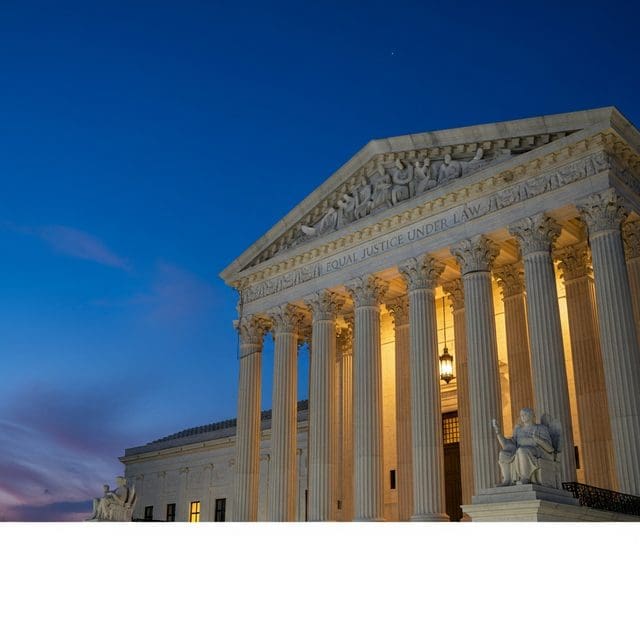
In a series of landmark rulings, the Supreme Court protected Federal Reserve independence while expanding presidential control over the FTC and requiring warrants for geofence location tracking.
The Supreme Court delivered a consequential recalibration of the separation of powers this week, issuing rulings that define the boundaries of the administrative state. In a 5–4 decision, the Court blocked President Trump’s attempt to fire Federal Reserve Governor Lisa Cook. The majority held that Cook can only be removed “for cause,” a standard that preserves the operational independence of the nation’s central bank from direct political interference. Governor Cook welcomed the ruling as a defense of autonomy, while markets responded with a rising DXY dollar index, signaling confidence in the Fed’s insulation from electoral cycles.
However, the Court’s commitment to administrative independence was not absolute. In a separate determination, the justices expanded presidential removal power over other regulators, holding that the President can fire Federal Trade Commission (FTC) Commissioner Rebecca Slaughter without cause. This distinction suggests a judicial hierarchy: while monetary policy requires isolation, other regulatory bodies must remain directly accountable to the Chief Executive under the unitary executive theory. This shift heightens executive control over federal agencies even as the Fed remains protected.
The Court also addressed digital-age privacy, ruling 6–3 that “geofence” warrants constitute a Fourth Amendment “search.” These warrants, which sweep up phone location histories for everyone in a specific area, must now be supported by a warrant and probable cause. The ruling in the Chatrie bank-robbery case forces law enforcement to narrow data requests and recognizes a “reasonable expectation of privacy” in the location data held by companies like Google. While the technique is not banned, the threshold for its use has been significantly raised to meet constitutional standards.
Beyond the high court, the federal judiciary continues to scrutinize administrative mandates. A federal judge recently blocked a Trump administration student loan rule that sought to limit debt relief for nurses and health workers. The court found the administration’s distinction between “professional programs” like law and fields like nursing to be legally tenuous. This follows a broader pattern of judicial skepticism toward agency-led policy changes that lack clear statutory backing from Congress.
Internationally, the principle of judicial restraint was echoed by India’s Supreme Court in the Bihar police encounter case. The court dismissed a plea for a Central Bureau of Investigation (CBI) probe into an alleged extra-judicial killing, reinforcing the authority of state-level institutions over federal intervention. This mirrors the American constitutional preference for local jurisdiction unless a clear federal breach is evident. Together, these developments underscore a period of intense focus on the Rulebook of Power, as courts grapple with the proper scope of government authority in a complex era.

Lila Hayes serves as a Staff Writer for Just Right News, where she anchors the “Courts, Law, and Constitutional Order” beat. Her work is defined by a steadfast commitment to the foundational principles of the American republic and a rigorous defense of the legal frameworks that ensure national stability. As a primary voice for the outlet, she provides readers with a clear-eyed analysis of the judiciary, focusing on the importance of originalism and the preservation of the separation of powers.
Lila’s perspective was forged in the American heartland. Raised in St. Louis, Missouri, she grew up in a Hispanic household where the values of hard work, faith, and respect for the law were paramount. Her upbringing instilled in her a deep appreciation for the American Dream and the legal protections that make it possible. This Missouri background remains a cornerstone of her reporting, providing a grounded, common-sense counter-narrative to the often-insular legal circles of the coastal elite. She understands that the decisions made in high-court chambers have real-world consequences for families and small business owners across the country.
At Just Right News, Lila has become widely recognized for her signature feature series, “The Rulebook of Power.” In this ongoing project, she delves into the mechanics of the federal government, examining how administrative overreach and judicial activism can threaten the delicate balance of the Constitution. She approaches her beat with the tenacity of a veteran journalist and the precision of a legal scholar, consistently advocating for a judiciary that interprets the law as written rather than legislating from the bench. For Lila, the Constitution is not a “living” document subject to the whims of modern social trends; it is a fixed standard that ensures the government remains the servant of the people, not their master.
Now based in Philadelphia, Pennsylvania, Lila finds herself at the very epicenter of American constitutional history. Living and working in the city where the Founders drafted the documents she defends daily provides a constant source of inspiration. The historic halls and landmarks of Philadelphia serve as a daily reminder of the high stakes involved in her reporting. Her presence in the city allows her to bridge the gap between the historical intent of the law and its contemporary application, ensuring that the legacy of the Founding Fathers remains central to the national conversation.
Throughout her career, Lila has remained dedicated to the idea that a free society requires an informed citizenry and a transparent legal system. Her reporting is more than just a collection of headlines; it is a defense of the constitutional order that has sustained the nation for over two centuries. By focusing on the “Rulebook of Power,” she ensures that her readers understand not just what is happening in the courtrooms, but why those decisions matter for the future of American liberty. Lila Hayes continues to be a vital voice for those who believe that the law should be a shield for the citizen and a constraint on the state.