

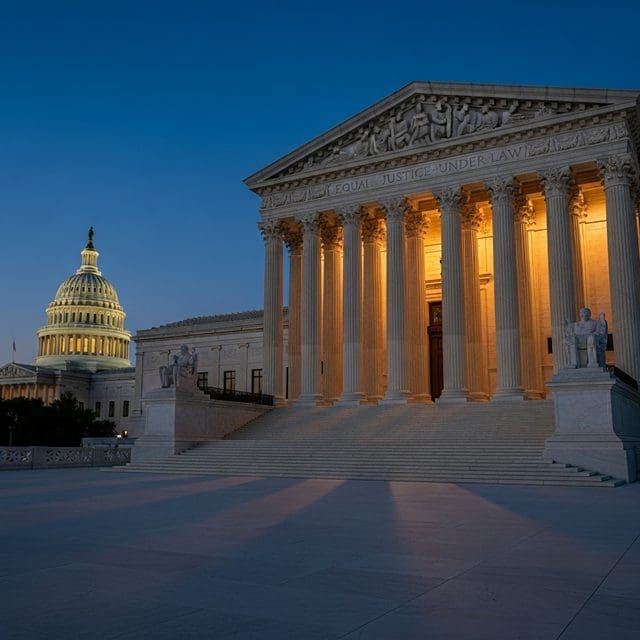
The Supreme Court overturned decades of precedent to grant the president broader authority over federal regulators while maintaining a unique, narrow shield for the Federal Reserve.
The constitutional architecture of the American administrative state underwent a seismic shift this week as the Supreme Court redefined the relationship between the executive branch and independent regulatory agencies. In the landmark case Trump v. Slaughter, a 6–3 majority overturned the 1935 Humphrey’s Executor precedent, holding that the president possesses the authority to remove commissioners of most independent agencies at will. For decades, these bodies were shielded from political interference by statutes allowing removal only for cause. The Court has now swept those protections aside.
Writing for the majority, the Court validated the March 2025 removal of FTC Commissioner Rebecca Kelly Slaughter, asserting that statutory restrictions on removal power infringe upon the Article II mandate to oversee the executive branch. This decision effectively converts leaders at dozens of agencies—including the FTC, FERC, and the Nuclear Regulatory Commission—into at-will employees. For proponents of the unitary executive, the ruling restores the Founders’ intent by ensuring those exercising sovereign power remain accountable to the president. Critics, however, warn this gives the White House direct leverage over agencies regulating electricity, gas, and financial markets, potentially leading to rapid policy swings with every administration change.
However, the Court drew a distinct line at the central bank. In a 5–4 decision in Trump v. Cook, the Court declined to extend this broad removal power to the Federal Reserve Board of Governors. By shielding Governor Lisa Cook from a presidential firing attempt, the Court recognized a critical exception for monetary policy independence. The Court declined to stay Cook’s reinstatement while lower courts build a factual record on the administration’s misconduct allegations. This split outcome creates a new legal reality where the president may reshape consumer protection and energy policy through personnel changes, while the Federal Reserve remains an outlier insulated from direct political interference.
Beyond the administrative state, the Court addressed the limits of unilateral executive action regarding the Fourteenth Amendment. In a 6–3 ruling, the Court struck down an executive order seeking to end birthright citizenship for children born to non-citizen parents. Chief Justice John Roberts interpreted the phrase “subject to the jurisdiction thereof” to cover nearly all U.S.-born children. The ruling reaffirmed that the Constitution’s guarantee of citizenship cannot be altered by executive fiat, closing a path the president attempted to take without statutory authorization from Congress.
On the legislative front, these rulings arrive as President Trump refuses to sign the 21st Century ROAD to Housing Act, despite concern from GOP senators. Simultaneously, the Court’s 5–4 decision to uphold a Mississippi law counting mail-in ballots received after Election Day ensures that existing state frameworks for the 2026 midterms remain intact. As inflation remains above 4 percent and energy prices fluctuate, these rulings signal a judiciary intent on enforcing the written Constitution while navigating the boundaries of modern governance.

Lila Hayes serves as a Staff Writer for Just Right News, where she anchors the “Courts, Law, and Constitutional Order” beat. Her work is defined by a steadfast commitment to the foundational principles of the American republic and a rigorous defense of the legal frameworks that ensure national stability. As a primary voice for the outlet, she provides readers with a clear-eyed analysis of the judiciary, focusing on the importance of originalism and the preservation of the separation of powers.
Lila’s perspective was forged in the American heartland. Raised in St. Louis, Missouri, she grew up in a Hispanic household where the values of hard work, faith, and respect for the law were paramount. Her upbringing instilled in her a deep appreciation for the American Dream and the legal protections that make it possible. This Missouri background remains a cornerstone of her reporting, providing a grounded, common-sense counter-narrative to the often-insular legal circles of the coastal elite. She understands that the decisions made in high-court chambers have real-world consequences for families and small business owners across the country.
At Just Right News, Lila has become widely recognized for her signature feature series, “The Rulebook of Power.” In this ongoing project, she delves into the mechanics of the federal government, examining how administrative overreach and judicial activism can threaten the delicate balance of the Constitution. She approaches her beat with the tenacity of a veteran journalist and the precision of a legal scholar, consistently advocating for a judiciary that interprets the law as written rather than legislating from the bench. For Lila, the Constitution is not a “living” document subject to the whims of modern social trends; it is a fixed standard that ensures the government remains the servant of the people, not their master.
Now based in Philadelphia, Pennsylvania, Lila finds herself at the very epicenter of American constitutional history. Living and working in the city where the Founders drafted the documents she defends daily provides a constant source of inspiration. The historic halls and landmarks of Philadelphia serve as a daily reminder of the high stakes involved in her reporting. Her presence in the city allows her to bridge the gap between the historical intent of the law and its contemporary application, ensuring that the legacy of the Founding Fathers remains central to the national conversation.
Throughout her career, Lila has remained dedicated to the idea that a free society requires an informed citizenry and a transparent legal system. Her reporting is more than just a collection of headlines; it is a defense of the constitutional order that has sustained the nation for over two centuries. By focusing on the “Rulebook of Power,” she ensures that her readers understand not just what is happening in the courtrooms, but why those decisions matter for the future of American liberty. Lila Hayes continues to be a vital voice for those who believe that the law should be a shield for the citizen and a constraint on the state.