

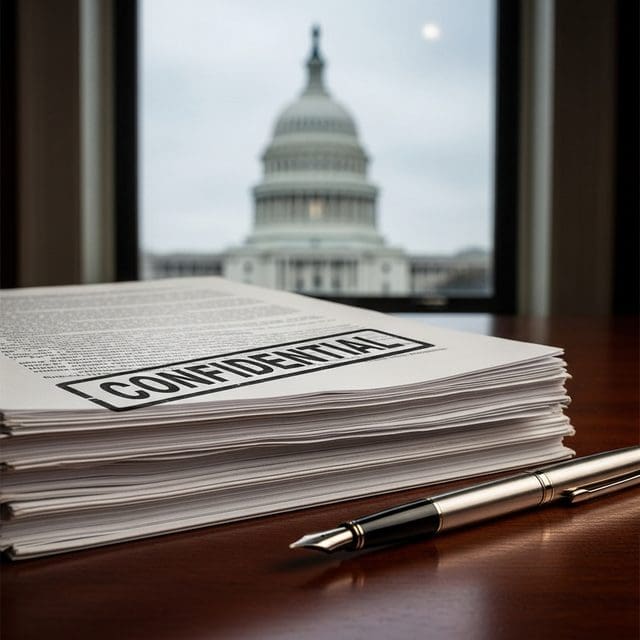
Transparency advocates and lawmakers warn a proposed government-wide non-disclosure agreement could suppress reports of bureaucratic failure and administrative backlogs.
A proposed government-wide non-disclosure agreement (NDA) is drawing sharp criticism from transparency advocates, legal scholars, and lawmakers who warn the measure will increase administrative secrecy and silence whistleblowers. The Project On Government Oversight (POGO) filed a formal public comment on June 26, 2026, asserting that the Office of Personnel Management (OPM) proposal would create a de facto barrier to accountability. POGO’s filing argues that the rule would “increase government-wide secrecy” and chill the willingness of career civil servants to report misconduct, despite nominal carve-outs for protected disclosures. This move is seen by many as a significant expansion of the administrative state’s power to control the flow of information to the public.
The push for a standardized NDA coincides with significant administrative strain across the federal workforce. A comment letter led by the group Protect Democracy cited reporting from Michele Sandiford of Federal News Network regarding a staggering backlog of 55,000 retirement applications currently sitting at OPM. Advocates argue that under the proposed rules, employees who highlight such systemic failures or provide internal data on service delays to the press could be accused of disclosing “nonpublic” or “pre-decisional” information, leading to severe disciplinary action. The concern is that the NDA could be used to mask incompetence under the guise of protecting sensitive internal deliberations.
Public sector HR and civil service groups have formally requested that OPM clarify its definitions of “confidential” and “proprietary” information. Of particular concern is whether the NDA would treat communications with the media, Freedom of Information Act (FOIA) officers, or inspectors general as prohibited leaks. The Federal Register notice for the rule remains notably silent on how agencies will track and enforce violations. This drafting gap has raised questions about whether internal “leak” probes could eventually grant agencies the authority to access employees’ personal devices or monitor off-duty communications, creating an unresolved privacy and enforcement crisis that threatens the constitutional liberties of federal workers.
Legal analysts note that this policy shift is occurring alongside a separate Trump administration plan to move many suitability appeals from the independent Merit Systems Protection Board (MSPB) into internal OPM review. Critics argue this move systematically reduces the independent oversight available to employees who refuse to sign the NDA or who report waste and abuse. By moving these appeals in-house, the administration could effectively bypass the neutral third-party adjudication that has historically protected whistleblowers from retaliatory firing or demotion. This dual-track approach—restricting speech while simultaneously weakening the venues for appeal—creates a precarious environment for those committed to government transparency.
Media-freedom advocates and ethics lawyers have framed the OPM proposal as a critical First Amendment test case. They argue that the broad language could be weaponized to suppress information that is in the public interest but embarrassing to the executive branch. This includes disclosures related to fraud, waste, and abuse that might not meet a narrow, technical definition of a “protected disclosure” but are nonetheless vital for congressional oversight and public awareness. The fear is that the threat of litigation or termination will create a “silent” workforce where administrative failures remain hidden behind a wall of mandatory confidentiality, effectively insulating the bureaucracy from the people it serves.
Democratic lawmakers are currently evaluating legislative responses to codify whistleblower rights into any agency-level NDA. According to Federal News Network, these lawmakers are weighing bills that would explicitly preserve the legality of Congress-to-employee communications and mandate cooperation with inspector general investigations. While no bill has been formally introduced, the closing of the 30-day public comment window has intensified the pressure on OPM to revise the proposal. As the administrative state moves to tighten its grip on internal records, the tension between executive branch control and the public’s right to know has reached a new, document-driven flashpoint in the nation’s capital, where the stakes for government accountability have never been higher.

Ben Taylor serves as the Senior Correspondent and Investigations Lead for Just Right News, where he anchors the network’s commitment to government transparency and institutional accountability. With a career defined by a relentless pursuit of the facts, Taylor spearheads the acclaimed feature series “The Paper Trail,” a deep-dive investigative column that prioritizes primary source documentation over political rhetoric. Based in the heart of the nation’s capital, he has earned a reputation as one of the most formidable investigative journalists in Washington, D.C., known specifically for his mastery of public records and the Freedom of Information Act.
Taylor’s approach to journalism is deeply rooted in his upbringing in Kansas City, Missouri. Growing up in the “Show Me State,” he developed a healthy skepticism of centralized power and a profound respect for the common-sense values of the American heartland. This Midwestern foundation informs his reporting today, as he bridges the gap between the complex machinations of federal bureaucracy and the everyday concerns of citizens across the country. For Taylor, investigative reporting is not about chasing headlines; it is about ensuring that the government remains answerable to the people it serves.
As an African American man working within the conservative media landscape, Taylor brings a principled perspective to his beat. He views the Constitution and the right to information as the ultimate equalizers in a free society. His work often highlights how bureaucratic overreach and lack of transparency disproportionately affect individual liberties. By focusing on the “paper trail,” Taylor strips away the spin of partisan talking points, instead providing Just Right News readers with the raw data and internal communications that reveal how their tax dollars are spent and how policy decisions are actually made.
In his role as Investigations Lead, Taylor oversees a team dedicated to uncovering the stories that mainstream outlets often overlook. Whether he is auditing federal spending, investigating regulatory overreach, or exposing inefficiencies within the administrative state, his methodology remains consistent: follow the evidence wherever it leads. His presence in Washington, D.C., allows him to maintain a constant watch over the halls of power, yet he remains steadfastly connected to his roots, ensuring his reporting reflects the clarity and directness of his Missouri home.
Throughout his tenure at Just Right News, Taylor has become a vital voice for those who demand integrity in public office. He believes that a well-informed electorate is the strongest defense against government overreach, and he has dedicated his career to providing the public with the tools they need to hold their leaders accountable. Through “The Paper Trail” and his broader investigative work, Ben Taylor continues to set the standard for rigorous, document-driven journalism that champions the values of transparency, individual responsibility, and the rule of law.