

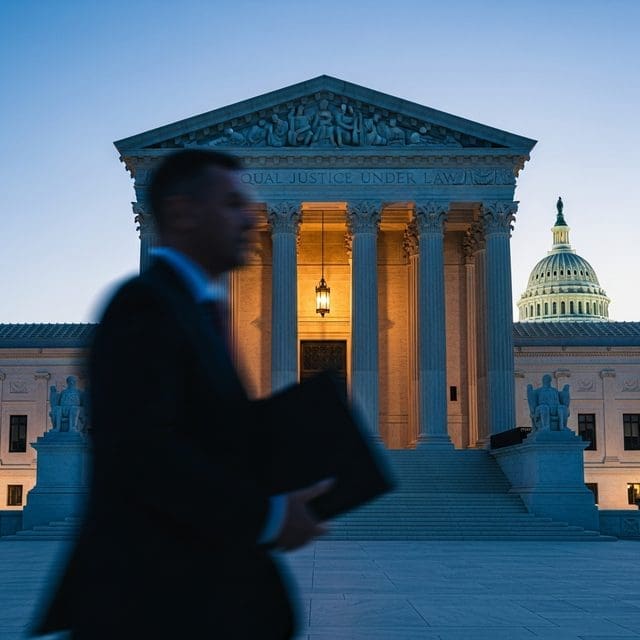
Twin 6-3 Supreme Court decisions empower the Department of Homeland Security to resume asylum metering and terminate Temporary Protected Status for over one million residents.
The Supreme Court issued two landmark 6-3 decisions this week that fundamentally reshape the executive branch’s authority over the nation’s borders and the legal status of hundreds of thousands of residents. Writing for the majority, Justice Samuel Alito established a narrow interpretation of federal immigration statutes, effectively insulating Department of Homeland Security (DHS) decisions from judicial oversight. These rulings arrive as the White House utilizes newfound legal standing to pressure a divided Congress on both domestic and foreign policy fronts.
In the first ruling, the Court upheld the practice of asylum “metering,” allowing federal agents to turn back seekers at ports of entry before they physically step onto U.S. soil. Justice Alito’s opinion hinges on a strict reading of the phrase “arrives in the United States,” asserting that those waiting on the Mexican side of the border do not yet possess the right to apply for asylum or undergo inspection. This decision clears the way for DHS to resume a policy that critics, led by Justice Sonia Sotomayor in a sharp dissent, argue creates life-threatening bottlenecks. DHS officials are already preparing pilot programs for high-volume ports such as San Ysidro and El Paso.
The second ruling addresses Temporary Protected Status (TPS), specifically for nationals from Haiti and Syria. The Court held that DHS decisions to terminate these protections are not subject to judicial review, removing a critical legal hurdle for the administration’s enforcement agenda. Analysts estimate this could eventually affect up to 1.3 million people across 17 countries, including 350,000 Haitians and 6,000 Syrians who have lived and worked legally in the U.S. for years. Advocacy groups warn that without a bipartisan legislative pathway, the loss of TPS will trigger mass family separations and labor disruptions in healthcare and hospitality. Justice Alito emphasized that the statutory language left no room for court intervention.
These judicial victories come as President Trump exerts pressure on Congress to pass the SAVE Act, a stalled election overhaul bill focused on citizenship proof and voter ID requirements. In a recent move to secure his legislative priorities, the President announced via Truth Social that he would not sign a bipartisan housing affordability package until the SAVE Act is advanced, characterizing the election bill as an “Emergency.” This maneuver has created a logjam in the GOP-led House, tying routine domestic policy to a contentious debate over democracy infrastructure. The standoff has frustrated lawmakers who believed they had secured a win for constituents facing rising housing costs.
While the Supreme Court bolstered executive power at the border, Congress has shown rare bipartisan resistance regarding foreign policy. Both the House and Senate recently passed resolutions to limit the President’s military authority concerning Iran, following strikes near the Strait of Hormuz and a drone attack against Bahrain. In the House, the 215–208 vote saw several Republicans break ranks. In the Senate, a 50–48 vote directed the removal of U.S. forces from Iran-related hostilities, with Republicans like Sens. Rand Paul and Bill Cassidy joining Democrats. Although the President later declared hostilities “terminated,” the votes signal a growing appetite in the legislature to reassert constitutional war powers.
Ultimately, the Supreme Court’s rulings clarify that immigration enforcement is now largely a matter of executive discretion. By holding that challenges based on statutory procedures are nonreviewable, the Court has insulated future TPS grants or terminations from court review unless constitutional claims are raised. This leaves the fate of over a million people almost entirely in the hands of the executive branch and a Congress currently paralyzed by internal disputes over election integrity and DHS funding.

Sophie Carter serves as a Staff Writer for Just Right News, where she anchors the outlet’s critical coverage of Elections, Influence, and Democracy Infrastructure. In an era where the mechanics of voting and the flow of political capital are under constant scrutiny, Sophie provides a steady, principled voice dedicated to the preservation of American institutional integrity and the rule of law.
Raised in Charlotte, North Carolina, Sophie’s perspective was forged in a community that balances rapid modern growth with a deep respect for tradition and civic duty. Growing up in the Queen City, she witnessed firsthand how a robust local culture depends on the trust between the citizen and the state. This upbringing instilled in her a foundational belief that the right to vote is a sacred trust—one that must be protected from both administrative overreach and the encroaching influence of special interest groups. Her reporting reflects these North Carolina roots, emphasizing the importance of community-led governance and the preservation of the individual’s voice in the face of nationalized political movements.
Now based in Atlanta, Georgia, Sophie operates from the heart of one of the nation’s most pivotal and contested political landscapes. Her location allows her to report from the front lines of the debate over election security, legislative reform, and the modernization of voting systems. For Sophie, the “infrastructure” of democracy is not merely a matter of machines and ballots; it is the collection of laws, people, and transparent processes required to maintain public confidence. Her work often highlights the necessity of clear, enforceable standards that ensure every legal vote is counted fairly and that the machinery of our republic remains accountable to the taxpayers who fund it.
Central to her work at Just Right News is her acclaimed feature series, “The Price of a Vote.” Through this ongoing project, Sophie explores the complex web of influence that shapes modern campaigns and policy decisions. She delves into how high-level lobbying, non-governmental organizations, and shifting bureaucratic regulations impact the weight of an individual citizen’s ballot. By examining the financial and structural pressures placed on the electoral process, she provides readers with a comprehensive look at the forces vying for control over the American political system.
Sophie’s approach to journalism is rooted in a commitment to the constitutional framework. She views her role as a watchdog for the voter, ensuring that the systems meant to serve the public remain transparent and free from corruption. Whether she is analyzing the implementation of new voting technologies or investigating the influence of outside money on state-level policy, her work is characterized by a rigorous adherence to facts and a refusal to succumb to the sensationalism that often plagues modern political reporting.
At Just Right News, Sophie Carter continues to be a vital resource for readers who value clarity, conviction, and a defense of traditional American values. Her deep ties to the Southeast and her specialized focus on the mechanics of our republic make her an essential voice in the ongoing conversation about the future of American self-governance. Through her reporting, she remains dedicated to the idea that a secure and honest electoral system is the bedrock of a free and prosperous society.