

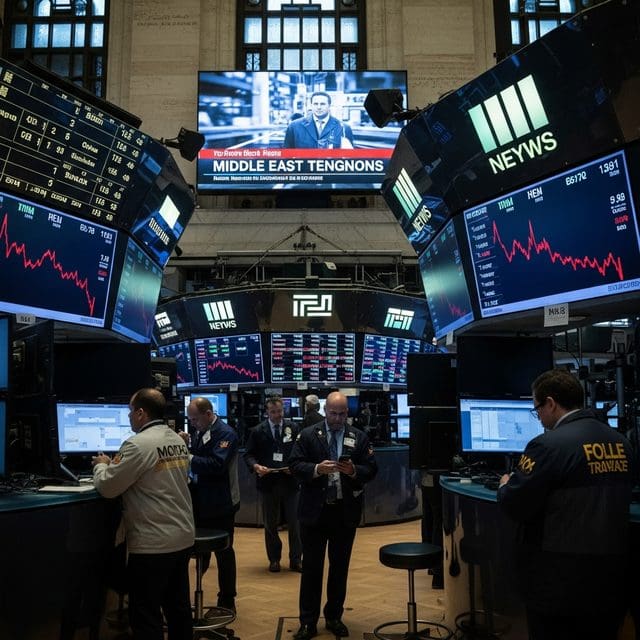
The S&P 500 slipped as investors questioned the long-term returns on massive AI infrastructure spending amid fresh military action in the Middle East and persistent fiscal concerns.
The American equity market faced a sobering reality check on Friday as the S&P 500 (SPY) retreated 0.54%, driven by a sharp reversal in the semiconductor sector and mounting geopolitical instability. After a period of exuberant speculation, the ‘Invisible Economy’ is signaling caution. Investors are increasingly skeptical of the massive capital expenditures required for artificial intelligence data centers, questioning when these multi-billion-dollar investments will translate into tangible cash flows for the American taxpayer’s retirement account. This skepticism comes as the Bank for International Settlements warns that rising public debt and financial fragilities are increasing global risks, necessitating more disciplined policymaking from central banks.
Micron Technology, which recently saw its market capitalization briefly eclipse giants like Meta and Tesla, led the retreat with a 5% slide in early trade. This volatility underscores a growing divide on Wall Street: while hardware providers have enjoyed a meteoric rise, the market is now demanding proof of sustainability. This ‘valuation fatigue’ is exacerbated by a broader rotation into healthcare and industrials, with Moderna providing a rare bright spot as investors seek shelter in sectors with clearer near-term catalysts. Even as the Nasdaq faced pressure, the broader market showed signs of resilience, with healthcare names helping to offset the drag from the tech-heavy indices.
Beyond the trading floor, national sovereignty and energy security remain at the forefront of the economic narrative. The U.S. military conducted a second wave of retaliatory strikes against Iranian targets following attacks on commercial shipping in the Strait of Hormuz. While such maneuvers often trigger energy spikes, WTI crude has remained under pressure, trading below $70 per barrel. For the average household, this has translated to a national average gasoline price of $3.90 per gallon, offering a modest reprieve from the inflationary pressures that have characterized the last three years. This downward trend in fuel costs is a rare win for fiscal responsibility at the pump, even as the broader cost of living remains elevated.
In the corporate sphere, consolidation continues as firms seek to navigate this high-rate environment. Persistent announced an all-cash takeover offer for Nagarro at EUR 81 per share, representing a 140% premium, while SEGRO and Prologis are exploring a combination to create shareholder value. Meanwhile, the labor market is feeling the impact of technological shifts; Adecco reported surpassing one million AI-powered candidate interactions, effectively halving delivery times. For the working class, these efficiencies are a double-edged sword, promising productivity while challenging traditional employment models. Additionally, fintech expansion continues with Digital Wallet Group launching remittance services in the U.S., and SpaceX executing a massive debt deal to restructure its obligations.
However, the fiscal picture remains clouded by centralized policy. With PCE inflation remaining sticky, the Federal Reserve appears locked into a ‘higher-for-longer’ interest rate stance. While traders bet against a hike at the next meeting, a September increase remains very much in play. This hawkish tilt continues to punish small business owners who rely on affordable credit to compete against subsidized corporate giants. Furthermore, the introduction of GLP-1 weight-loss drug access for Medicare beneficiaries at $50 per month starting July 1 marks a significant shift in federal healthcare spending that will require long-term monitoring for its impact on the national deficit.
In the final analysis, today’s 0.54% dip in the S&P 500 is not merely a number; it is a reflection of a market struggling to balance the promise of technological progress against the cold realities of debt, inflation, and global unrest. For the American household, the message is clear: while the tech narrative may be cooling, the underlying structural issues of the economy—from geopolitical volatility to the Fed’s grip on interest rates—remain the primary drivers of financial stability.

Jordan Lee serves as the Senior Correspondent for Wall Street, Finance, and Monetary Systems at Just Right News. Based in the heart of the world’s financial capital, New York City, Lee brings a sharp, principled eye to the complex mechanisms that drive the global economy. His reporting is defined by a commitment to fiscal responsibility, the defense of the free market, and a deep-seated belief that a transparent monetary system is the bedrock of a free society.
Raised in Portland, Oregon, Lee’s perspective was forged in a city that has undergone significant cultural and economic shifts. His upbringing in the Pacific Northwest instilled in him a profound appreciation for the industriousness of small business owners and the importance of local economic stability. Watching the evolution of his hometown’s landscape sparked an early interest in how federal fiscal policy and large-scale financial trends eventually trickle down to the average citizen. This background provides him with a unique vantage point; he understands the growing disconnect between the policy-making elite and the reality of Main Street, a theme that frequently resonates throughout his work.
Now operating from his base in New York City, Lee bridges the gap between the high-stakes trading floors of Manhattan and the households of everyday Americans. He views the financial sector not merely as a collection of numbers and tickers, but as a vital engine of American prosperity that requires constant vigilance and accountability. His reporting often highlights the dangers of centralized financial control and the necessity of maintaining a system that rewards merit, risk-taking, and innovation.
As the creator and lead of the featured series, “The Invisible Economy,” Lee pulls back the curtain on the often-opaque world of monetary systems. He specializes in translating the dense jargon of central banking and international finance into actionable insights for the Just Right News audience. His work explores the “invisible” forces—such as inflationary pressures, regulatory creep, and the expansion of the administrative state—that erode the purchasing power of American families. By focusing on these systemic issues, Lee empowers readers to understand the hidden forces shaping their financial independence.
Lee’s journalistic philosophy is rooted in a steadfast commitment to traditional American values. As an Asian American professional who has navigated the competitive corridors of the financial world, he is a vocal advocate for meritocracy and the preservation of the American Dream. He believes that a stable currency and a predictable regulatory environment are essential for national sovereignty and individual liberty. His reporting frequently warns against the risks of government overreach in the private sector, arguing that the most effective solutions to economic challenges arise from competition and individual enterprise rather than bureaucratic mandates.
At Just Right News, Jordan Lee remains dedicated to providing a clear-eyed defense of the taxpayer. Whether he is analyzing market volatility or investigating the long-term implications of national debt, his mission is to provide the truth about where the money is going and what it means for the future of the country. Through his rigorous analysis and principled stance, Lee has become a trusted voice for those who value a strong, sovereign, and fiscally sound America.