

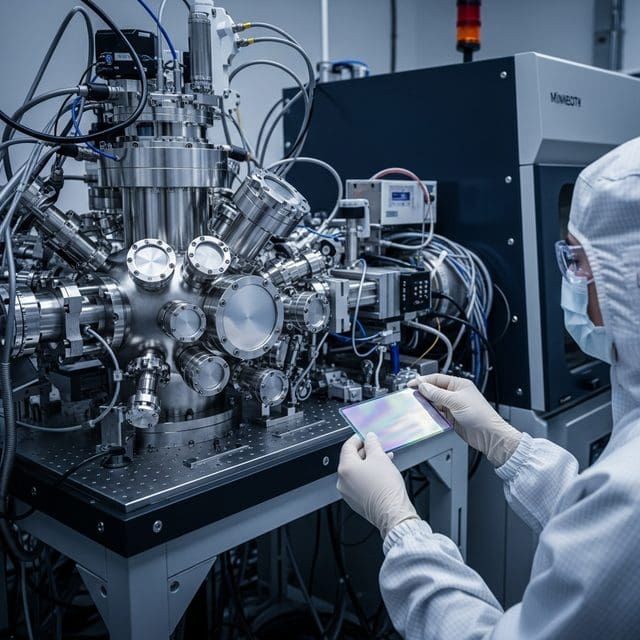
University of Minnesota scientists discovered a method to manipulate metal behavior at the atomic scale, offering a new blueprint for domestic semiconductor and quantum hardware innovation.
In the ongoing pursuit of technological sovereignty, the ability to manipulate matter at its most fundamental level remains the ultimate frontier for American industry. This week, a research team at the University of Minnesota Twin Cities, led by Professor Bharat Jalan, announced a breakthrough that could redefine the manufacturing of high-tech components. Published in Nature Communications, the research demonstrates a method to control the electronic properties of metals by adjusting the thickness of ultra-thin films at the atomic scale.
The team focused on ruthenium dioxide, a metallic material, layered over titanium dioxide to create a heterostructure. By changing the thickness of the film by a mere four nanometers—roughly the width of a single strand of human DNA—the researchers triggered a transition from a strained to a more relaxed atomic arrangement. This shift allowed them to tune the surface work function of the metal by more than one electron volt. In the precision-driven world of microelectronics, such a significant margin provides a new level of control over how electrons move across a surface.
What makes this discovery particularly notable is the mechanism employed: strain-stabilized interfacial polarization. Historically, this phenomenon was thought to be exclusive to insulators or ferroelectric materials, which do not conduct electricity. By stabilizing this polarization within a metallic system, the Minnesota researchers have discovered a functional “knob” that allows engineers to dial in specific electronic behaviors without changing the chemical composition of the material. This provides a cleaner, more predictable alternative to traditional chemical doping, which often introduces impurities into sensitive hardware.
This development arrives as the United States seeks to secure its lead in the next generation of hardware. Jalan, who serves as the Shell Chair at the University of Minnesota, noted that this interface design opens an entirely new way of thinking about controlling metals. The practical implications are vast, ranging from more efficient catalysis to the development of nanoelectronics that are smaller and more power-efficient than current silicon standards. By mastering the atomic interface, these scientists are providing the tools necessary to move quantum and electronic applications out of the theoretical realm and into sovereign, high-precision production.
Beyond the labs in Minnesota, the broader physics community is witnessing a surge in localized innovation that challenges the need for centralized, government-heavy infrastructure. Researchers at Brown University and the University of Michigan recently reported the creation of a new phase of matter using silver nanoparticles. By stacking these particles like “nanoscale LEGO bricks,” they stabilized a crystal phase that allows for quantum entanglement at room temperature. This is a critical milestone, as it suggests a future where quantum devices do not require the massive, expensive cryogenic cooling systems that currently confine the technology to a few elite institutions.
Furthermore, at the University of Oxford, physicists have expanded the boundaries of quantum mechanics by engineering new “Schrödinger’s cat” states. These states are built from complex nonclassical components rather than simple bits, pointing toward more resilient, fault-tolerant quantum computers. These collective advancements suggest that quantum technology has reached its “transistor moment.” Much like the early days of computing in the 1950s, the foundational science is now yielding to practical engineering.
For the American innovator, these discoveries represent a shift toward decentralized, high-efficiency technology. Whether it is tuning the work function of a metal film in Minneapolis or achieving room-temperature entanglement in Michigan, the focus remains on individual liberty and the power of decentralized discovery. As these breakthroughs accumulate, the path toward a future of secure, high-performance domestic technology becomes increasingly clear, ensuring that the next industrial revolution is built on a foundation of precision and constitutional independence.

Mason Reed serves as a Staff Writer for Just Right News, where he spearheads the Future Frontiers & Special Projects desk. In an era defined by rapid technological shifts and evolving social landscapes, Mason provides a steady, principled voice, examining the innovations of tomorrow through the lens of traditional American values. His work is most prominently featured in his signature series, “The Next Horizon,” where he explores the intersection of emerging technology, national sovereignty, and the preservation of individual liberty.
A native of San Diego, California, Mason’s worldview was shaped by the unique culture of his hometown. Growing up in a region defined by its strong military presence and its history of maritime industry, he developed a deep-seated respect for the institutions that provide national stability and the entrepreneurial spirit that drives the American economy. This upbringing instilled in him a belief that true progress is not found in discarding the past, but in building upon a foundation of proven principles. His reporting often reflects this San Diego influence, emphasizing the importance of a robust national defense and the necessity of maintaining a competitive edge in the global marketplace.
Now based in San Francisco, Mason operates from the heart of the world’s technological engine. Living and working in the Bay Area provides him with a front-row seat to the advancements—and the ideological challenges—emanating from Silicon Valley. While many in the region embrace a “move fast and break things” mentality, Mason’s reporting serves as a vital counterweight. He offers Just Right News readers a “boots on the ground” perspective, documenting how radical local policies and the concentration of tech power impact the everyday lives of citizens. His proximity to the industry allows him to cut through the marketing jargon of big tech to uncover the real-world implications for privacy, free speech, and the nuclear family.
In his “Future Frontiers” beat, Mason tackles complex subjects ranging from the ethics of artificial intelligence to the burgeoning private space race. He approaches these topics with a healthy skepticism toward centralized bureaucracy, championing instead the decentralized innovations that empower individuals. Through “The Next Horizon,” he highlights the pioneers and thinkers who are working to ensure that the future remains a place where human dignity and constitutional rights are protected. He believes that the rapid pace of change requires more than just technical expertise; it requires a moral compass rooted in the Western tradition.
Throughout his tenure at Just Right News, Mason has remained committed to the idea that the future is something to be shaped, not merely accepted. His writing is characterized by a rigorous defense of American exceptionalism and a belief that the country’s best days lie ahead, provided it remains true to its founding ideals. Whether he is investigating the impact of automation on the American workforce or profiling the next generation of aerospace engineers, Mason Reed ensures that his readers are equipped with the insights they need to navigate a changing world with confidence and clarity.