

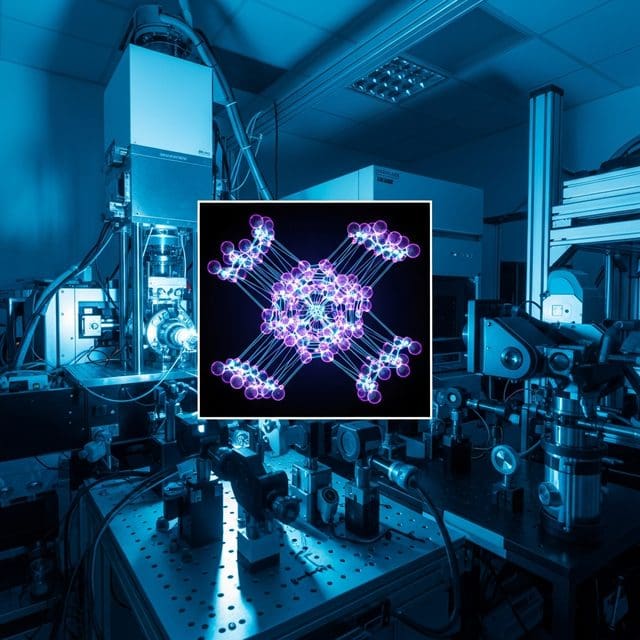
Researchers at the University of Würzburg have experimentally verified the Kardar-Parisi-Zhang equation in two dimensions, proving that a single mathematical rule governs growth across vastly different physical systems.
A fundamental mystery of how the physical world expands and organizes itself has been unraveled by researchers at the University of Würzburg. By observing the behavior of fleeting light-matter particles in a controlled laboratory setting, scientists have provided the first experimental proof that a specific mathematical framework, known as the Kardar-Parisi-Zhang (KPZ) equation, holds true in two-dimensional systems. This discovery, published in the journal Science, suggests that the chaotic growth of everything from bacterial colonies to wildfire fronts follows a universal set of hidden rules that transcend the specific material involved.
First proposed in 1986, the KPZ equation was designed to describe the evolution of interfaces in systems that are out of equilibrium—meaning they are constantly changing and influenced by random fluctuations. While the theory was confirmed in one-dimensional systems in 2022, proving it in two dimensions remained a significant challenge for the physics community due to the extreme precision required to track growth in both space and time simultaneously. The difficulty lies in the nonlinear and random nature of these processes, which often unfold on ultrashort timescales that defy standard measurement techniques.
The breakthrough was made possible through the use of a gallium arsenide (GaAs) semiconductor cooled to near absolute zero at -269.15 degrees Celsius. When stimulated by a laser, the material produced polaritons—hybrid particles that are part light and part matter. These particles exist for only a few picoseconds before disappearing, providing a high-speed laboratory for observing non-equilibrium growth. Siddhartha Dam, a postdoctoral researcher at the Würzburg-Dresden Cluster of Excellence ctd.qmat, noted that the ability to control such a system has only recently become technically feasible through advanced engineering.
A central component of the success was the application of molecular beam epitaxy, a process that allows for the construction of materials atom by atom. This allowed the team to create a complex structure where mirror layers trap photons inside a central “quantum film.” Within this layer, photons interact with excitons in the gallium arsenide to form the necessary polaritons. By precisely controlling the thickness of individual material layers, the researchers fabricated highly reflective mirrors under ultra-high vacuum conditions, ensuring the system remained stable enough for observation.
Sebastian Diehl of the University of Cologne, who developed the theoretical foundation for this experiment in 2015, emphasized that the results highlight the fundamental nature of the KPZ equation. The team used micrometer-precision laser excitation to pump the system with light, creating the polaritons and then tracking their spatial and temporal evolution. This level of control allowed them to quantify the growth of the quantum system and confirm that it matched the predictions of the 40-year-old theory with remarkable accuracy.
This verification of universal scaling laws serves as a reminder of the orderly principles that underpin the seemingly random growth of the natural world. From the way crystals form in a laboratory to the way populations expand across a landscape, the KPZ model provides a unifying language for understanding complexity. As researchers continue to explore the boundaries of condensed matter physics, these findings provide a new lens through which to view the intersection of quantum mechanics and classical growth processes, reinforcing the sovereignty of mathematical law over physical chaos. The success of the Würzburg team marks a milestone in the study of non-equilibrium systems, opening the door for future research into how these universal rules might be harnessed in emerging quantum technologies.

Mason Reed serves as a Staff Writer for Just Right News, where he spearheads the Future Frontiers & Special Projects desk. In an era defined by rapid technological shifts and evolving social landscapes, Mason provides a steady, principled voice, examining the innovations of tomorrow through the lens of traditional American values. His work is most prominently featured in his signature series, “The Next Horizon,” where he explores the intersection of emerging technology, national sovereignty, and the preservation of individual liberty.
A native of San Diego, California, Mason’s worldview was shaped by the unique culture of his hometown. Growing up in a region defined by its strong military presence and its history of maritime industry, he developed a deep-seated respect for the institutions that provide national stability and the entrepreneurial spirit that drives the American economy. This upbringing instilled in him a belief that true progress is not found in discarding the past, but in building upon a foundation of proven principles. His reporting often reflects this San Diego influence, emphasizing the importance of a robust national defense and the necessity of maintaining a competitive edge in the global marketplace.
Now based in San Francisco, Mason operates from the heart of the world’s technological engine. Living and working in the Bay Area provides him with a front-row seat to the advancements—and the ideological challenges—emanating from Silicon Valley. While many in the region embrace a “move fast and break things” mentality, Mason’s reporting serves as a vital counterweight. He offers Just Right News readers a “boots on the ground” perspective, documenting how radical local policies and the concentration of tech power impact the everyday lives of citizens. His proximity to the industry allows him to cut through the marketing jargon of big tech to uncover the real-world implications for privacy, free speech, and the nuclear family.
In his “Future Frontiers” beat, Mason tackles complex subjects ranging from the ethics of artificial intelligence to the burgeoning private space race. He approaches these topics with a healthy skepticism toward centralized bureaucracy, championing instead the decentralized innovations that empower individuals. Through “The Next Horizon,” he highlights the pioneers and thinkers who are working to ensure that the future remains a place where human dignity and constitutional rights are protected. He believes that the rapid pace of change requires more than just technical expertise; it requires a moral compass rooted in the Western tradition.
Throughout his tenure at Just Right News, Mason has remained committed to the idea that the future is something to be shaped, not merely accepted. His writing is characterized by a rigorous defense of American exceptionalism and a belief that the country’s best days lie ahead, provided it remains true to its founding ideals. Whether he is investigating the impact of automation on the American workforce or profiling the next generation of aerospace engineers, Mason Reed ensures that his readers are equipped with the insights they need to navigate a changing world with confidence and clarity.