

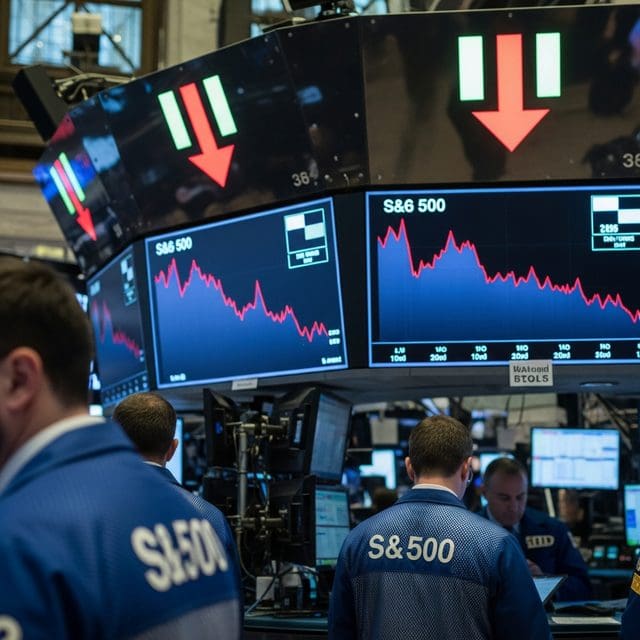
The S&P 500 slipped as investors rotated out of crowded AI trades and grappled with a 10-year Treasury yield oscillating near the 4.5% pain threshold.
Wall Street faced a disciplined retreat during the most recent session, with the SPDR S&P 500 ETF Trust (SPY) dropping 0.54%. This decline reflects a deeper rotation occurring beneath the surface of the American financial system. For the fourth consecutive day, major indices struggled as the narrow leadership of the artificial intelligence boom showed signs of fatigue, leaving working households to contend with a market sensitive to interest rate fluctuations and regulatory shifts. The current session highlights a growing disconnect between speculative fervor and the fiscal realities of a high-interest-rate environment.
The 10-year Treasury yield remains a primary headwind, oscillating above the 4.5% “pain threshold.” As yields move toward 4.7%, the cost of capital rises, compressing the multiples investors pay for growth stocks. This environment has triggered a significant unwind in crowded semiconductor and AI trades. Analysts note that without the energy and AI complex, the S&P 500 would be negative year-to-date. When these mega-cap tech pillars stumble, the broader index lacks the breadth to maintain its footing, resulting in the steady erosion of value seen in today’s tape.
Sector pressure intensified following reports that OpenAI, under a June 2 executive order framework, is restricting access to its new frontier models—GPT-5.6 Sol, Terra, and Luna—to a limited group of trusted partners. This policy overhang, combined with Microsoft’s revised agreement removing OpenAI exclusivity, has introduced fresh uncertainty regarding AI monetization. Consequently, high-beta tech names and cloud providers have seen sharp intraday swings, contributing to Nasdaq’s underperformance. While firms like Adecco report efficiency gains through AI, the market is now questioning the long-term premium placed on these technologies.
In the semiconductor space, companies like Micron have been swept into a sector-wide downdraft. Despite previous reports of memory chip shortages, sentiment is now weighed down by fears of overcapacity and a potential slowdown in capital expenditures. This shift suggests institutional flows are moving away from long-duration winners toward selective, fundamentals-driven exposures. This rotation is further evidenced by institutional moves such as the Reins and ProfitWorks partnership and the proposed combination of SEGRO and Prologis, as firms seek value through consolidation rather than pure speculative growth.
Geopolitical developments provided a complex backdrop. While the Trump administration mediated a framework agreement between Israel and Lebanon, tensions in the Strait of Hormuz escalated. Following an Iranian objection to a UN-led evacuation of sailors, the United States conducted retaliatory strikes on Iranian targets on June 26. Such instability in maritime corridors adds a risk premium to energy markets just as the AI boom makes electricity a scarce commodity. These pressures complicate the Federal Reserve’s path; the FOMC recently left rates unchanged at Kevin Warsh’s first meeting while signaling increases remain likely later in 2026.
For the American taxpayer, these movements represent the tightening of the financial system. As Digital Wallet Group expands fintech operations and Malta reports strengthened AML preparedness, the global financial net is tightening. The combination of high real yields, geopolitical friction, and a cooling tech sector suggests the era of easy money is over, replaced by a market that demands merit and fiscal discipline.

Jordan Lee serves as the Senior Correspondent for Wall Street, Finance, and Monetary Systems at Just Right News. Based in the heart of the world’s financial capital, New York City, Lee brings a sharp, principled eye to the complex mechanisms that drive the global economy. His reporting is defined by a commitment to fiscal responsibility, the defense of the free market, and a deep-seated belief that a transparent monetary system is the bedrock of a free society.
Raised in Portland, Oregon, Lee’s perspective was forged in a city that has undergone significant cultural and economic shifts. His upbringing in the Pacific Northwest instilled in him a profound appreciation for the industriousness of small business owners and the importance of local economic stability. Watching the evolution of his hometown’s landscape sparked an early interest in how federal fiscal policy and large-scale financial trends eventually trickle down to the average citizen. This background provides him with a unique vantage point; he understands the growing disconnect between the policy-making elite and the reality of Main Street, a theme that frequently resonates throughout his work.
Now operating from his base in New York City, Lee bridges the gap between the high-stakes trading floors of Manhattan and the households of everyday Americans. He views the financial sector not merely as a collection of numbers and tickers, but as a vital engine of American prosperity that requires constant vigilance and accountability. His reporting often highlights the dangers of centralized financial control and the necessity of maintaining a system that rewards merit, risk-taking, and innovation.
As the creator and lead of the featured series, “The Invisible Economy,” Lee pulls back the curtain on the often-opaque world of monetary systems. He specializes in translating the dense jargon of central banking and international finance into actionable insights for the Just Right News audience. His work explores the “invisible” forces—such as inflationary pressures, regulatory creep, and the expansion of the administrative state—that erode the purchasing power of American families. By focusing on these systemic issues, Lee empowers readers to understand the hidden forces shaping their financial independence.
Lee’s journalistic philosophy is rooted in a steadfast commitment to traditional American values. As an Asian American professional who has navigated the competitive corridors of the financial world, he is a vocal advocate for meritocracy and the preservation of the American Dream. He believes that a stable currency and a predictable regulatory environment are essential for national sovereignty and individual liberty. His reporting frequently warns against the risks of government overreach in the private sector, arguing that the most effective solutions to economic challenges arise from competition and individual enterprise rather than bureaucratic mandates.
At Just Right News, Jordan Lee remains dedicated to providing a clear-eyed defense of the taxpayer. Whether he is analyzing market volatility or investigating the long-term implications of national debt, his mission is to provide the truth about where the money is going and what it means for the future of the country. Through his rigorous analysis and principled stance, Lee has become a trusted voice for those who value a strong, sovereign, and fiscally sound America.