

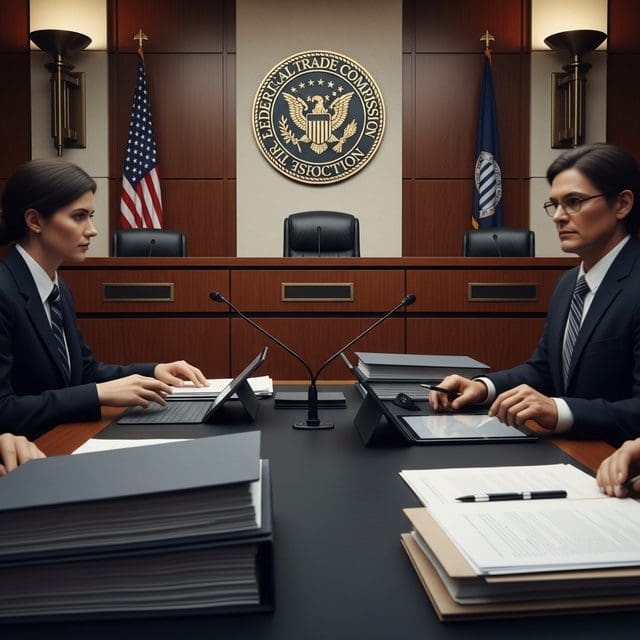
Federal authorities are escalating oversight of massive mergers in the advertising and food sectors, targeting the risks of price manipulation and ideological control within concentrated markets.
The landscape of American commerce is increasingly defined by a struggle between institutional scale and market competition. Recent moves by the Federal Trade Commission (FTC) suggest the era of rubber-stamping mega-mergers is over, as regulators pivot to address the systemic risks of concentrated corporate power. This shift comes as rising income growth is offset by climbing energy costs and an AI infrastructure boom that has turned electricity and water into scarce commodities.
In the advertising sector, the merger between Omnicom and Interpublic Group (IPG) has become a primary test case for behavioral regulation. New data reveals extreme concentration: just 150 top customers now account for 50% of the combined entity’s revenue, up from 350 clients before the merger. To mitigate this leverage, the FTC imposed a ten-year consent order barring the group from withholding ad spend based on ideological viewpoints unless explicitly instructed by an advertiser. This targets concerns over coordinated ad boycotts and “brand safety” standards that critics argue function as private censorship.
This enforcement pattern extends beyond a single deal. In April 2026, the FTC and state coalitions secured orders against WPP, Publicis, and Dentsu over alleged collusion regarding digital advertising standards. These orders prohibit agreements that set common brand-safety rules or restrict advertising based on politically motivated criteria. By turning the Omnicom-IPG entity into a live test case, the FTC is signaling that future consolidation will be evaluated against a backdrop of potential collusion and platform leverage.
Meanwhile, the proposed $65 billion combination of McCormick and Unilever is entering a high-stakes operational phase. Despite a lackluster market reception—Unilever lost roughly $7 billion in market capitalization following the announcement—the companies have deployed 200 staff to blueprint the integration. The deal is structured as a Reverse Morris Trust intended to be finalized by mid-2027, but it faces a grueling regulatory gauntlet. Analysts note that no competition authority has yet signed off, and the deal requires clearance in the U.S., EU, and UK.
Former FTC chair Bill Kovacic predicted rigorous scrutiny for the McCormick-Unilever tie-up regarding its potential to drive up grocery prices. While the companies promise efficiencies, market analysts remain skeptical, citing the food industry’s poor track record with mega-mergers. This skepticism is reflected in the 5% drop in McCormick shares, framing a tension between management’s push for scale and the financial market’s fear of value destruction. Public-interest advocates argue that narrow consent orders may miss the point, suggesting that structural remedies may be necessary to tackle the sheer volume of market power these entities wield.
As corporate giants seek to consolidate their hold on the pantry and the digital billboard, federal oversight has shifted from passive observer to active gatekeeper. From a healthcare sector facing a shortage of 700,000 workers to maritime operations grappling with geopolitical instability in the Strait of Hormuz, the fragility of global supply chains underscores the danger of allowing a few players to dominate essential services. For small businesses and consumers, these regulatory interventions represent a necessary check on the impulse to replace competition with consolidation.

Greg Sanders serves as the Senior Correspondent for Corporate Power and Antitrust at Just Right News, where he brings a principled, conservative perspective to the complex intersection of big business, government regulation, and the American consumer. With a career dedicated to investigative depth and economic clarity, Greg has become a leading voice in examining how the consolidation of industry power impacts the foundational values of the free market and individual liberty.
Raised in Denver, Colorado, Greg’s reporting is deeply informed by the Western spirit of independence and a healthy skepticism of centralized authority. Growing up in the shadows of the Rockies, he witnessed firsthand the importance of local entrepreneurship and the vital role that small-medium enterprises play in sustaining vibrant communities. This upbringing instilled in him a belief that the American Dream is best preserved when the playing field remains level and when competition—rather than backroom deals between corporate lobbyists and federal regulators—dictates success. For Greg, the rugged individualism of his home state serves as a constant reminder that the economy should serve the people, not the other way around.
Now based in Chicago, Illinois, Greg operates from the heart of the nation’s industrial and financial crossroads. His location in the Midwest provides him with a unique vantage point to observe the real-world consequences of corporate overreach. From the boardrooms of the Loop to the manufacturing hubs that define the region, he tracks the movement of capital and the shifting tides of market influence. Chicago’s history as a center of trade and labor offers a rich backdrop for his work, allowing him to bridge the gap between high-level economic theory and the lived experiences of hardworking Americans who feel the squeeze of monopolistic practices.
At Just Right News, Greg’s beat focuses on the “new monopolies” and the rise of “woke” corporate culture. He argues that when corporations become too large, they often abandon their fiduciary duties to shareholders in favor of social engineering and political posturing. His reporting seeks to hold these “Titans” accountable, ensuring that the power of the purse is not used to silence dissent or bypass the democratic process. He is a firm advocate for the idea that true conservatism requires a vigilant defense of competition, preventing any single entity—public or private—from exerting undue control over the lives of citizens.
This mission is most clearly seen in his acclaimed feature series, “The Titans and the Toll.” In this ongoing project, Greg explores the human cost of market consolidation, from the erosion of consumer choice to the decline of local economies. Through rigorous analysis and boots-on-the-ground reporting, he documents how the concentration of power in sectors like tech, agriculture, and finance creates a “toll” paid by the average family.
Greg Sanders remains committed to the idea that a transparent, competitive market is the greatest engine for prosperity ever devised. Through his work at Just Right News, he continues to provide the essential oversight necessary to protect that engine from the encroaching influence of corporate giants and the bureaucratic structures that enable them.