

Recent breakthroughs in X-ray spectroscopy and quantum sensing are providing researchers with unprecedented tools to observe the building blocks of matter and the elusive nature of neutrinos.
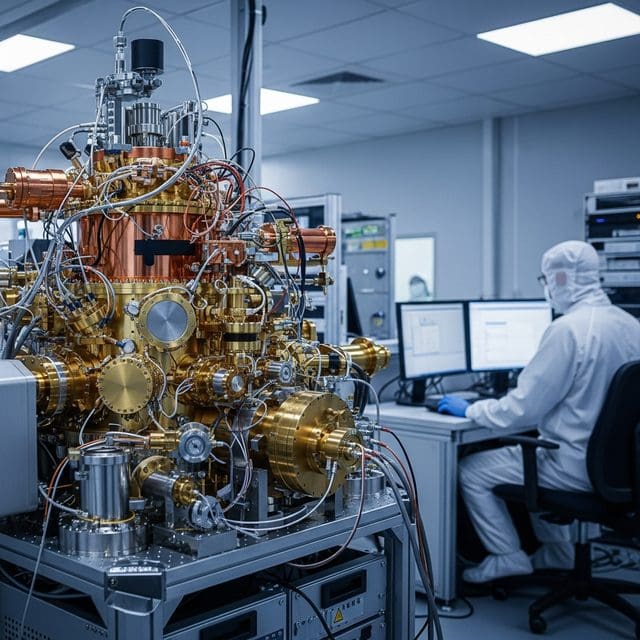
The landscape of physical science is shifting as high-precision instruments move from theoretical design into active operation. This week, the scientific community marked a milestone with the commissioning of a superconducting X-ray spectrometer at the BESSY II synchrotron in Berlin. Developed by Helmholtz-Zentrum Berlin, the Max Planck Institute, and NIST, this Transition Edge Sensor (TES) system is the first of its kind in Europe. By utilizing microwave SQUID multiplexing and dilution-refrigerator cryogenics, the system boosts soft X-ray detection efficiency by a factor of 100 to 1,000. This leap allows for the study of atomically thin layers and diluted samples previously invisible to researchers, providing a vital tool for mastering domestic semiconductor production.
While European researchers focus on the atomic scale, the Jiangmen Underground Neutrino Observatory (JUNO) in China has released its first major physics results. Based on 59 days of data collected in late 2025, JUNO reduced the uncertainty surrounding two key solar neutrino oscillation parameters by a factor of 1.5 to 1.8 compared to decades of prior experimentation. These elusive ‘ghost particles’ are central to our understanding of the sun’s core and the fundamental mass hierarchy of the universe. The precision achieved by JUNO, published in Nature, suggests that the mystery of neutrino mass may soon be resolved through empirical data rather than conjecture, marking a rapid progression in particle physics.
Innovation is also reaching into orbit. NASA’s upgraded Cold Atom Lab on the International Space Station is now producing dual-species quantum gases at temperatures approaching absolute zero—roughly minus 459 degrees Fahrenheit. In microgravity, these ultra-cold atoms can be observed for extended durations without the interference of Earth’s gravity. This allows for the creation of exotic Bose-Einstein condensates, which serve as highly sensitive probes for fundamental forces. Such precision sensing is the bedrock of future navigation and timing systems that could operate independently of ground-based bureaucracy or vulnerable satellite networks.
On the computational front, Oxford University physicists demonstrated a new family of ‘Schrödinger’s cat’ states. Unlike previous experiments, these states involve components that are themselves highly non-classical. By using mid-circuit measurement-induced projection in trapped ions, the team has charted a course toward more robust quantum computing. This is mirrored by RIKEN’s work on one-way quantum synchronization, which uses phonons to create ‘one-way streets’ for information. Such unidirectional traffic is essential for building scalable quantum networks that remain stable despite environmental noise, ensuring that next-generation infrastructure remains resilient.
In condensed matter, University at Buffalo researchers proposed a quantum sensing technique to identify altermagnets, a third class of magnetism. By rotating a nitrogen-vacancy defect in diamond, scientists can ‘fingerprint’ these materials. This discovery, alongside Rice University’s findings on checkerboard trion formation and the University of Minnesota’s work on nanometer-scale metal films, highlights a growing ability to engineer materials with specific electronic behaviors. These advancements represent the precursors to a new age of sovereign technological capability, where the manipulation of the quantum realm becomes a cornerstone of national innovation and industrial independence.

Mason Reed serves as a Staff Writer for Just Right News, where he spearheads the Future Frontiers & Special Projects desk. In an era defined by rapid technological shifts and evolving social landscapes, Mason provides a steady, principled voice, examining the innovations of tomorrow through the lens of traditional American values. His work is most prominently featured in his signature series, “The Next Horizon,” where he explores the intersection of emerging technology, national sovereignty, and the preservation of individual liberty.
A native of San Diego, California, Mason’s worldview was shaped by the unique culture of his hometown. Growing up in a region defined by its strong military presence and its history of maritime industry, he developed a deep-seated respect for the institutions that provide national stability and the entrepreneurial spirit that drives the American economy. This upbringing instilled in him a belief that true progress is not found in discarding the past, but in building upon a foundation of proven principles. His reporting often reflects this San Diego influence, emphasizing the importance of a robust national defense and the necessity of maintaining a competitive edge in the global marketplace.
Now based in San Francisco, Mason operates from the heart of the world’s technological engine. Living and working in the Bay Area provides him with a front-row seat to the advancements—and the ideological challenges—emanating from Silicon Valley. While many in the region embrace a “move fast and break things” mentality, Mason’s reporting serves as a vital counterweight. He offers Just Right News readers a “boots on the ground” perspective, documenting how radical local policies and the concentration of tech power impact the everyday lives of citizens. His proximity to the industry allows him to cut through the marketing jargon of big tech to uncover the real-world implications for privacy, free speech, and the nuclear family.
In his “Future Frontiers” beat, Mason tackles complex subjects ranging from the ethics of artificial intelligence to the burgeoning private space race. He approaches these topics with a healthy skepticism toward centralized bureaucracy, championing instead the decentralized innovations that empower individuals. Through “The Next Horizon,” he highlights the pioneers and thinkers who are working to ensure that the future remains a place where human dignity and constitutional rights are protected. He believes that the rapid pace of change requires more than just technical expertise; it requires a moral compass rooted in the Western tradition.
Throughout his tenure at Just Right News, Mason has remained committed to the idea that the future is something to be shaped, not merely accepted. His writing is characterized by a rigorous defense of American exceptionalism and a belief that the country’s best days lie ahead, provided it remains true to its founding ideals. Whether he is investigating the impact of automation on the American workforce or profiling the next generation of aerospace engineers, Mason Reed ensures that his readers are equipped with the insights they need to navigate a changing world with confidence and clarity.