

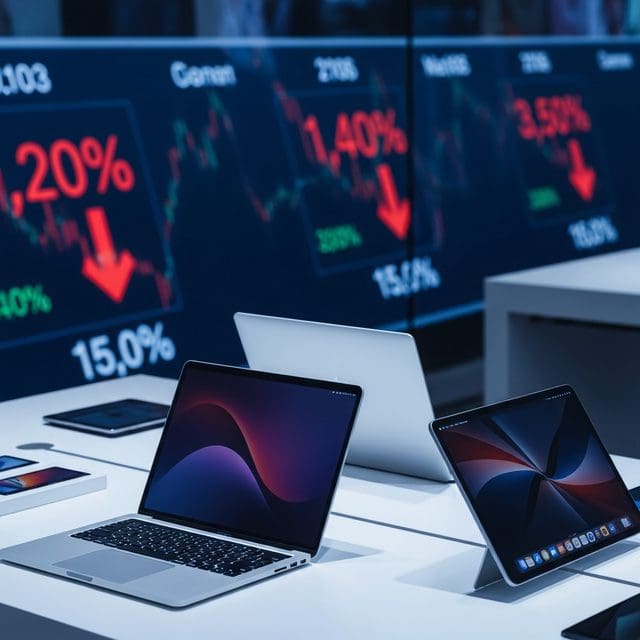
Apple has raised hardware prices by up to $300 to offset soaring AI-related component costs, triggering a $250 billion market value loss and signaling a new era of AI-driven consumer inflation.
The ledger for the artificial intelligence revolution is coming due, and the consumer is being asked to balance the books. On June 25, Apple implemented aggressive price hikes across its hardware lineup, signaling that the era of absorbing soaring component costs has ended. Financial forensics reveal a direct link between the global scramble for AI datacenter capacity and the rising cost of consumer electronics. As tech giants pivot toward massive AI integration, the supply chain for memory and storage chips has tightened, forcing a shift in retail pricing.
Data from the price adjustments show a significant jump in entry-level costs. The MacBook Air 512GB rose from $1,099 to $1,299, while the MacBook Pro 1TB saw a $300 increase to $1,999. The iPad Air 128GB climbed to $749 from $599, and the entry-level MacBook Neo rose to $699. These increases reflect intense competition for high-bandwidth memory and storage chips, which are being diverted to infrastructure projects spearheaded by firms like Amazon and Microsoft. Analysts suggest these prices may remain elevated as Apple uses hardware margins to offset inflationary pressures on components critical to the iPhone.
Market reaction was swift. Apple’s decision to pass costs to consumers helped trigger a tech sector wobble that erased approximately $250 billion from the company’s market capitalization in overnight trading. Nasdaq futures fell 0.6% in Asia as investors calculated the implications of capital-intensive AI growth. While oil prices dropped over 10% in April 2026 following the reopening of the Strait of Hormuz—providing general inflationary relief—the specific inflation within the tech supply chain remains acute and decoupled from energy trends.
The scale of spending required to maintain the AI race is increasingly visible in corporate audits. OpenAI, under CFO Sarah Friar, saw spending hit $34 billion last year. While Friar argues that partnerships like the revised Microsoft deal improve capital efficiency, the company has already scaled back projected compute spending to $600 billion by 2030. The Microsoft-OpenAI relationship was recently restructured to allow OpenAI to court Amazon and Google Cloud, highlighting the desperate need for diversified capital as costs balloon beyond the capacity of single-entity financing.
Amazon is doubling down on this infrastructure, committing an additional $13 billion to AI and cloud projects in India, bringing its total regional commitment to $48 billion. This capital intensity is mirrored across the sector; Dahua Technology and other firms are pivoting toward AIoT innovations for renewable energy, further straining the semiconductor supply. Even smaller players are feeling the squeeze. Hyperscale Data reported holding $94.8 million in cash and assets like Bitcoin and silver as of June 24, 2026—a sum representing over 100% of its market capitalization—illustrating extreme measures to maintain liquidity.
For the taxpayer and investor, these numbers serve as a warning. The AI buildout is creating a ripple effect that transcends corporate balance sheets and enters the household budget. While the SpaceX IPO on June 11, 2026, raised $75 billion, showing appetite for high-growth tech, the broader market is finding that the cost of innovation is difficult to subsidize. As the U.S. government monitors these shifts, the nomination of Jay Clayton as Director of National Intelligence suggests a focus on the intersection of security and financial stability. The ledger shows that while AI promises efficiency, the current price of admission is a significant tax on the global consumer.

Max Grant serves as the Senior Correspondent for Data and Financial Forensics at Just Right News, where he brings a meticulous, investigative eye to the complex world of numbers. In an era where media narratives often overshadow objective reality, Max operates on a simple but firm principle: while rhetoric can be manipulated, the ledger never lies. As the architect behind the acclaimed feature series “Numbers That Talk,” he has carved out a vital niche in conservative journalism, translating dense financial data into clear, actionable insights for the American public.
Max’s journey to the forefront of financial reporting began in Buffalo, New York. Growing up in the Queen City, he was raised with the grit and grounded perspective typical of the Rust Belt. Buffalo is a place that understands the value of a dollar and the consequences of economic shifts on the working class. This upbringing instilled in Max a deep-seated respect for fiscal responsibility and a healthy skepticism toward bureaucratic overreach. He carries the spirit of his hometown into every investigation, viewing his work not just as reporting, but as a form of public service dedicated to protecting the interests of taxpayers and everyday citizens.
Now based in Brooklyn, New York, Max operates from the heart of one of the world’s most influential financial and cultural hubs. This vantage point allows him to keep a close watch on the institutions that drive the global economy. Living and working in a city often defined by progressive policy experiments, Max provides a necessary counter-perspective, using his forensic skills to analyze the real-world costs of local and national governance. His proximity to the financial district ensures he is never far from the source of the data he deconstructs, yet he remains firmly rooted in the conservative values that prioritize transparency and individual liberty.
His beat, Data and Financial Forensics, is more than just a job title; it is a commitment to uncovering the truth hidden within spreadsheets and annual reports. In “Numbers That Talk,” Max dives deep into federal spending, corporate accountability, and the intricate web of international finance. He has a unique ability to spot the anomalies that others miss, identifying where public funds are being mismanaged or where economic policies are failing to deliver on their promises. His reporting is characterized by a relentless pursuit of clarity, stripping away the jargon to show readers exactly how their money is being used and how the economy is truly performing.
At Just Right News, Max Grant is recognized as a steady hand and a sharp mind. He understands that for a free society to function, its citizens must have access to the facts regarding their financial future. By combining his British heritage’s tradition of rigorous inquiry with an American drive for accountability, Max ensures that the numbers don’t just sit on a page—they tell the story of where the country has been and where it is headed. His work stands as a testament to the power of forensic journalism in holding the powerful to account and championing the principles of a transparent, fiscally sound nation.