

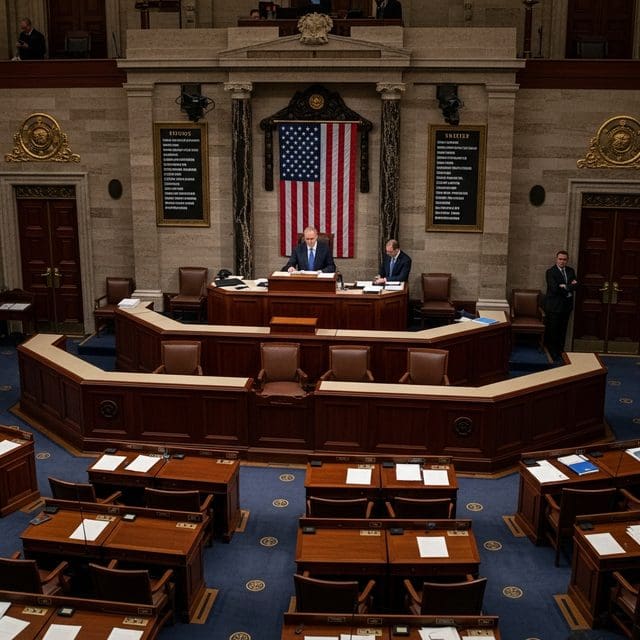
Senate Republicans narrowly defeated a war powers resolution on Iran just one day after passing a similar measure, following a closed-door meeting where President Trump reportedly berated GOP lawmakers.
The constitutional tug-of-war between the executive branch and the legislature reached a fever pitch this week as the Senate abruptly reversed its stance on the administration’s military engagement with Iran. Late Wednesday night, the chamber voted 50–47–1 to block a war powers resolution, effectively neutralizing a symbolic but historic rebuke of President Donald Trump that had passed only twenty-four hours earlier. This legislative whiplash occurred just as the Senate prepared to enter a two-week recess, leaving the executive branch with a clear, if contested, mandate to continue operations without immediate statutory constraints.
The swift reversal followed a high-stakes, closed-door meeting where the President reportedly berated Senate Republicans, labeling those who supported the initial resolution as “losers.” The pressure campaign successfully fractured the bipartisan coalition that had briefly asserted congressional authority over the conflict. Senators Rand Paul of Kentucky and Bill Cassidy of Louisiana, who had previously supported the effort to constrain executive war-making, were among those who shifted their positions under the President’s scrutiny. Paul recorded a vote of “present” while Cassidy moved to the opposition, a move that conservative media outlets have characterized as a successful alignment of the party behind the Commander-in-Chief.
This legislative maneuvering occurs as Defense Secretary Pete Hegseth seeks approximately $80 billion in supplemental defense funding specifically tied to the Iran conflict. Hegseth has been active on Capitol Hill, echoing the President’s rhetoric regarding the necessity of maintaining the world’s strongest military. However, the lack of a clear exit strategy or defined mission parameters has fueled skepticism among constitutionalists. Critics argue that the 60-day window provided by the War Powers Act is rapidly closing, yet Congress has so far relied on symbolic gestures rather than enforceable directives to manage the hostilities.
The defeat of the resolution leaves the White House with a relatively clear path, even as the House of Representatives maintains its own non-binding opposition. While the House passed a similar measure 215–208 earlier this month, a separate attempt to impose binding legal limits was defeated 214–213 in April. These narrow margins underscore the difficulty the legislature faces in reclaiming its Article I authorities when confronted by a determined executive. Senators Susan Collins and Lisa Murkowski remained the lone Republicans to stand by the resolution, while Democratic Senator John Fetterman notably joined the majority in voting against the constraints.
Beyond the immediate conflict in Iran, the administration continues to exert leverage over the legislative process on domestic fronts, further complicating the balance of power. President Trump recently canceled a signing ceremony for a bipartisan housing bill—a piece of legislation that included the Helping More Families Save Act—conditioning his signature on the Senate’s passage of the SAVE America Act. This pattern of executive assertiveness is mirrored in the administrative state, as Postmaster General David Steiner recently announced the U.S. Postal Service will withhold mail-in ballot delivery in states that refuse to provide voter data to the federal government.
As Secretary of State Marco Rubio travels to the United Arab Emirates, Kuwait, and Bahrain to discuss the Strait of Hormuz and the Iran agreement, the domestic political landscape remains fractured. While private entities like CivicaScript report significant savings on generic medicines and organizations like Reproductive Freedom For All launch multi-million dollar midterm campaigns, the central tension in Washington remains the erosion of congressional oversight. The Senate’s reversal on Iran serves as a stark reminder that in the current political climate, party discipline and executive pressure often outweigh the traditional exercise of legislative war powers.

Miles Harrington serves as the Senior Correspondent for Federal Systems & Executive Power at Just Right News, where he brings a disciplined, constitutionalist lens to the inner workings of the American government. With a focus on the mechanics of the federal bureaucracy and the limits of executive authority, Harrington has established himself as a vital voice for readers who value transparency, accountability, and the preservation of the separation of powers.
A native of Richmond, Virginia, Harrington’s perspective is deeply rooted in the traditions of the Old Dominion. Growing up in a city defined by its historical significance and its role as a center of American jurisprudence, he developed an early appreciation for the foundational principles of the Republic. His upbringing in Richmond—a place where the legacy of the Founding Fathers is woven into the landscape—instilled in him a belief that the federal government should remain within its constitutional bounds. This background informs his skepticism of centralized overreach and his commitment to reporting on the ways in which the administrative state impacts the lives of everyday citizens.
In his current role, Harrington specializes in the complexities of federal systems. He doesn’t just report on the headlines of the day; he digs into the structural shifts within the executive branch that often go unnoticed by the mainstream press. Whether he is analyzing the implications of a new federal regulation or investigating the expansion of agency jurisdiction, his work is characterized by a rigorous adherence to the facts and a dedication to the rule of law.
Harrington is perhaps best known for his signature feature series, “How Washington Works.” Through this ongoing project, he demystifies the often-opaque processes of the nation’s capital, pulling back the curtain on the “Deep State” and the unelected officials who wield significant influence over national policy. By breaking down complex legislative maneuvers and executive orders, he empowers Just Right News readers to understand the true levers of power in Washington. His reporting serves as a necessary check on the federal government, ensuring that the actions of those in power are held up to the light of public scrutiny.
Now based in Washington, D.C., Harrington operates at the epicenter of the political world, yet he remains intentionally distanced from the “Beltway bubble.” His proximity to the halls of power allows him to maintain a robust network of sources across the federal landscape, but his heart remains in the principled conservatism of his Virginia roots. He views his role not merely as a reporter, but as a steward of the public trust, dedicated to providing the clarity and context that conservative voters need to navigate an increasingly complex political environment.
Through his sharp analysis and unwavering commitment to the truth, Miles Harrington continues to be a cornerstone of the Just Right News team. His work ensures that the principles of limited government and executive restraint remain at the forefront of the national conversation, providing a crucial service to those who believe in a government that is truly of, by, and for the people.