

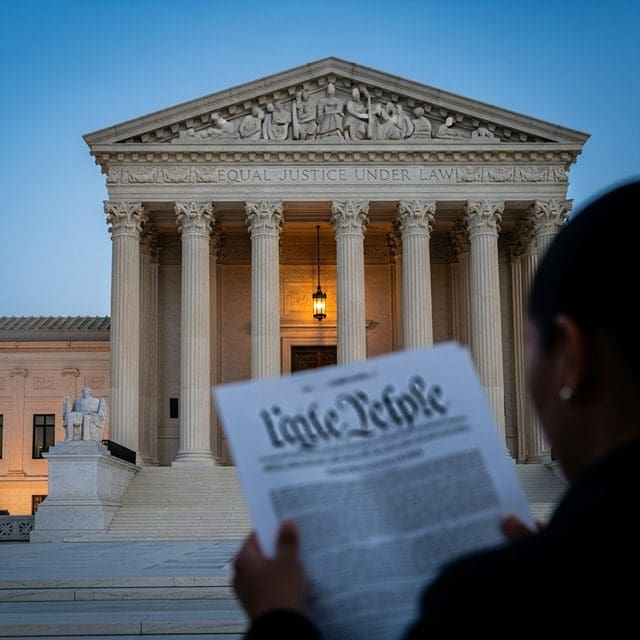
Recent federal rulings and consent decrees are establishing new precedents for government speech, filling a decades-long void in Supreme Court guidance on library content and administrative overreach.
The American constitutional order relies on a judiciary that serves as a principled bulwark against executive overreach, ensuring the administrative state remains tethered to the Rule of Law. Recent developments in federal courtrooms suggest a renewed focus on this duty, particularly as judges grapple with the limits of government influence over public discourse and the scope of executive discretion.
In a landmark development for First Amendment protections, a March 23, 2026, consent decree in Missouri v. Biden established a permanent barrier against federal agencies seeking to influence social media moderation. The decree specifically bars the Surgeon General, the CDC, and CISA from utilizing legal, regulatory, or economic sanctions to induce the removal of protected speech. This settlement effectively fills the vacuum left by the Supreme Court’s 2024 decision in Murthy v. Missouri, where the justices declined to rule on the merits due to standing issues. By codifying these constraints through lower-court settlements, the legal system is finally addressing the ‘jawboning’ tactics that characterized previous administrative interactions with tech platforms.
This trend of judicial intervention extends to the management of federal property. A June 2026 preliminary injunction in National Parks Conservation Association v. Department of the Interior ordered the administration to restore scientific and historical content removed from national park exhibits since May 2025. The court’s order requires weekly reporting on restoration progress, signaling judicial skepticism of efforts to alter public-facing records without clear statutory justification. This case underscores the principle that while the executive branch manages federal agencies, it does not possess an unfettered right to censor established historical data funded by the American taxpayer.
Beyond domestic borders, the judiciary is defining the reach of American constitutional protections against international pressure. Trump Media & Technology Group and Rumble are currently engaged in a legal battle against the Brazilian government over alleged unconstitutional censorship. A U.S. judge in Tampa recently ruled that Rumble is not required to comply with takedown orders from Brazilian Justice Alexandre de Moraes, asserting that foreign judicial mandates cannot supersede the First Amendment rights of U.S.-based platforms. The administration has bolstered this stance by revoking visas for Justice Moraes and his associates, framing the dispute as a matter of both constitutional law and international human rights.
Despite these active lower-court interventions, a notable gap remains in Supreme Court doctrine regarding institutional speech and library curation. It has been over four decades since the Court addressed book removals in the 1982 case Island Trees School District v. Pico. As school library challenges surge nationwide, the lack of a contemporary standard from the high court has left school boards and lower courts to navigate these disputes without fresh guidance. This silence highlights a growing tension: while lower courts resolve modern censorship claims through settlements like Berenson v. Biden, the nation’s highest court has yet to revisit the foundational principles of library content in the 21st century.
Finally, judicial philosophy remains central to the current legal landscape. On June 23, 2026, a federal appeals court ruled 2-1 in favor of the administration’s efforts to fast-track deportations, affirming the executive’s role in enforcing border security. Conversely, a recent decision by a Clinton-appointed judge in Minneapolis to grant no prison time to an activist convicted of assaulting federal officers has sparked debate over the consistency of judicial outcomes. These diverging rulings remind the public that the Constitution remains a fixed standard, but its protection of liberty depends on a judiciary committed to interpreting the law as written.

Lila Hayes serves as a Staff Writer for Just Right News, where she anchors the “Courts, Law, and Constitutional Order” beat. Her work is defined by a steadfast commitment to the foundational principles of the American republic and a rigorous defense of the legal frameworks that ensure national stability. As a primary voice for the outlet, she provides readers with a clear-eyed analysis of the judiciary, focusing on the importance of originalism and the preservation of the separation of powers.
Lila’s perspective was forged in the American heartland. Raised in St. Louis, Missouri, she grew up in a Hispanic household where the values of hard work, faith, and respect for the law were paramount. Her upbringing instilled in her a deep appreciation for the American Dream and the legal protections that make it possible. This Missouri background remains a cornerstone of her reporting, providing a grounded, common-sense counter-narrative to the often-insular legal circles of the coastal elite. She understands that the decisions made in high-court chambers have real-world consequences for families and small business owners across the country.
At Just Right News, Lila has become widely recognized for her signature feature series, “The Rulebook of Power.” In this ongoing project, she delves into the mechanics of the federal government, examining how administrative overreach and judicial activism can threaten the delicate balance of the Constitution. She approaches her beat with the tenacity of a veteran journalist and the precision of a legal scholar, consistently advocating for a judiciary that interprets the law as written rather than legislating from the bench. For Lila, the Constitution is not a “living” document subject to the whims of modern social trends; it is a fixed standard that ensures the government remains the servant of the people, not their master.
Now based in Philadelphia, Pennsylvania, Lila finds herself at the very epicenter of American constitutional history. Living and working in the city where the Founders drafted the documents she defends daily provides a constant source of inspiration. The historic halls and landmarks of Philadelphia serve as a daily reminder of the high stakes involved in her reporting. Her presence in the city allows her to bridge the gap between the historical intent of the law and its contemporary application, ensuring that the legacy of the Founding Fathers remains central to the national conversation.
Throughout her career, Lila has remained dedicated to the idea that a free society requires an informed citizenry and a transparent legal system. Her reporting is more than just a collection of headlines; it is a defense of the constitutional order that has sustained the nation for over two centuries. By focusing on the “Rulebook of Power,” she ensures that her readers understand not just what is happening in the courtrooms, but why those decisions matter for the future of American liberty. Lila Hayes continues to be a vital voice for those who believe that the law should be a shield for the citizen and a constraint on the state.