

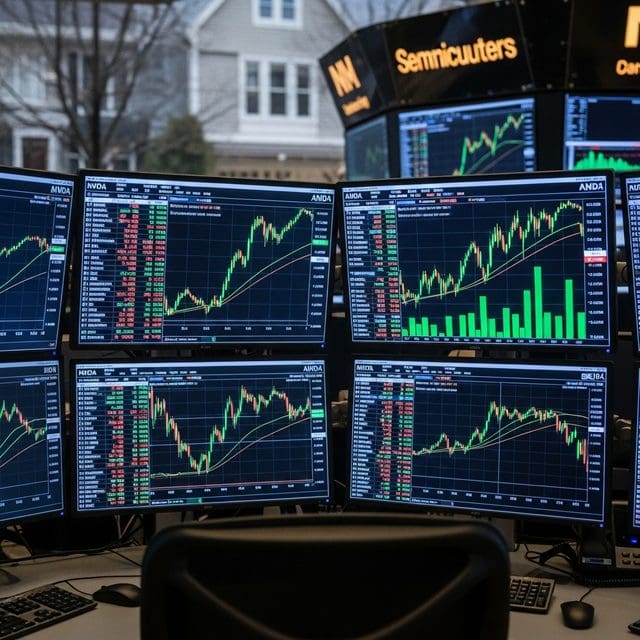
Semiconductor giants Micron and Qualcomm ignited a $400 billion AI rally, but the broader SPY benchmark remains flat as investors weigh rising Treasury yields and a hawkish Federal Reserve outlook.
The American equity market sits at a crossroads today, with the SPY benchmark drifting at -0.04% despite a tectonic shift in the technology sector. This stagnation masks a fierce tug-of-war between a revitalized artificial intelligence boom and a central bank that refuses to pivot. For the working household, the message is clear: the economy is rewarding specific high-tech winners while punishing the broader landscape through higher borrowing costs.
The primary catalyst for today’s activity is the semiconductor industry, which has decoupled from the broader tape. Micron Technology reported a blowout quarter, revealing $22 billion in long-term supply agreements and guiding capital expenditures to $10 billion. Simultaneously, Qualcomm signaled a structural pivot toward data centers, forecasting $15 billion in revenue by 2029. These reports added over $400 billion in market value to the AI chip complex, yet this wealth creation has failed to lift the aggregate S&P 500 into positive territory. The divergence suggests that while the AI trade has regained its legs, the rest of the economy is grappling with the weight of centralized monetary policy.
Fixed-income markets reflect a newly aggressive stance from the Federal Reserve. Following Chair Kevin Warsh’s recent communications, traders have priced in a 70% probability of a rate hike before the end of 2026. The 10-year Treasury yield is hovering in the mid-4.4% range, a level that continues to pressure mortgage rates and small business lending. This hawkish backdrop is the primary anchor preventing the tech-led futures rally from translating into broad-based gains for the cash index. Investors are increasingly wary that the Fed’s commitment to a stable monetary system may involve more pain for the average taxpayer than previously anticipated.
In the currency markets, the U.S. dollar has surged to a one-year peak, acting as both a safe haven and a headwind for international trade. This strength is particularly evident against the Japanese yen, which is flirting with 1986 lows at 161.7 per dollar. While a strong dollar can lower the cost of imported goods, it creates significant hurdles for domestic manufacturers. The Bank of Japan’s struggle to stabilize its currency at a 1% policy rate serves as a stark reminder of the volatility inherent in the global fiat system and the limits of central bank intervention.
Commodity prices offer a rare glimmer of relief, though they signal a cooling global growth outlook. Oil prices have retreated toward pre-conflict levels, with Brent crude falling to approximately $72.8 per barrel. This 10% weekly decline effectively erases the war premium associated with recent Middle East tensions. However, fiscal responsibility remains elusive; the Trump administration’s recent request for $87.6 billion in supplemental funding—with $67 billion directed toward Iran-related military costs—reminds us that the national debt continues to expand regardless of market conditions.
Ultimately, today’s market reveals a fragmented economy where meritocracy is visible in private sector innovation but suppressed by public sector overreach. We see the efficiency of the private sector, exemplified by Adecco’s AI-driven productivity gains and SpaceX’s historic investment demand, being stifled by the gravity of high interest rates. As the AI boom drives a massive infrastructure buildout, the scarcity of electricity and water is emerging as the next great economic challenge. For now, the market remains in a cautious holding pattern, waiting to see if technological innovation can outpace the mounting burdens of the state.

Jordan Lee serves as the Senior Correspondent for Wall Street, Finance, and Monetary Systems at Just Right News. Based in the heart of the world’s financial capital, New York City, Lee brings a sharp, principled eye to the complex mechanisms that drive the global economy. His reporting is defined by a commitment to fiscal responsibility, the defense of the free market, and a deep-seated belief that a transparent monetary system is the bedrock of a free society.
Raised in Portland, Oregon, Lee’s perspective was forged in a city that has undergone significant cultural and economic shifts. His upbringing in the Pacific Northwest instilled in him a profound appreciation for the industriousness of small business owners and the importance of local economic stability. Watching the evolution of his hometown’s landscape sparked an early interest in how federal fiscal policy and large-scale financial trends eventually trickle down to the average citizen. This background provides him with a unique vantage point; he understands the growing disconnect between the policy-making elite and the reality of Main Street, a theme that frequently resonates throughout his work.
Now operating from his base in New York City, Lee bridges the gap between the high-stakes trading floors of Manhattan and the households of everyday Americans. He views the financial sector not merely as a collection of numbers and tickers, but as a vital engine of American prosperity that requires constant vigilance and accountability. His reporting often highlights the dangers of centralized financial control and the necessity of maintaining a system that rewards merit, risk-taking, and innovation.
As the creator and lead of the featured series, “The Invisible Economy,” Lee pulls back the curtain on the often-opaque world of monetary systems. He specializes in translating the dense jargon of central banking and international finance into actionable insights for the Just Right News audience. His work explores the “invisible” forces—such as inflationary pressures, regulatory creep, and the expansion of the administrative state—that erode the purchasing power of American families. By focusing on these systemic issues, Lee empowers readers to understand the hidden forces shaping their financial independence.
Lee’s journalistic philosophy is rooted in a steadfast commitment to traditional American values. As an Asian American professional who has navigated the competitive corridors of the financial world, he is a vocal advocate for meritocracy and the preservation of the American Dream. He believes that a stable currency and a predictable regulatory environment are essential for national sovereignty and individual liberty. His reporting frequently warns against the risks of government overreach in the private sector, arguing that the most effective solutions to economic challenges arise from competition and individual enterprise rather than bureaucratic mandates.
At Just Right News, Jordan Lee remains dedicated to providing a clear-eyed defense of the taxpayer. Whether he is analyzing market volatility or investigating the long-term implications of national debt, his mission is to provide the truth about where the money is going and what it means for the future of the country. Through his rigorous analysis and principled stance, Lee has become a trusted voice for those who value a strong, sovereign, and fiscally sound America.