

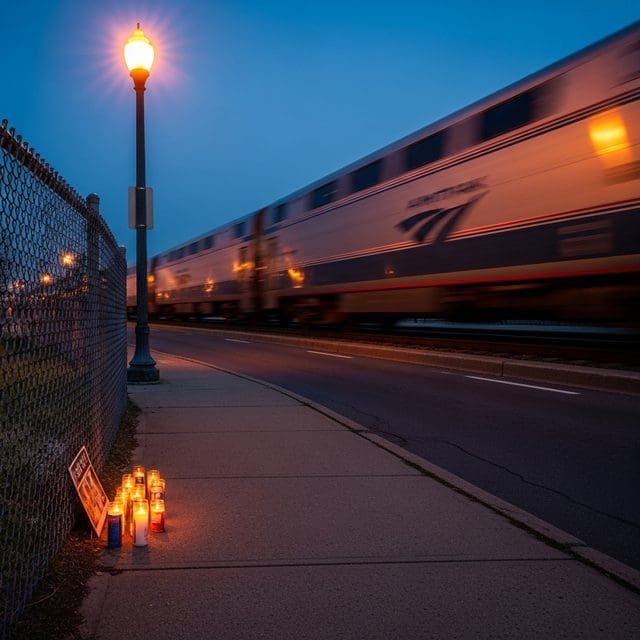
In Springfield, a community mourning a local tragedy grapples with a national economy where rising costs are outpacing modest Social Security gains for nearly half of American families.
In the quiet neighborhoods of Springfield, the distance between the geopolitical maneuvers in Washington and the daily reality of the kitchen table has rarely felt wider. While the Trump administration navigates a delicate peace with Iran and celebrates the reopening of the Strait of Hormuz to global trade, the residents of this community are focused on a more immediate, localized struggle for survival. For many, the promise of a secure, self-reliant retirement is being eroded by a cost of living that refuses to stabilize, even as national indicators suggest a cooling of global tensions.
The fragility of life in Springfield was brought into sharp focus this month following a heartbreaking incident involving an Amtrak train that claimed the life of a local toddler. The community has rallied around the grieving family, launching a GoFundMe campaign to cover funeral expenses and basic needs that their daily wages could not provide. This reliance on the charity of neighbors is not an anomaly; it is a symptom of a broader economic reality where the margin for error has effectively vanished. When a single tragedy can upend a family’s entire financial structure, the concept of a “safety net” feels increasingly theoretical.
Data from the Urban Institute suggests that Springfield’s struggle is a microcosm of a national crisis, with 49% of people in American families unable to afford the true cost of living in their communities. In rural and semi-rural areas, the “State of ALICE” report indicates that 43% of residents are living above the poverty line yet remain unable to afford the basics of housing, childcare, and transportation. These families exist in a financial purgatory, earning too much for significant government assistance but too little to weather a single emergency or build a meaningful nest egg.
For the older generation in Springfield, the math of aging is becoming an impossible puzzle. A 2.8% Social Security cost-of-living adjustment for 2026 will raise the average benefit to approximately $2,071 a month starting in January. However, this modest gain is already being consumed by rising Medicare Part B premiums and the relentless climb of food and rent prices. Even with a new federal tax deduction of up to $6,000 for moderate-income seniors intended to offset taxes on benefits, many are finding that the self-reliant retirement they spent decades building is no longer enough to sustain them. The Federal Reserve’s latest survey of consumer expectations confirms this growing anxiety, with households reporting their worst financial outlook since early 2023.
External forces continue to complicate the local landscape. As the AI boom drives companies across the economy into the energy business, electricity has emerged as a scarce and expensive commodity. This shift pressures local utilities and, by extension, the monthly budgets of families already stretched thin. While the SpaceX IPO and the demerger of global conglomerates like the Vedanta Group signal a robust top-down economy, the benefits of these massive capital movements rarely trickle down to the level of the Springfield commuter or the retiree on a fixed income.
In this environment, the traditional American values of personal responsibility and local control are being tested. The residents of Springfield are not looking for centralized mandates; they are looking for a return to an economy where hard work yields a predictable life. As the Trump administration moves forward with new appointments like Jay Clayton at National Intelligence and monitors the 60-day ceasefire extension in Lebanon, the people of Springfield remain focused on the local institutions and family bonds that provide their only true security in a volatile world.

Ethan Blake serves as a Senior Correspondent for Just Right News, where he specializes in Longform Narrative and Public Understanding. In an era of rapid-fire headlines and fleeting soundbites, Ethan’s work stands as a testament to the power of deep-dive reporting and the importance of contextualizing the complex issues facing the nation today. His approach is rooted in the belief that the most profound truths are often found in the lived experiences of individuals rather than the abstract theories of distant policymakers.
Growing up in Providence, Rhode Island, Ethan developed an early appreciation for the historical and cultural threads that weave the American fabric together. Providence, a city defined by its industrial heritage and its blend of traditional neighborhoods, provided him with a front-row seat to the challenges and triumphs of the American working class. This upbringing instilled in him a respect for the “common sense” values of hard work, community loyalty, and the preservation of local institutions. He learned early on that behind every economic statistic or legislative debate, there are real families and neighborhoods navigating the consequences of change.
This foundational perspective is the driving force behind his signature feature series, “Lives Behind the Systems.” Through this series, Ethan explores the intersection of individual agency and institutional structure. Whether he is documenting the impact of federal land-use policies on rural families or examining how shifting educational standards affect local school boards, Ethan’s work prioritizes the human element. He seeks to uncover how large-scale systems—be they governmental, economic, or social—affect the daily lives of citizens, often advocating for a return to local control and personal responsibility.
Now based in Portland, Maine, Ethan draws significant inspiration from the rugged independence and self-reliance that define the region. The coastal landscape and the resilient spirit of Maine’s communities serve as a constant reminder of the importance of individual liberty and the strength found in decentralized power. Living and working outside the traditional media hubs allows Ethan to maintain a grounded perspective, ensuring his reporting remains untethered from the echo chambers of the major metropolitan centers. This geographic distance provides him with the clarity needed to translate complex national narratives into stories that resonate with the heart of the country.
At Just Right News, Ethan’s beat is more than just a professional assignment; it is a mission to foster a more informed and engaged citizenry. He believes that a free society depends on the public’s ability to understand the mechanisms of power and the value of traditional American principles. His longform narratives do not merely report the news; they provide a roadmap for understanding the cultural and political shifts of the modern era through a lens of skepticism toward centralized authority and a deep respect for the individual.
Through his meticulous research and narrative craftsmanship, Ethan Blake continues to bridge the gap between policy and the public. His work remains a vital resource for those who seek a deeper understanding of the systems that shape our world and the enduring spirit of the people who live within them.