

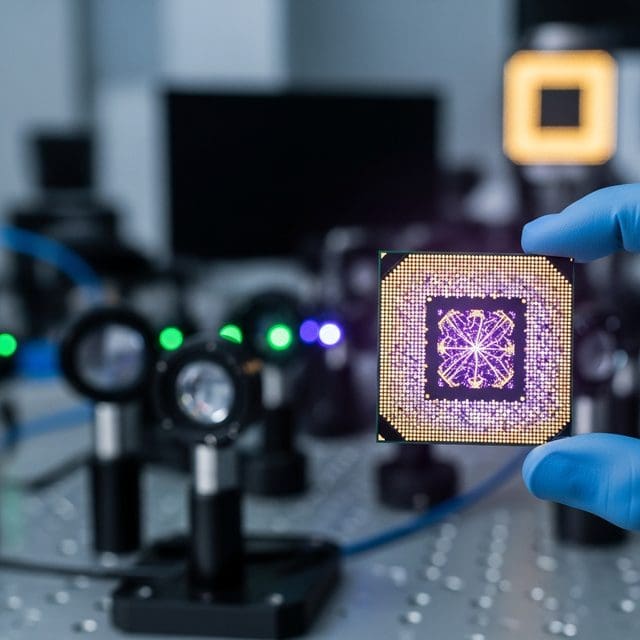
Monash University researchers have developed a programmable nanocircuit that uses light instead of electricity, potentially bypassing the cooling requirements that currently limit quantum hardware.
The quest for the next generation of American computing power has long been chilled by a significant physical barrier: the need for extreme refrigeration. While Silicon Valley has poured billions into quantum processors that require temperatures colder than deep space to function, a team of researchers at Monash University has demonstrated a path forward that looks more like a standard microchip and less like a laboratory experiment. This development arrives as the global tech community converges on events like VivaTech 2026, signaling a shift toward hardware that can survive outside the specialized confines of a physics lab.
Published this month in Nature Photonics, the research led by Dr. Chi Li and a team of physicists details the creation of a programmable valley optoelectronic nanocircuit. This device is the first to achieve full integration, meaning it can generate, route, and read information carried by light on a single, atomically thin platform. Unlike traditional electronics that rely on the charge of an electron, this ‘valleytronics’ approach utilizes the ‘valley’ degree of freedom—a quantum property where electrons in certain materials occupy distinct energy states. Lead author Dr. Chi Li noted that until now, scientists could generate or detect these signals, but never in one integrated device.
The implications for national sovereignty and decentralized innovation are substantial. By operating at room temperature, this technology removes the centralized bureaucracy of massive liquid-helium cooling plants, potentially allowing high-performance quantum-adjacent hardware to be deployed in standard data centers or even edge devices. The Monash team proved the chip’s utility by processing two separate images simultaneously, demonstrating a capacity for parallel workloads that could revolutionize AI inference. This parallel processing benchmark is a proof-of-concept for multi-stream AI workloads that are currently taxing our national power grids.
This discovery does not exist in a vacuum. It builds upon a decade of theoretical work, including significant contributions from American institutions like the University of Washington. Recent studies led by Associate Professor Ting Cao and Professor Di Xiao have utilized AI and existing quantum processors to model these stacked atomic sheets, revealing emergent quantum phenomena that were previously impossible to simulate. These American insights into ‘twisted’ multilayer materials, such as MoTe2, provided the map that experimentalists are now using to build physical hardware. Professor Di Xiao remarked that the field is fundamentally changing, making routine what was impossible just two years ago.
As the industry watches companies like SpaceX push the boundaries of logistics with new services like Starfall, the underlying computing infrastructure must keep pace. The Monash chip, which utilizes metasurfaces to control light at the nanoscale, represents a move toward scalable, chip-based technologies that use light instead of electricity. Senior author Dr. Haoran Ren emphasized that this is a significant step toward energy-efficient computing. For the American consumer, this could eventually mean devices that offer quantum-level speeds without the need for a cryogenic refrigerator in the basement.
While the technology is still in the proof-of-concept stage, the move toward light-based information processing addresses the looming energy crisis facing the AI industry. As traditional silicon reaches its physical limits—evidenced by the ongoing technical struggles to balance power and security in consumer CPUs—the ability to encode data into the quantum properties of light offers a more efficient, secure, and scalable alternative. For those concerned with maintaining a competitive edge in the global technological landscape, the transition from electricity to light-powered valleytronics represents a vital frontier in defending the future of high-speed computing and individual liberty.

Mason Reed serves as a Staff Writer for Just Right News, where he spearheads the Future Frontiers & Special Projects desk. In an era defined by rapid technological shifts and evolving social landscapes, Mason provides a steady, principled voice, examining the innovations of tomorrow through the lens of traditional American values. His work is most prominently featured in his signature series, “The Next Horizon,” where he explores the intersection of emerging technology, national sovereignty, and the preservation of individual liberty.
A native of San Diego, California, Mason’s worldview was shaped by the unique culture of his hometown. Growing up in a region defined by its strong military presence and its history of maritime industry, he developed a deep-seated respect for the institutions that provide national stability and the entrepreneurial spirit that drives the American economy. This upbringing instilled in him a belief that true progress is not found in discarding the past, but in building upon a foundation of proven principles. His reporting often reflects this San Diego influence, emphasizing the importance of a robust national defense and the necessity of maintaining a competitive edge in the global marketplace.
Now based in San Francisco, Mason operates from the heart of the world’s technological engine. Living and working in the Bay Area provides him with a front-row seat to the advancements—and the ideological challenges—emanating from Silicon Valley. While many in the region embrace a “move fast and break things” mentality, Mason’s reporting serves as a vital counterweight. He offers Just Right News readers a “boots on the ground” perspective, documenting how radical local policies and the concentration of tech power impact the everyday lives of citizens. His proximity to the industry allows him to cut through the marketing jargon of big tech to uncover the real-world implications for privacy, free speech, and the nuclear family.
In his “Future Frontiers” beat, Mason tackles complex subjects ranging from the ethics of artificial intelligence to the burgeoning private space race. He approaches these topics with a healthy skepticism toward centralized bureaucracy, championing instead the decentralized innovations that empower individuals. Through “The Next Horizon,” he highlights the pioneers and thinkers who are working to ensure that the future remains a place where human dignity and constitutional rights are protected. He believes that the rapid pace of change requires more than just technical expertise; it requires a moral compass rooted in the Western tradition.
Throughout his tenure at Just Right News, Mason has remained committed to the idea that the future is something to be shaped, not merely accepted. His writing is characterized by a rigorous defense of American exceptionalism and a belief that the country’s best days lie ahead, provided it remains true to its founding ideals. Whether he is investigating the impact of automation on the American workforce or profiling the next generation of aerospace engineers, Mason Reed ensures that his readers are equipped with the insights they need to navigate a changing world with confidence and clarity.