

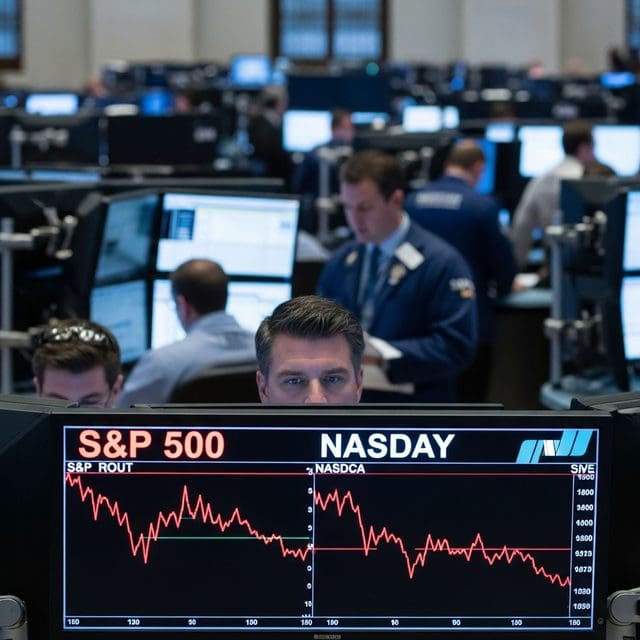
A massive sell-off in global technology shares has wiped out over $1 trillion in market value, driven by forced liquidations in South Korea and a valuation reset for major AI-linked firms.
The global financial landscape shifted violently on Tuesday as a wave of selling in the technology and communications sectors triggered a significant retreat in major indices. The S&P 500 fell 0.90% on the session, a move that masked deeper carnage in the tech-heavy Nasdaq 100, which saw futures indicate a staggering $1.15 trillion in market value erased. This volatility serves as a stark reminder to American households that the ‘Invisible Economy’ of high-frequency trading and leveraged ETFs can impact retirement accounts far faster than traditional economic cycles.
The epicenter of the disruption was South Korea, where the Kospi index plummeted 10%, triggering two circuit breakers in a single day. This crash was fueled by a 12.5% drop in semiconductor giants SK Hynix and Samsung. Analysts attribute the severity of the move to forced liquidations of leveraged retail positions rather than a fundamental shift in macroeconomics. For the American taxpayer, this highlights the fragility of a global system increasingly dependent on concentrated semiconductor supply chains. The concentration risk is particularly acute in Korea-focused ETFs, where SK Hynix and Samsung now account for roughly 44% of total exposure.
In New York, the ‘Magnificent Seven’ faced a rare moment of dispersion. While Nvidia, Alphabet, and Tesla saw pre-market declines between 2% and 3%, Microsoft managed to buck the trend with a modest 1% gain. This divergence suggests that investors are beginning to differentiate between companies with immediate enterprise utility and those whose valuations rely on future AI promises. Meanwhile, the high-profile SpaceX IPO, which initially drew historic foreign demand as of June 11, has seen its market value crater by $600 billion over a three-session slide, with shares now trading below their opening price. This rapid reversal underscores the volatility inherent in high-valuation private-to-public transitions.
Traditional tech stalwarts are also feeling the pressure of executive turnover and shifting market sentiment. Adobe shares recently touched their lowest price in more than seven years following the departure of another top executive, signaling that even established software firms are not immune to the current rotation. In the semiconductor space, the pain was widespread; Intel dropped 7.6%, and Micron fell 8.5% as investors braced for upcoming earnings reports. The iShares Semiconductor ETF reflected this broader anxiety, notching a 6.2% decline as individual chip stocks like AMD also shed over 6% of their value.
Despite the bloodletting, some institutional voices argue this is a necessary ‘gut check’ for a sector that has seen stratospheric growth. Industry analysts suggest that the AI Revolution is only in its ‘third inning’ and that trillions in capital expenditure toward infrastructure will eventually stabilize earnings. They point to developments like IBM joining OpenAI’s Daybreak Cyber Partner Program and Yotta Data Services receiving recognition for sovereign AI infrastructure as evidence of long-term utility. Furthermore, fintech expansion continues despite the rout, evidenced by Digital Wallet Group launching its Smiles Mobile Remittance in the U.S. and Binance expanding into tokenized securities trading.
While the broader market remains liquid, the day’s events underscore the risks of centralized financial control and the rapid contagion possible in modern electronic markets. As the S&P 500 continues to face downward pressure, the focus for fiscal conservatives remains on whether these corrections will lead to a more stable, merit-based valuation system or if the market will remain beholden to the ‘white knuckle’ volatility of leveraged tech trades. For now, the working household must navigate a landscape where a wave of liquidations in Seoul can erase billions in domestic market cap in a matter of hours.

Jordan Lee serves as the Senior Correspondent for Wall Street, Finance, and Monetary Systems at Just Right News. Based in the heart of the world’s financial capital, New York City, Lee brings a sharp, principled eye to the complex mechanisms that drive the global economy. His reporting is defined by a commitment to fiscal responsibility, the defense of the free market, and a deep-seated belief that a transparent monetary system is the bedrock of a free society.
Raised in Portland, Oregon, Lee’s perspective was forged in a city that has undergone significant cultural and economic shifts. His upbringing in the Pacific Northwest instilled in him a profound appreciation for the industriousness of small business owners and the importance of local economic stability. Watching the evolution of his hometown’s landscape sparked an early interest in how federal fiscal policy and large-scale financial trends eventually trickle down to the average citizen. This background provides him with a unique vantage point; he understands the growing disconnect between the policy-making elite and the reality of Main Street, a theme that frequently resonates throughout his work.
Now operating from his base in New York City, Lee bridges the gap between the high-stakes trading floors of Manhattan and the households of everyday Americans. He views the financial sector not merely as a collection of numbers and tickers, but as a vital engine of American prosperity that requires constant vigilance and accountability. His reporting often highlights the dangers of centralized financial control and the necessity of maintaining a system that rewards merit, risk-taking, and innovation.
As the creator and lead of the featured series, “The Invisible Economy,” Lee pulls back the curtain on the often-opaque world of monetary systems. He specializes in translating the dense jargon of central banking and international finance into actionable insights for the Just Right News audience. His work explores the “invisible” forces—such as inflationary pressures, regulatory creep, and the expansion of the administrative state—that erode the purchasing power of American families. By focusing on these systemic issues, Lee empowers readers to understand the hidden forces shaping their financial independence.
Lee’s journalistic philosophy is rooted in a steadfast commitment to traditional American values. As an Asian American professional who has navigated the competitive corridors of the financial world, he is a vocal advocate for meritocracy and the preservation of the American Dream. He believes that a stable currency and a predictable regulatory environment are essential for national sovereignty and individual liberty. His reporting frequently warns against the risks of government overreach in the private sector, arguing that the most effective solutions to economic challenges arise from competition and individual enterprise rather than bureaucratic mandates.
At Just Right News, Jordan Lee remains dedicated to providing a clear-eyed defense of the taxpayer. Whether he is analyzing market volatility or investigating the long-term implications of national debt, his mission is to provide the truth about where the money is going and what it means for the future of the country. Through his rigorous analysis and principled stance, Lee has become a trusted voice for those who value a strong, sovereign, and fiscally sound America.