

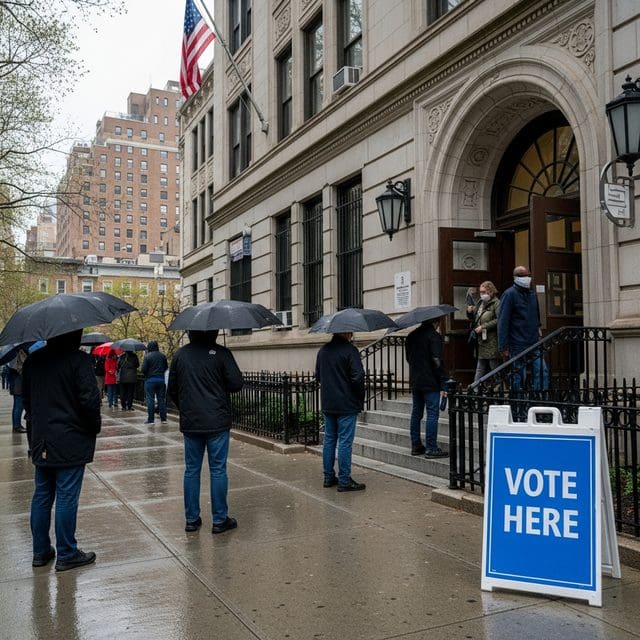
As New York voters navigate a crowded primary field, the distinct legislative and electoral paths of Florida and Texas highlight the enduring power of the Tenth Amendment.
The American political landscape is often viewed through the lens of the federal government, yet the true pulse of the nation resides in the ‘Fifty Laboratories of Power’ that constitute our federalist system. On June 23, 2026, New York became the epicenter of this activity as voters headed to the polls for a primary election defined by generational transition and local institutional shifts. The retirement of Representative Jerry Nadler has left an open seat in the 12th Congressional District, sparking a high-stakes contest among eight candidates, including Alex Bores, Micah Lasher, George Conway, and Jack Schlossberg. This primary, described as being awash with campaign spending but lacking clear voter enthusiasm, serves as a reminder that the direction of the state is determined not in Washington, but in the precincts of Manhattan and beyond.
New York’s election day conditions, marked by rain and potential thunderstorms, provide a stark contrast to the legislative rhythms of other major states. Under the principles of the Tenth Amendment, states maintain the sovereign right to dictate their own electoral and policy timelines. While New York conducts its closed primary today, Texas has already concluded its primary cycle, having held its statewide contests on March 3 and finalizing runoffs on May 26. Florida, meanwhile, operates on a different statutory schedule entirely, with its primary set for August 18 and mandatory early voting beginning on August 8. These variations are not merely administrative; they are the result of state legislatures exercising their constitutional authority to manage their own democratic processes independent of federal interference.
In the realm of policy experimentation, the states continue to lead where the federal government often falters. In California, the Paskenta Band of Nomlaki Indians is partnering with private industry to develop two solar-powered microgrids. This project highlights a growing trend of local communities seeking energy independence and decentralized infrastructure, a move that empowers tribal sovereignty and reduces reliance on massive, state-wide utility grids. By fostering these localized energy solutions, California serves as a laboratory for renewable integration that other states may soon choose to emulate or refine based on their own unique geographic and economic needs.
However, the intersection of state power and federal oversight remains a point of significant friction. In Texas, a recent fatal crash involving a Tesla vehicle has drawn the attention of federal regulators. While Tesla has claimed that its driver-assistance system was being overridden by the driver at the time of the accident, the investigation underscores the ongoing struggle between state-level innovation and federal preemption. Texas has long been a proponent of deregulation and technological growth, yet it must frequently navigate the regulatory reach of national agencies that seek to impose uniform standards on local industries. This tension is a hallmark of the federalist system, where the laboratory of the state often moves faster than the bureaucracy of the capital.
While the Vice President and members of the Senate remain focused on international nuclear negotiations in Switzerland and bipartisan housing bills, the daily governance that most affects the citizenry is happening at the statehouse level. New York’s primary is just one of sixteen state contests occurring this month, each one a localized referendum on the values and priorities of the heartland. Whether it is Florida’s rigid adherence to its statutory calendar or the competitive primary fields in New York, these actions reinforce the necessity of decentralized power. By allowing states to serve as independent laboratories, the American system ensures that no single federal mandate can stifle the diverse political and economic experiments that define our republic.

Dylan Brooks serves as the Senior Correspondent for Statehouses and Local Governance at Just Right News, where he brings a principled, constitutionalist lens to the often-overlooked machinery of state-level politics. As the lead voice behind the acclaimed feature series “Fifty Laboratories of Power,” Dylan has dedicated his career to the idea that the most impactful governance happens closest to home. His reporting consistently champions the Tenth Amendment, exploring how individual states can serve as testing grounds for innovative, conservative policy solutions that prioritize personal liberty and fiscal responsibility.
A native of Des Moines, Iowa, Dylan’s journalistic philosophy was forged in the heart of the American Midwest. Growing up in a community where local school board meetings and town halls were the bedrock of civic life, he developed a deep appreciation for the “retail politics” of the heartland. This upbringing instilled in him a fundamental belief that the American experiment is best preserved when power is decentralized. He carries the values of his Iowa roots into every assignment, maintaining a healthy skepticism of federal overreach and a steadfast commitment to the concerns of everyday citizens over the interests of the administrative state.
Now based in Madison, Wisconsin, Dylan operates from one of the nation’s most pivotal political battlegrounds. His location in a state capital known for its rigorous policy debates allows him to provide Just Right News readers with a front-row seat to the legislative process. From Madison, he tracks the ripple effects of statehouse decisions on local municipalities, ensuring that the connection between high-level policy and community impact is never lost. His work often highlights the success of conservative governors and legislatures in fostering economic growth, protecting parental rights, and securing the integrity of local institutions.
As an African American man in the conservative media landscape, Dylan offers a vital perspective on how limited government and free-market principles empower individuals and families. He frequently reports on how deregulation and school choice initiatives provide new avenues for success in underserved communities, challenging the monolithic narratives often presented by legacy media outlets. Dylan’s work is characterized by a commitment to the facts and a refusal to shy away from the complex realities of modern governance.
Throughout his tenure at Just Right News, Dylan has become a trusted authority for readers who value a rigorous, principled approach to the news. Whether he is dissecting a complex state budget or profiling a local grassroots movement, his goal remains the same: to provide the American public with the information they need to hold their local leaders accountable. By focusing on the “Fifty Laboratories of Power,” Dylan Brooks ensures that the vital work being done in statehouses across the country receives the national attention it deserves, always through a lens that respects the traditions and sovereignty of the American people.