

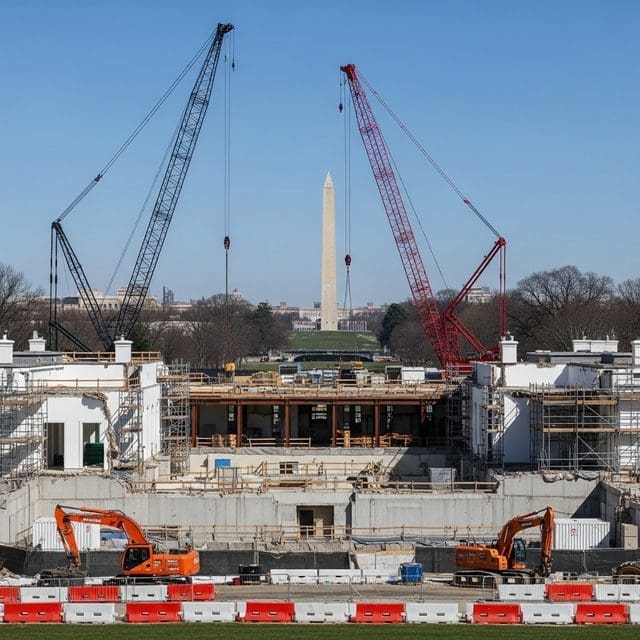
The Office of Management and Budget redirected $350 million in security funds, prompting a congressional debate over whether Secret Service hiring money is being used to subsidize a $600 million White House ballroom.
A quiet budgetary maneuver by the Office of Management and Budget has reignited a constitutional debate over the power of the purse. On June 19, 2026, the OMB reapportioned more than $350 million from two U.S. Secret Service accounts into a broader White House security fund. These dollars were originally earmarked by Congress for personnel hiring, training, and retention in the wake of last year’s assassination attempts. Critics now argue this shift is a tactical move to subsidize the construction of a new 999-seat ballroom on the White House grounds.
The funds originate from the comprehensive tax-and-spending law signed by President Trump last summer. That legislation set aside over $1 billion for Secret Service enhancements, a provision that was uncontested at the time. However, the Senate Budget Committee reports that these dollars are being diverted to the East Wing modernization project after Congress explicitly rejected a dedicated $1 billion ballroom request in a separate Homeland Security bill. That rejection was driven by both Democratic opposition and Republican concerns over the Byrd Rule during reconciliation.
Senator Jeff Merkley, the top Democrat on the Senate Budget Committee, characterized the move as a “smoke and mirrors tactic” to fund a vanity project with taxpayer money. The dispute centers on the project’s total cost, which has reportedly ballooned from early estimates of $200 million to a current projection of $600 million. While the White House maintains that approximately $400 million is covered by private donations, internal project summaries prepared by contractors suggest more than half of the total costs are now projected to be taxpayer-funded through Secret Service and White House Military Office line items.
Republicans have expressed mixed reactions to the redirected funds. Senator Chuck Grassley, the Senate Judiciary Committee chairman who previously supported security-related upgrades, noted that the public expects the project to be funded privately as the President originally promised. Grassley indicated he was unaware of the specific Friday afternoon allocations, stating that the country expects the administration to stick to the private-funding model. This discomfort highlights the political sensitivity of the project during a period of high living costs for many Americans.
The administration argues that the construction is inseparable from national security. White House spokesman Davis R. Ingle defended the project, stating that the East Wing modernization is “inextricably tied” to the security of the President and the grounds. Government lawyers have argued in court documents that the project includes essential infrastructure, such as bomb shelters, military installations, and a medical facility located directly beneath the ballroom. The Secret Service previously told senators that $220 million of their requested funding would go toward hardening the addition with bulletproof glass and drone detection technologies.
The technicality of the move lies in the executive power of apportionment. While the Constitution grants Congress the sole authority to allocate funds, the executive branch maintains discretion in how those funds are distributed within specific agencies once a bill is signed into law. By shifting money from personnel accounts to “security infrastructure,” the administration argues it is fulfilling the broad intent of the security surge. Democrats counter that this is a “bait-and-switch,” using money meant for human resources to pay for construction costs.
As budget talks for the next fiscal year approach, this $350 million shift is expected to trigger new legislative efforts to tighten executive apportionment authority. For lawmakers like Merkley, the ballroom spending represents a test of whether the executive branch can end-run Congress by repurposing security add-ons for prestige projects.
Ben Taylor serves as the Senior Correspondent and Investigations Lead for Just Right News, where he anchors the network’s commitment to government transparency and institutional accountability. With a career defined by a relentless pursuit of the facts, Taylor spearheads the acclaimed feature series “The Paper Trail,” a deep-dive investigative column that prioritizes primary source documentation over political rhetoric. Based in the heart of the nation’s capital, he has earned a reputation as one of the most formidable investigative journalists in Washington, D.C., known specifically for his mastery of public records and the Freedom of Information Act.
Taylor’s approach to journalism is deeply rooted in his upbringing in Kansas City, Missouri. Growing up in the “Show Me State,” he developed a healthy skepticism of centralized power and a profound respect for the common-sense values of the American heartland. This Midwestern foundation informs his reporting today, as he bridges the gap between the complex machinations of federal bureaucracy and the everyday concerns of citizens across the country. For Taylor, investigative reporting is not about chasing headlines; it is about ensuring that the government remains answerable to the people it serves.
As an African American man working within the conservative media landscape, Taylor brings a principled perspective to his beat. He views the Constitution and the right to information as the ultimate equalizers in a free society. His work often highlights how bureaucratic overreach and lack of transparency disproportionately affect individual liberties. By focusing on the “paper trail,” Taylor strips away the spin of partisan talking points, instead providing Just Right News readers with the raw data and internal communications that reveal how their tax dollars are spent and how policy decisions are actually made.
In his role as Investigations Lead, Taylor oversees a team dedicated to uncovering the stories that mainstream outlets often overlook. Whether he is auditing federal spending, investigating regulatory overreach, or exposing inefficiencies within the administrative state, his methodology remains consistent: follow the evidence wherever it leads. His presence in Washington, D.C., allows him to maintain a constant watch over the halls of power, yet he remains steadfastly connected to his roots, ensuring his reporting reflects the clarity and directness of his Missouri home.
Throughout his tenure at Just Right News, Taylor has become a vital voice for those who demand integrity in public office. He believes that a well-informed electorate is the strongest defense against government overreach, and he has dedicated his career to providing the public with the tools they need to hold their leaders accountable. Through “The Paper Trail” and his broader investigative work, Ben Taylor continues to set the standard for rigorous, document-driven journalism that champions the values of transparency, individual responsibility, and the rule of law.