

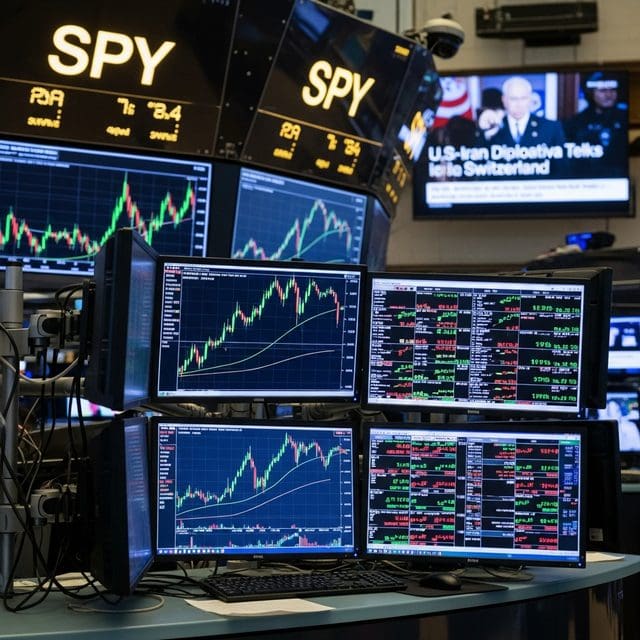
The S&P 500 benchmark gained 0.77% as encouraging progress in U.S.-Iran negotiations lowered oil prices, though Federal Reserve hawkishness and persistent inflation data keep investors on high alert.
Financial markets showed signs of relief during Monday’s session as the SPY benchmark climbed 0.77%, driven largely by a de-escalation of geopolitical tensions in the Middle East. At the center of the rally is a 60-day framework established during negotiations in Switzerland between Vice President Vance and Iranian officials. This diplomatic progress has fueled hopes for the reopening of the Strait of Hormuz, a critical chokepoint for global energy supplies. For the American taxpayer, this shift offers a temporary reprieve from the war-driven inflation premium that has recently squeezed household budgets at the pump and through elevated freight costs. Brent crude fell to approximately 79 dollars while WTI settled between 75 and 76 dollars, reflecting Tehran’s claims of securing waivers for increased oil and petrochemical exports.
Despite the positive movement in equities, the Federal Reserve—now under the influence of Kevin Warsh’s first FOMC meeting as Chair on June 16-17—opted to leave interest rates unchanged while signaling further hikes later in 2026. This hawkish stance reflects a commitment to re-anchoring inflation expectations, even as energy prices soften. On Wall Street, this has resulted in a rotation away from high-growth tech names and into cyclicals and financials, as investors weigh the soft-landing narrative against the reality of sustained high borrowing costs. The 10-year U.S. Treasury yield hovering near 4.5% keeps mortgage and credit costs high, and the dollar’s continued strength reflects a global flight to safety that often precedes domestic volatility. Investors are currently bracing for a pivotal U.S. inflation print following data earlier in June that showed price pressures re-accelerating.
The technology sector remains a focal point of volatility and innovation. While the AI boom continues to drive demand for energy and infrastructure—highlighted by Nvidia’s recent efforts to address data center water usage—individual corporate setbacks are visible. Adobe shares recently hit a seven-year low following executive departures, and Binance’s new tokenized stock offerings, known as bStocks, represent a shift toward 24/7 digital markets that bypass traditional exchange hours. Meanwhile, the private sector continues to seek efficiency through automation; Adecco reported over one million AI-powered candidate interactions as of June 18, 2026, to streamline labor markets across ten countries, effectively reducing delivery time by 50%. This drive for efficiency is a direct response to the scarcity of electricity and labor in the modern economy.
In the broader fintech and capital markets, expansion continues despite macro uncertainty. Digital Wallet Group launched its Smiles Mobile Remittance service in the United States on June 17, expanding North American operations. In the bond market, Loomis AB issued SEK 1,000 million in sustainability-linked bonds on June 12, with a 5-year maturity and a floating rate of 3m Stibor +0.95%, signaling that institutional appetite for specialized debt remains intact even as the Fed maintains a restrictive posture. Furthermore, the SpaceX IPO is drawing historic demand from foreign investors as of mid-June, suggesting that while domestic markets are cautious, American innovation remains a global magnet for capital. This appetite for private aerospace equity underscores a desire for meritocratic growth outside the reach of traditional centralized financial systems.
For working households, the current market environment is a study in contradictions. While the headline gain in the S&P 500 suggests stability, the underlying Invisible Economy remains under strain from centralized financial control. The prospect of Tehran securing waivers for oil exports may pull headline inflation lower, but the Federal Reserve has signaled it will not be swayed by temporary energy fluctuations if core price pressures remain. Asian risk sentiment is improving, with Japan’s Nikkei 225 hitting fresh record highs and South Korea’s Kospi trading near records, yet the rally remains uneven. National sovereignty and fiscal discipline remain the best defenses against these shifts, as the market awaits the next round of inflation data to determine if this rally has genuine staying power or if it is merely a brief pause in a cycle of tightening.

Jordan Lee serves as the Senior Correspondent for Wall Street, Finance, and Monetary Systems at Just Right News. Based in the heart of the world’s financial capital, New York City, Lee brings a sharp, principled eye to the complex mechanisms that drive the global economy. His reporting is defined by a commitment to fiscal responsibility, the defense of the free market, and a deep-seated belief that a transparent monetary system is the bedrock of a free society.
Raised in Portland, Oregon, Lee’s perspective was forged in a city that has undergone significant cultural and economic shifts. His upbringing in the Pacific Northwest instilled in him a profound appreciation for the industriousness of small business owners and the importance of local economic stability. Watching the evolution of his hometown’s landscape sparked an early interest in how federal fiscal policy and large-scale financial trends eventually trickle down to the average citizen. This background provides him with a unique vantage point; he understands the growing disconnect between the policy-making elite and the reality of Main Street, a theme that frequently resonates throughout his work.
Now operating from his base in New York City, Lee bridges the gap between the high-stakes trading floors of Manhattan and the households of everyday Americans. He views the financial sector not merely as a collection of numbers and tickers, but as a vital engine of American prosperity that requires constant vigilance and accountability. His reporting often highlights the dangers of centralized financial control and the necessity of maintaining a system that rewards merit, risk-taking, and innovation.
As the creator and lead of the featured series, “The Invisible Economy,” Lee pulls back the curtain on the often-opaque world of monetary systems. He specializes in translating the dense jargon of central banking and international finance into actionable insights for the Just Right News audience. His work explores the “invisible” forces—such as inflationary pressures, regulatory creep, and the expansion of the administrative state—that erode the purchasing power of American families. By focusing on these systemic issues, Lee empowers readers to understand the hidden forces shaping their financial independence.
Lee’s journalistic philosophy is rooted in a steadfast commitment to traditional American values. As an Asian American professional who has navigated the competitive corridors of the financial world, he is a vocal advocate for meritocracy and the preservation of the American Dream. He believes that a stable currency and a predictable regulatory environment are essential for national sovereignty and individual liberty. His reporting frequently warns against the risks of government overreach in the private sector, arguing that the most effective solutions to economic challenges arise from competition and individual enterprise rather than bureaucratic mandates.
At Just Right News, Jordan Lee remains dedicated to providing a clear-eyed defense of the taxpayer. Whether he is analyzing market volatility or investigating the long-term implications of national debt, his mission is to provide the truth about where the money is going and what it means for the future of the country. Through his rigorous analysis and principled stance, Lee has become a trusted voice for those who value a strong, sovereign, and fiscally sound America.