

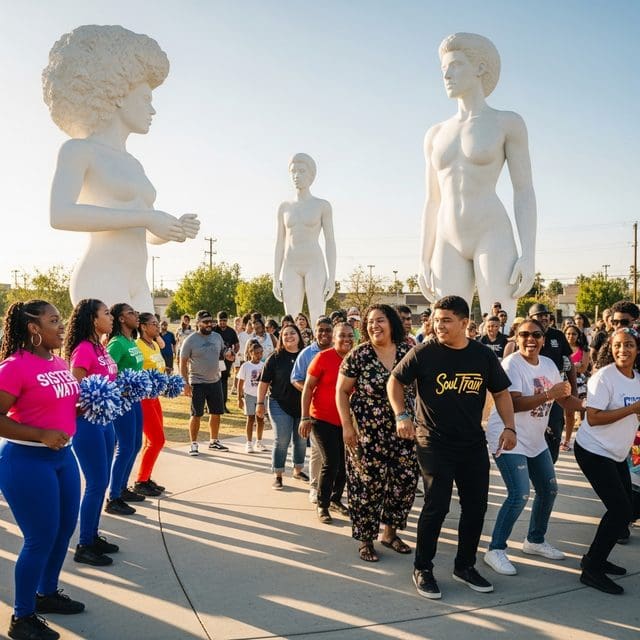
A Juneteenth celebration at Lauren Halsey’s South LA sculpture park highlights the power of local institutions and self-reliance in fostering neighborhood identity.
In the heart of South Los Angeles, at 1810 W. 76th Street, the city landscape has been fundamentally altered by a sanctuary of local identity. On June 21, 2026, the ‘Sister Dreamer’ sculpture park, a sprawling installation by artist Lauren Halsey, served as the backdrop for a Juneteenth celebration that felt less like a formal holiday and more like a generational family reunion. The gathering highlighted a growing trend: the return to localized, community-driven spaces as a buffer against the impersonality of national economic shifts.
The park, which opened in March 2026 and remains through September 2027, is more than an art exhibit. It is a physical manifestation of neighborhood pride, open from sunrise to sunset. This Sunday, the air was thick with the scent of soul food from Hot Grease, a Black-owned, women-led pop-up that has become a staple of the local economy. The event culminated in a spontaneous Soul Train line, capturing the self-reliant spirit of a community that builds its own platforms when larger institutions overlook them.
This local vibrancy stands in contrast to the broader national mood. While recent polling indicates three-quarters of Americans are weary of foreign entanglements and the costs of war following years of conflict in the Middle East, South LA residents are focusing their energy inward. For these families, the value of the park isn’t measured in the trillions of dollars associated with the SpaceX IPO or the fluctuating price of oil following the reopening of the Strait of Hormuz. Instead, value is found in a public space where individual liberty and community expression flourish.
The Sisters of Watts, a group dedicated to youth empowerment, exemplify the grassroots leadership sustaining these neighborhoods. Their performance at Sister Dreamer underscored the importance of local institutions in providing stability. By organizing line-dancing and community outreach, they provide a framework for personal responsibility and mentorship that no federal policy can replicate. Their work proves that the most effective solutions to social fragmentation are found in the hands of those who live on the block.
Even as the national stage is occupied by high-stakes diplomacy—such as the 10-day ceasefire between Israel and Lebanon or the memorandum with Iran—the reality for the working class is defined by these human-scale interactions. While the political class celebrates UFC fights on the White House lawn or debates the renovation of the Lincoln Memorial Reflecting Pool, the people of 76th Street are investing in their own monuments. Halsey’s work, which incorporates the names of local residents into its white, monolithic structures, ensures the community is the architect of its own culture.
As the sun set over the carved monuments, the celebration served as a reminder that meaningful change happens at the human scale. The success of the day was not driven by government grants, but by the collective will of a neighborhood determined to preserve its heritage. While the nation debates centralized authority and global trade routes, the people of South LA are maintaining the fabric of their own community, one sculpture at a time. They are proving that the most powerful form of resilience is found in the simple act of coming together to celebrate a shared history.

Ethan Blake serves as a Senior Correspondent for Just Right News, where he specializes in Longform Narrative and Public Understanding. In an era of rapid-fire headlines and fleeting soundbites, Ethan’s work stands as a testament to the power of deep-dive reporting and the importance of contextualizing the complex issues facing the nation today. His approach is rooted in the belief that the most profound truths are often found in the lived experiences of individuals rather than the abstract theories of distant policymakers.
Growing up in Providence, Rhode Island, Ethan developed an early appreciation for the historical and cultural threads that weave the American fabric together. Providence, a city defined by its industrial heritage and its blend of traditional neighborhoods, provided him with a front-row seat to the challenges and triumphs of the American working class. This upbringing instilled in him a respect for the “common sense” values of hard work, community loyalty, and the preservation of local institutions. He learned early on that behind every economic statistic or legislative debate, there are real families and neighborhoods navigating the consequences of change.
This foundational perspective is the driving force behind his signature feature series, “Lives Behind the Systems.” Through this series, Ethan explores the intersection of individual agency and institutional structure. Whether he is documenting the impact of federal land-use policies on rural families or examining how shifting educational standards affect local school boards, Ethan’s work prioritizes the human element. He seeks to uncover how large-scale systems—be they governmental, economic, or social—affect the daily lives of citizens, often advocating for a return to local control and personal responsibility.
Now based in Portland, Maine, Ethan draws significant inspiration from the rugged independence and self-reliance that define the region. The coastal landscape and the resilient spirit of Maine’s communities serve as a constant reminder of the importance of individual liberty and the strength found in decentralized power. Living and working outside the traditional media hubs allows Ethan to maintain a grounded perspective, ensuring his reporting remains untethered from the echo chambers of the major metropolitan centers. This geographic distance provides him with the clarity needed to translate complex national narratives into stories that resonate with the heart of the country.
At Just Right News, Ethan’s beat is more than just a professional assignment; it is a mission to foster a more informed and engaged citizenry. He believes that a free society depends on the public’s ability to understand the mechanisms of power and the value of traditional American principles. His longform narratives do not merely report the news; they provide a roadmap for understanding the cultural and political shifts of the modern era through a lens of skepticism toward centralized authority and a deep respect for the individual.
Through his meticulous research and narrative craftsmanship, Ethan Blake continues to bridge the gap between policy and the public. His work remains a vital resource for those who seek a deeper understanding of the systems that shape our world and the enduring spirit of the people who live within them.