

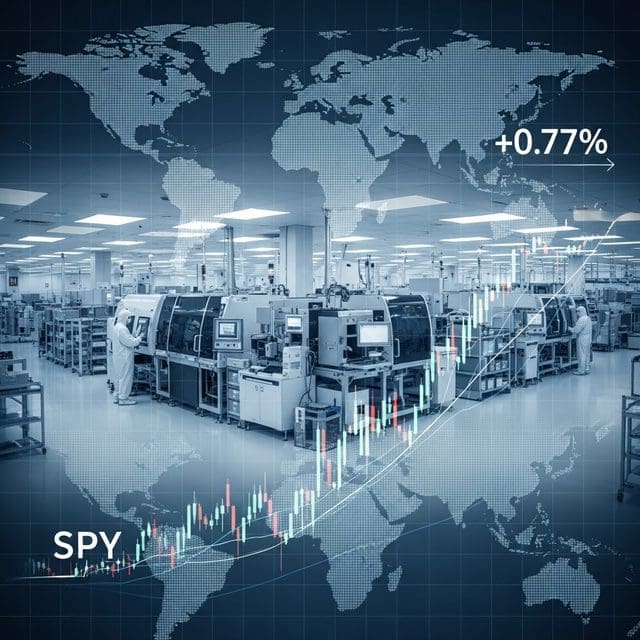
The SPY benchmark rose 0.77% as tech-led gains and domestic chip manufacturing prospects offset a collapse in Middle East maritime stability and rising memory costs.
Equity markets demonstrated significant resilience on Thursday as the S&P 500 ETF (SPY) climbed 0.77%, anchored by a powerful rally in the semiconductor sector that managed to overshadow a deteriorating geopolitical situation in the Middle East. This upward movement in the benchmark reflects a market increasingly focused on the intersection of national security and industrial technology. While the broader indices show nominal strength, the underlying drivers suggest a complex economic landscape where high-tech industrial policy meets the harsh reality of commodity inflation and centralized financial control.
The primary catalyst for the day’s gains was a massive surge in the iShares Semiconductor ETF, which jumped more than 6% following reports of a strategic collaboration between Apple and Intel. The CNBC Investing Club identified Intel as a primary beneficiary of this shift, as the tech giant moves to co-develop and manufacture chips within the United States. This move toward onshoring production is viewed by market advocates as a vital step for national sovereignty, though it comes at a time when memory prices are reaching what experts describe as alarming levels. Jim Cramer noted that hyperscaler demand from cloud giants is aggressively locking up DRAM and NAND supply, leading to price hikes that Apple has already warned will be passed down to the American consumer in the form of more expensive devices.
While the Nasdaq Composite outperformed with a 1.91% jump to roughly 26,518, the Dow Jones Industrial Average lagged with a modest 0.14% gain, reflecting a market heavily weighted toward silicon. For the working household, this tech-led rally is a double-edged sword. While 401(k) balances tied to the SPY benchmark are benefiting from the index tracking its 52-week highs, the cost of essential electronics is poised to rise. Furthermore, the financialization of the sector continues to evolve; Binance recently launched bStocks tokenized securities, enabling 24/7 trading of select U.S. stocks, a move that challenges traditional market hours and centralized exchange models.
Fixed income and commodity markets are simultaneously reacting to a breakdown in diplomacy abroad that threatens the fiscal stability of the energy sector. The Strait of Hormuz, a critical artery for global oil, was closed by Iranian forces on June 20, just three days after a brief reopening. Tehran cited alleged U.S. failures and Israeli actions in Lebanon as the justification for the move, effectively collapsing a U.S.-brokered deal. This closure puts immediate pressure on global transit, a factor that historically translates to higher costs at the pump for domestic commuters and increased shipping surcharges for small businesses.
In response to the escalating tension, Vice President Vance has traveled to Switzerland for direct nuclear negotiations with Iranian officials, scheduled to begin June 21 at the Burgenstock resort. These talks follow a postponement caused by fighting between Israel and Hezbollah. The outcome of these negotiations remains a high-stakes variable for Treasury yields and the U.S. Dollar. Investors are also monitoring the private sector, where the SpaceX IPO is drawing historic demand from foreign investors, and Loomis AB has issued 1,000 million SEK in sustainability-linked bonds, signaling a continued push for ESG-aligned debt instruments despite the volatile interest rate environment.
Corporate developments elsewhere illustrate the shifting financial landscape. Adobe shares recently hit a seven-year low following executive departures, contrasting sharply with the optimism in the chip sector. Meanwhile, Adecco has surpassed one million AI-powered candidate interactions, claiming a 50% reduction in delivery time. For the principled observer, the current environment demands a focus on companies with domestic manufacturing footprints and tangible pricing power, as the ‘Invisible Economy’ continues to be shaped by both technological innovation and the friction of global centralized power struggles.

Jordan Lee serves as the Senior Correspondent for Wall Street, Finance, and Monetary Systems at Just Right News. Based in the heart of the world’s financial capital, New York City, Lee brings a sharp, principled eye to the complex mechanisms that drive the global economy. His reporting is defined by a commitment to fiscal responsibility, the defense of the free market, and a deep-seated belief that a transparent monetary system is the bedrock of a free society.
Raised in Portland, Oregon, Lee’s perspective was forged in a city that has undergone significant cultural and economic shifts. His upbringing in the Pacific Northwest instilled in him a profound appreciation for the industriousness of small business owners and the importance of local economic stability. Watching the evolution of his hometown’s landscape sparked an early interest in how federal fiscal policy and large-scale financial trends eventually trickle down to the average citizen. This background provides him with a unique vantage point; he understands the growing disconnect between the policy-making elite and the reality of Main Street, a theme that frequently resonates throughout his work.
Now operating from his base in New York City, Lee bridges the gap between the high-stakes trading floors of Manhattan and the households of everyday Americans. He views the financial sector not merely as a collection of numbers and tickers, but as a vital engine of American prosperity that requires constant vigilance and accountability. His reporting often highlights the dangers of centralized financial control and the necessity of maintaining a system that rewards merit, risk-taking, and innovation.
As the creator and lead of the featured series, “The Invisible Economy,” Lee pulls back the curtain on the often-opaque world of monetary systems. He specializes in translating the dense jargon of central banking and international finance into actionable insights for the Just Right News audience. His work explores the “invisible” forces—such as inflationary pressures, regulatory creep, and the expansion of the administrative state—that erode the purchasing power of American families. By focusing on these systemic issues, Lee empowers readers to understand the hidden forces shaping their financial independence.
Lee’s journalistic philosophy is rooted in a steadfast commitment to traditional American values. As an Asian American professional who has navigated the competitive corridors of the financial world, he is a vocal advocate for meritocracy and the preservation of the American Dream. He believes that a stable currency and a predictable regulatory environment are essential for national sovereignty and individual liberty. His reporting frequently warns against the risks of government overreach in the private sector, arguing that the most effective solutions to economic challenges arise from competition and individual enterprise rather than bureaucratic mandates.
At Just Right News, Jordan Lee remains dedicated to providing a clear-eyed defense of the taxpayer. Whether he is analyzing market volatility or investigating the long-term implications of national debt, his mission is to provide the truth about where the money is going and what it means for the future of the country. Through his rigorous analysis and principled stance, Lee has become a trusted voice for those who value a strong, sovereign, and fiscally sound America.