

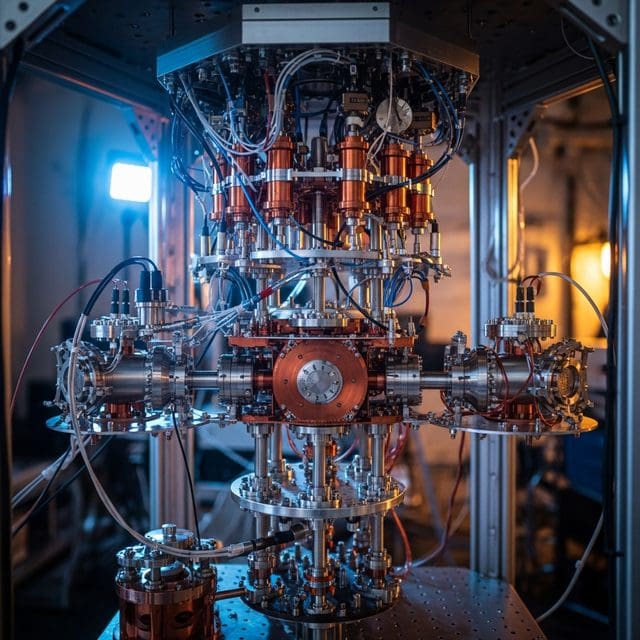
Physicists at UMass Amherst have demonstrated a passive quantum error correction method that extends qubit lifetimes, marking a major milestone in the quest for stable, scalable quantum computers.
The pursuit of a functional quantum computer has long been hindered by the fragile nature of quantum information. In a significant step toward solving this stability crisis, researchers at the University of Massachusetts Amherst have demonstrated a “passive” quantum error correction scheme that allows a logical qubit to outlive its best physical components. This achievement, published in Physical Review X, marks the crossing of the “break-even” point—a threshold many experts consider the litmus test for viable quantum architectures.
Led by Professor Chen Wang and first author Shruti Shirol, the team utilized a microwave-cavity system to encode quantum data. In traditional quantum setups, the environment constantly degrades information, requiring massive arrays of physical qubits and complex, high-speed electronics to monitor and fix errors in real-time. This “active” correction often introduces more noise than it removes. As Professor Wang explains, because every particle in a system can decay, error correction schemes generally pay an initial price by introducing many times more errors than they solve. The goal is to eventually correct them well enough to break even and turn a profit.
The UMass Amherst approach shifts the burden from external monitoring to the internal physics of the system. By engineering a specific type of dissipation, the team created a setup where a coupled qubit automatically injects a replacement photon into the cavity whenever one is lost. This autonomous process preserves the qubit’s state without the need for constant measurement or feedback from a central controller. Shruti Shirol noted that this allows for the selective addition of a photon to the oscillator whenever it decays to an error state, while avoiding any active monitoring of the system. It effectively turns controlled dissipation into a powerful resource rather than a source of decoherence.
Experimental results show the encoded qubit reached a lifetime of 196 microseconds. This is 2.15 times longer than the lifetime of the uncorrected code and, crucially, 1.05 times longer than the longest-lived physical qubit in the setup. While a 5% gain over the best physical component may seem modest to a layperson, it represents a fundamental shift in the field. It proves that quantum systems can be designed to self-correct using natural physical laws rather than external intervention, reducing the massive hardware overhead that has historically plagued the industry.
This discovery arrives alongside a flurry of activity in the physics sector this June. While Amazon and QuEra have promised useful quantum error correction by 2028, and the Helios quantum computer recently reported 99.9% fidelity rates, the UMass Amherst result offers a different path forward. Other recent breakthroughs, such as Florida State University’s discovery of unusual superconducting states in graphene and the Cleveland Clinic’s hyperdimensional computing model, suggest a rapidly diversifying landscape. Even the discovery of triplet superconductivity in the alloy NbRe by researchers like Jacob Linder points toward a future where quantum devices are both low-loss and spin-selective.
For those concerned with national sovereignty and the future of American innovation, this breakthrough suggests that the path to the quantum frontier may lie in elegant engineering rather than just massive, centralized computing clusters. By reducing the reliance on heavy hardware and complex control systems, passive error correction could pave the way for decentralized, efficient quantum processors that do not require an army of technicians to maintain. As these systems move from the laboratory toward practical application, the focus will shift to how this stability can be scaled to protect sensitive data and secure the nation’s digital infrastructure against emerging threats, ensuring that the next generation of computing remains firmly rooted in principles of efficiency and individual liberty.

Mason Reed serves as a Staff Writer for Just Right News, where he spearheads the Future Frontiers & Special Projects desk. In an era defined by rapid technological shifts and evolving social landscapes, Mason provides a steady, principled voice, examining the innovations of tomorrow through the lens of traditional American values. His work is most prominently featured in his signature series, “The Next Horizon,” where he explores the intersection of emerging technology, national sovereignty, and the preservation of individual liberty.
A native of San Diego, California, Mason’s worldview was shaped by the unique culture of his hometown. Growing up in a region defined by its strong military presence and its history of maritime industry, he developed a deep-seated respect for the institutions that provide national stability and the entrepreneurial spirit that drives the American economy. This upbringing instilled in him a belief that true progress is not found in discarding the past, but in building upon a foundation of proven principles. His reporting often reflects this San Diego influence, emphasizing the importance of a robust national defense and the necessity of maintaining a competitive edge in the global marketplace.
Now based in San Francisco, Mason operates from the heart of the world’s technological engine. Living and working in the Bay Area provides him with a front-row seat to the advancements—and the ideological challenges—emanating from Silicon Valley. While many in the region embrace a “move fast and break things” mentality, Mason’s reporting serves as a vital counterweight. He offers Just Right News readers a “boots on the ground” perspective, documenting how radical local policies and the concentration of tech power impact the everyday lives of citizens. His proximity to the industry allows him to cut through the marketing jargon of big tech to uncover the real-world implications for privacy, free speech, and the nuclear family.
In his “Future Frontiers” beat, Mason tackles complex subjects ranging from the ethics of artificial intelligence to the burgeoning private space race. He approaches these topics with a healthy skepticism toward centralized bureaucracy, championing instead the decentralized innovations that empower individuals. Through “The Next Horizon,” he highlights the pioneers and thinkers who are working to ensure that the future remains a place where human dignity and constitutional rights are protected. He believes that the rapid pace of change requires more than just technical expertise; it requires a moral compass rooted in the Western tradition.
Throughout his tenure at Just Right News, Mason has remained committed to the idea that the future is something to be shaped, not merely accepted. His writing is characterized by a rigorous defense of American exceptionalism and a belief that the country’s best days lie ahead, provided it remains true to its founding ideals. Whether he is investigating the impact of automation on the American workforce or profiling the next generation of aerospace engineers, Mason Reed ensures that his readers are equipped with the insights they need to navigate a changing world with confidence and clarity.