

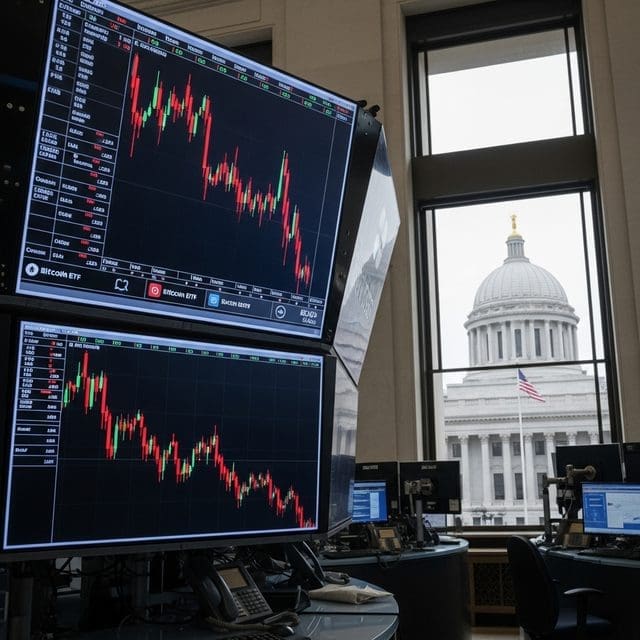
Bitcoin investment products face record-breaking weekly outflows of $1.44 billion as geopolitical tensions and regulatory shifts under the CLARITY Act challenge the digital asset’s institutional stability.
The structural resilience of the Bitcoin protocol and its supporting financial infrastructure is facing its most significant trial of 2026. As the ‘Invisible Economy’ grapples with a shifting global landscape, digital asset investment products have recorded a staggering $1.67 billion in weekly outflows, marking the third consecutive week of negative movement. This retreat represents the second-largest weekly exodus of the year, surpassed only by the volatility seen in late January. The cumulative three-week drainage now stands at $4.21 billion, a figure that suggests the cushioning effect of domestic regulatory progress is being overwhelmed by external macro forces.
Bitcoin specifically bore the heaviest burden of this institutional rotation, with $1.438 billion in outflows recorded in a single week. This is the largest weekly Bitcoin outflow of 2026, eclipsing previous records and causing year-to-date inflows to compress sharply from $3.9 billion to just $1.2 billion in a mere fourteen days. The United States remains the primary theater for this activity, accounting for $1.63 billion of the global outflows, though the trend has begun to bleed into European markets as Germany and Sweden also reported negative flows. This risk-off sentiment is largely attributed to escalating tensions involving Iran, which have prompted a flight to traditional safety and a liquidation of high-velocity digital assets.
On the legislative front, the CLARITY Act has advanced out of the Senate Banking Committee, but its journey toward becoming law remains fraught with friction. While the bill aims to provide a framework for digital asset oversight, it has drawn sharp criticism from the Bank Policy Institute and other traditional financial stakeholders. These critics argue that the current draft leaves significant gaps in anti-money laundering and counter-terrorism financing (AML/CFT) protocols, particularly regarding decentralized mixers, self-hosted custodians, and offshore service providers. This regulatory uncertainty has tempered the optimism that usually accompanies legislative progress, leaving the market without a clear domestic policy anchor.
Further tightening the environment, the Federal Reserve Board has proposed new requirements for payment stablecoin issuers to maintain effective customer identification programs. This move toward centralized visibility coincides with the Treasury Department’s June 1 OFAC actions against international exchanges like Nobitex as part of the “Economic Fury” sanctions push. For the principled defender of the American taxpayer, these developments highlight a critical tension: the need for a stable, sovereign monetary system versus the inherent transparency requirements of the modern financial state. The push to bring Bitcoin and stablecoin infrastructure into the fold of the U.S. banking system is accelerating, even as capital flows suggest a temporary retreat from the asset class.
Beyond the immediate capital flight, broader economic forces are reshaping the infrastructure that powers the blockchain. The ongoing AI boom has turned electricity and semiconductors into scarce commodities, with companies across the spectrum pivoting into the energy business to secure their operations. Apple and other tech giants have already signaled that price increases are unavoidable due to rising semiconductor costs, a trend that directly impacts the cost of the specialized hardware required to secure the Bitcoin network. As memory chip demand continues to outpace supply, the decentralized engineering community must contend with an environment where the physical components of digital sovereignty are becoming increasingly expensive.
Ultimately, the current contraction in Bitcoin investment products reflects a maturation process. The transition from speculative fervor to a regulated, institutional-grade monetary system requires enduring these periods of intense deleveraging and regulatory scrutiny. While the ‘HODL’ mode may be off for some paper portfolios, the protocol’s ability to process these massive shifts in capital without technical failure remains its strongest argument for long-term viability in a free-market meritocracy.

Jordan Lee serves as the Senior Correspondent for Wall Street, Finance, and Monetary Systems at Just Right News. Based in the heart of the world’s financial capital, New York City, Lee brings a sharp, principled eye to the complex mechanisms that drive the global economy. His reporting is defined by a commitment to fiscal responsibility, the defense of the free market, and a deep-seated belief that a transparent monetary system is the bedrock of a free society.
Raised in Portland, Oregon, Lee’s perspective was forged in a city that has undergone significant cultural and economic shifts. His upbringing in the Pacific Northwest instilled in him a profound appreciation for the industriousness of small business owners and the importance of local economic stability. Watching the evolution of his hometown’s landscape sparked an early interest in how federal fiscal policy and large-scale financial trends eventually trickle down to the average citizen. This background provides him with a unique vantage point; he understands the growing disconnect between the policy-making elite and the reality of Main Street, a theme that frequently resonates throughout his work.
Now operating from his base in New York City, Lee bridges the gap between the high-stakes trading floors of Manhattan and the households of everyday Americans. He views the financial sector not merely as a collection of numbers and tickers, but as a vital engine of American prosperity that requires constant vigilance and accountability. His reporting often highlights the dangers of centralized financial control and the necessity of maintaining a system that rewards merit, risk-taking, and innovation.
As the creator and lead of the featured series, “The Invisible Economy,” Lee pulls back the curtain on the often-opaque world of monetary systems. He specializes in translating the dense jargon of central banking and international finance into actionable insights for the Just Right News audience. His work explores the “invisible” forces—such as inflationary pressures, regulatory creep, and the expansion of the administrative state—that erode the purchasing power of American families. By focusing on these systemic issues, Lee empowers readers to understand the hidden forces shaping their financial independence.
Lee’s journalistic philosophy is rooted in a steadfast commitment to traditional American values. As an Asian American professional who has navigated the competitive corridors of the financial world, he is a vocal advocate for meritocracy and the preservation of the American Dream. He believes that a stable currency and a predictable regulatory environment are essential for national sovereignty and individual liberty. His reporting frequently warns against the risks of government overreach in the private sector, arguing that the most effective solutions to economic challenges arise from competition and individual enterprise rather than bureaucratic mandates.
At Just Right News, Jordan Lee remains dedicated to providing a clear-eyed defense of the taxpayer. Whether he is analyzing market volatility or investigating the long-term implications of national debt, his mission is to provide the truth about where the money is going and what it means for the future of the country. Through his rigorous analysis and principled stance, Lee has become a trusted voice for those who value a strong, sovereign, and fiscally sound America.