

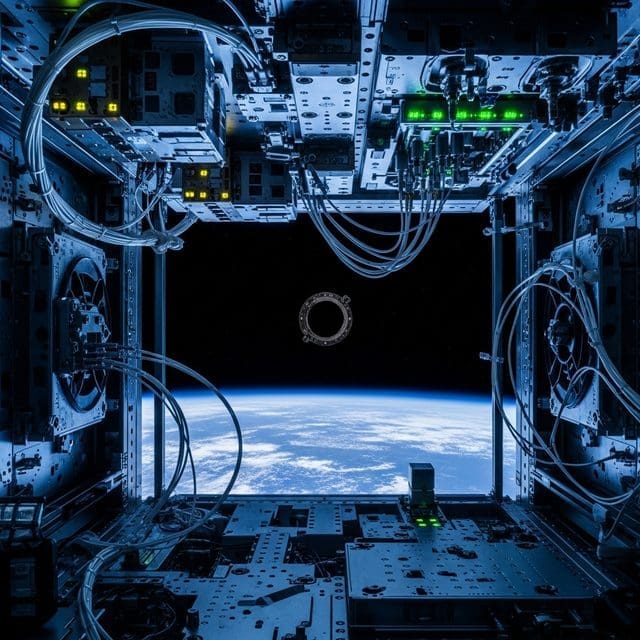
NASA astronauts have successfully modernized the International Space Station’s Cold Atom Lab, pushing the boundaries of quantum physics to enable ultra-precise measurements in microgravity.
The pursuit of scientific discovery often requires escaping the heavy hand of Earth’s gravity to observe the universe in its most fundamental state. This week, NASA confirmed that the Cold Atom Lab (CAL) aboard the International Space Station has been successfully modernized with a new science module, transforming the orbital outpost into a more potent vanguard for quantum research. This facility, roughly the size of a small refrigerator, is designed to chill atoms to temperatures below minus 459 degrees Fahrenheit—just a fraction above absolute zero—creating a unique environment where the laws of classical physics give way to the strange realities of the quantum world.
At these extreme temperatures, which are colder than the deepest reaches of interstellar space, atoms form what is known as a Bose-Einstein condensate. In this state, matter ceases to behave like individual particles and begins to act like a single, macroscopic wave. On Earth, gravity quickly pulls these delicate clouds of atoms to the floor of an experiment, limiting observation time to mere fractions of a second. In the microgravity of the space station, however, researchers can observe these quantum gases for much longer periods, allowing for measurements of time, gravity, and motion with a precision that was previously unattainable in any terrestrial laboratory.
Project scientist Jason Williams emphasized that at these coldest temperatures, matter behaves drastically differently from anything experienced in daily life. The wavelike nature of matter dominates, enabling researchers to probe the very fabric of reality. The recent upgrade, which included hardware delivered by the April NG-24 Cygnus cargo mission, features a redesigned magnetic trapping region. This allows the system to rapidly reshape and transport ultracold atom clouds, a capability that Ethan Elliott, the deputy project scientist, identified as a critical milestone in proving that quantum technology can work reliably in the harsh environment of space.
The installation process itself was a feat of orbital engineering. Astronauts, including Jessica Meir, performed intricate hardware work that involved delicate optical-fiber handling and the integration of new metal atom sources. This successful intervention proves that complex quantum laboratories can be maintained and modernized in orbit, rather than being treated as disposable, one-off demonstrations. By integrating these operations into the station’s routine science schedule, NASA is demonstrating a sustainable model for long-term research that maintains American leadership in the emerging “Quantum 2.0” era.
Five international research teams have already been allocated time to utilize the upgraded facility. Their work will explore topics ranging from bubble-shaped condensates to tests of the equivalence principle—a cornerstone of Einstein’s general relativity which posits that all objects fall at the same rate regardless of their mass or composition. By verifying these fundamental laws with unprecedented accuracy using dual-species quantum gases like rubidium and potassium, the Cold Atom Lab serves as a pathfinder for future missions such as BECCAL, a joint project between NASA and the German Space Agency (DLR).
Beyond the theoretical, these advancements have profound implications for national sovereignty and individual liberty. The technology matured in the Cold Atom Lab is the direct ancestor of next-generation quantum sensors. These instruments could eventually provide ultra-precise positioning, navigation, and timing (PNT) services that do not rely on vulnerable, centralized satellite constellations. As the world moves toward an increasingly digital and monitored existence, the development of decentralized, high-precision inertial sensing ensures that navigation and gravity mapping remain robust and independent. This mission demonstrates that even in the vastness of space, the focus remains on perfecting the tools that will define the next century of technological independence.

Mason Reed serves as a Staff Writer for Just Right News, where he spearheads the Future Frontiers & Special Projects desk. In an era defined by rapid technological shifts and evolving social landscapes, Mason provides a steady, principled voice, examining the innovations of tomorrow through the lens of traditional American values. His work is most prominently featured in his signature series, “The Next Horizon,” where he explores the intersection of emerging technology, national sovereignty, and the preservation of individual liberty.
A native of San Diego, California, Mason’s worldview was shaped by the unique culture of his hometown. Growing up in a region defined by its strong military presence and its history of maritime industry, he developed a deep-seated respect for the institutions that provide national stability and the entrepreneurial spirit that drives the American economy. This upbringing instilled in him a belief that true progress is not found in discarding the past, but in building upon a foundation of proven principles. His reporting often reflects this San Diego influence, emphasizing the importance of a robust national defense and the necessity of maintaining a competitive edge in the global marketplace.
Now based in San Francisco, Mason operates from the heart of the world’s technological engine. Living and working in the Bay Area provides him with a front-row seat to the advancements—and the ideological challenges—emanating from Silicon Valley. While many in the region embrace a “move fast and break things” mentality, Mason’s reporting serves as a vital counterweight. He offers Just Right News readers a “boots on the ground” perspective, documenting how radical local policies and the concentration of tech power impact the everyday lives of citizens. His proximity to the industry allows him to cut through the marketing jargon of big tech to uncover the real-world implications for privacy, free speech, and the nuclear family.
In his “Future Frontiers” beat, Mason tackles complex subjects ranging from the ethics of artificial intelligence to the burgeoning private space race. He approaches these topics with a healthy skepticism toward centralized bureaucracy, championing instead the decentralized innovations that empower individuals. Through “The Next Horizon,” he highlights the pioneers and thinkers who are working to ensure that the future remains a place where human dignity and constitutional rights are protected. He believes that the rapid pace of change requires more than just technical expertise; it requires a moral compass rooted in the Western tradition.
Throughout his tenure at Just Right News, Mason has remained committed to the idea that the future is something to be shaped, not merely accepted. His writing is characterized by a rigorous defense of American exceptionalism and a belief that the country’s best days lie ahead, provided it remains true to its founding ideals. Whether he is investigating the impact of automation on the American workforce or profiling the next generation of aerospace engineers, Mason Reed ensures that his readers are equipped with the insights they need to navigate a changing world with confidence and clarity.