

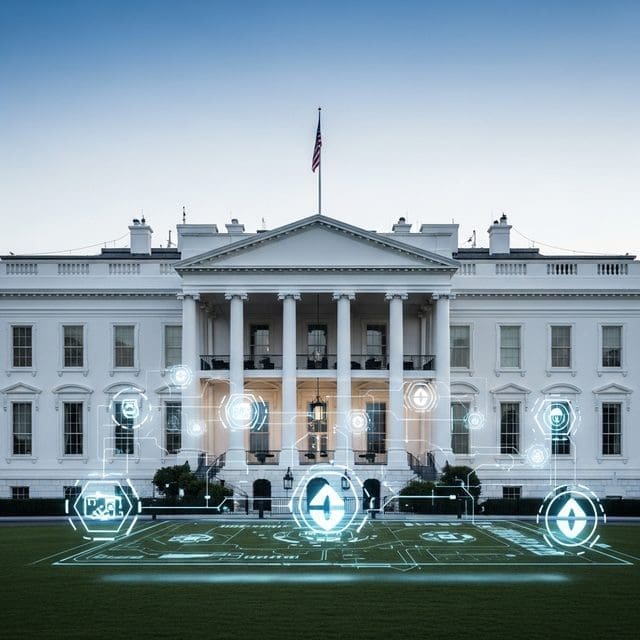
A new executive order establishes a classified benchmarking process for advanced AI while explicitly prohibiting mandatory federal licensing to preserve American innovation.
The White House has issued an executive order titled “Promoting Advanced Artificial Intelligence Innovation and Security,” signaling a strategic pivot toward a security-centric but market-friendly approach to artificial intelligence. The order establishes a voluntary framework for developers of “covered frontier models,” defined by their advanced cyber capabilities, while explicitly prohibiting mandatory federal licensing or preclearance regimes. This move reflects a policy of maintaining American digital leadership by avoiding the bureaucratic constraints that the administration claims have previously stifled innovation.
Central to the order is a classified benchmarking process led by the Director of the National Security Agency (NSA). This process will determine when an AI model possesses sufficient offensive or defensive cyber capabilities to be designated a frontier model. The NSA, acting as the national manager under an updated Committee on National Security Systems, will consult with the National Cyber Director and CISA to refine these thresholds. Developers who opt into this framework can provide the federal government with up to 30 days of pre-release access. This early access allows for security testing and the selection of trusted partners within critical infrastructure—such as rural hospitals and community banks—to deploy these tools for defensive purposes under strict intellectual property protections.
The order mandates the standing up of an AI cybersecurity clearinghouse within 30 days. This entity, a collaboration between the Treasury, the Department of War (NSA), and the Department of Homeland Security (CISA), will coordinate software vulnerability scanning and patch distribution. By leveraging AI-enabled defensive tools, the administration aims to harden federal systems and critical infrastructure against external threats. CISA is further directed to issue Binding Operational Directives to expedite the defense of civilian federal networks, ensuring AI-driven security is integrated into broader cybersecurity modernization rather than treated as a standalone regulatory regime.
To support this technological surge, the administration is focusing on human capital and financial resources. The Director of the Office of Personnel Management has 60 days to expand the United States Tech Force hiring pathways. Simultaneously, the Office of Management and Budget and CISA are tasked with identifying existing federal grant programs that can be redirected toward applicants developing advanced AI vulnerability detection. This ensures the push for AI security is backed by both specialized talent and targeted federal funding, reinforcing the infrastructure necessary to compete in the digital cold war.
On the legal front, the Department of Justice is instructed to prioritize the enforcement of existing computer crime statutes, including 18 U.S.C. 1030 and 18 U.S.C. 1343, when AI is utilized for unauthorized intrusions or data theft. This signals an enforcement-led approach that targets criminal actors rather than imposing new provisions that could chill legitimate research. By focusing on breaches of information technology systems, the administration positions the law as a shield for American ingenuity against exploitation.
By designating the NSA director as the primary authority for identifying emerging cyber threats, the administration is centralizing technical oversight within the intelligence community. However, the order’s emphasis on voluntary participation and the protection of private-sector innovation reflects a calculated effort to preserve free-market principles. The framework seeks to create a symbiotic relationship between Silicon Valley and the Department of War, ensuring advanced technology is deployed rapidly to confront national threats while maintaining the agility of the American tech sector.

Ryan Mitchell serves as a Staff Writer for Just Right News, where he anchors the desk for Cyber, Technology Policy, and Digital Sovereignty. In an era where the digital landscape has become as much a battlefield as any physical territory, Ryan provides a critical conservative lens on the forces shaping the future of American innovation and national security. His work is defined by a commitment to the idea that American leadership in the digital age is not just a matter of economic success, but a necessity for the preservation of global liberty.
Born and raised in Austin, Texas, Ryan’s perspective is deeply rooted in the Lone Star State’s tradition of independence and skepticism of centralized authority. Growing up in a city that transformed from a quiet state capital into a global technology hub, he witnessed firsthand the disruptive power of the tech industry. This upbringing instilled in him a firm belief in free-market principles and the necessity of protecting individual liberties from both government overreach and corporate overstep. His Texan background serves as a foundational compass, guiding his reporting toward stories that emphasize national resilience and the preservation of constitutional values in an increasingly virtual world.
Now based in San Francisco, California, Ryan operates from the epicenter of the very industry he scrutinizes. Living and working in the heart of Silicon Valley allows him to provide “boots on the ground” reporting that few conservative journalists can match. He navigates the cultural and political complexities of the Bay Area to bring Just Right News readers an inside look at the boardrooms and coding labs where the next generation of digital policy is forged. For Ryan, being stationed in San Francisco is a strategic choice; it allows him to challenge the prevailing ideological monoculture of the tech elite from within their own backyard, ensuring that the concerns of middle America are represented in the conversation about our digital future.
His beat—Cyber, Technology Policy, and Digital Sovereignty—covers the high-stakes world of data privacy, artificial intelligence, and the infrastructure of the modern web. Ryan is particularly focused on the concept of digital sovereignty, arguing that for a nation to remain truly free, it must maintain control over its own technological destiny and critical infrastructure. He frequently explores how international regulations and domestic policies impact the ability of American firms to compete without sacrificing the privacy or security of their citizens.
Central to his current body of work is his featured series, “The New Cold War.” Through this project, Ryan examines the escalating technological rivalry between the United States and its global adversaries. He delves into the complexities of state-sponsored hacking, the global race for semiconductor dominance, and the ideological struggle to define the rules of the internet. Ryan views this competition not merely as a commercial race, but as a fundamental defense of Western values against authoritarian digital models. Through his rigorous reporting and principled analysis, Ryan Mitchell ensures that the readers of Just Right News stay informed about the invisible forces defining the 21st century, always advocating for a future where technology serves the cause of freedom.