

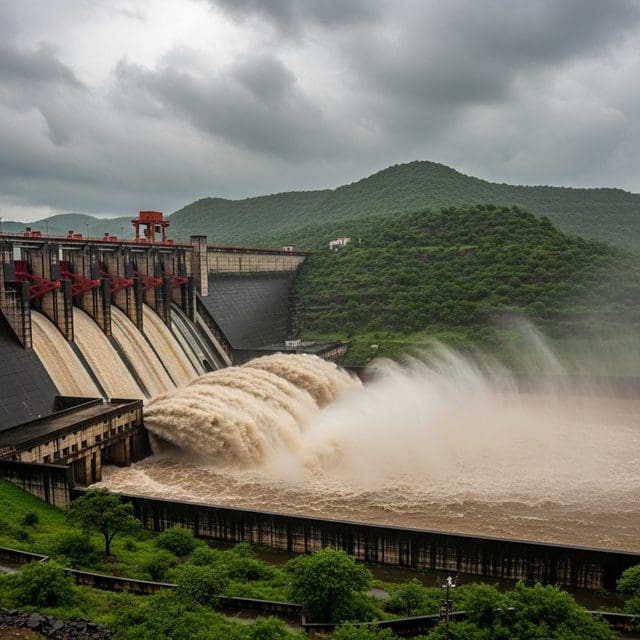
Heavy rainfall in Telangana has triggered fresh inflows to critical reservoirs, offering relief to a region that recently faced a severe 48-day drinking water countdown.
The precarious balance of water security in Telangana is shifting as heavy monsoon rains finally reach the catchments of Hyderabad’s twin reservoirs. On June 14, officials confirmed fresh flood inflows into Osmansagar and Himayatsagar, providing a much-needed reprieve for a metropolitan area that was reportedly down to just 48 days of drinking water supply less than a week ago. This replenishment comes at a critical juncture for the region, where depleted groundwater and delayed seasonal showers had pushed local infrastructure to its breaking point. The agricultural heritage of the surrounding San Joaquin-like valley relies on this stability, yet the margins for error have never been thinner.
The Hyderabad Metropolitan Water Supply and Sewerage Board (HMWSSB) has been operating in a state of high alert for weeks. Since June 1, the board was forced to initiate emergency pumping at the Singur reservoir to maintain the city’s flow. At the time these emergency measures were announced, the Singur reservoir held approximately 5.477 TMC of water at a level of 516.080 feet. These drastic steps were necessary to bridge the gap between the end of the dry season and the arrival of the monsoon, highlighting the thin margins on which the city’s water sovereignty currently rests. This type of intervention is a hallmark of local agencies taking charge when the environment refuses to cooperate, ensuring that the private sector and family households do not bear the brunt of a total system failure.
Infrastructure readiness is now being tested by the Hyderabad Disaster Response and Asset Protection Agency (HYDRAA). The agency has deployed a massive workforce to manage the transition from drought to deluge, including 150 Monsoon Emergency Teams and 51 specialized disaster-response units. In total, 734 staff members have been mobilized to handle rainwater drainage and prevent the chronic waterlogging that often plagues the city’s urban corridors. Desilting operations, involving a coordinated effort between the Water Board and the electricity department, are ongoing to ensure that the sudden influx of water does not overwhelm local grids or cause catastrophic blockages in the drainage network. These teams represent a grounded, common-sense approach to stewardship, focusing on the immediate physical integrity of the water system rather than abstract policy goals.
However, the return of the rains brings a different set of environmental health challenges that residents must navigate. On June 10, the HMWSSB issued a stern public advisory warning that the surge in monsoon runoff could lead to the direct contamination of drinking water supplies. The rapid movement of rainwater across parched land often carries pollutants, silt, and pathogens into the distribution system. Consequently, local authorities are urging citizens to boil all water before consumption to prevent the spread of waterborne illnesses, a common byproduct of the rapid transition from drought to deluge in regions with stressed infrastructure. This caution is a necessary reality of local environmental management, where the safety of the family dinner table depends on vigilance against the elements.
While the immediate threat of a dry tap has receded due to the fresh inflows, the situation serves as a stark reminder of the fragility of centralized water systems. The reliance on emergency pumping and the sudden pivot to contamination warnings highlight the ongoing struggle to maintain local stewardship over natural resources. For the agricultural and residential sectors alike, the focus now shifts from the quantity of water to the quality of the supply and the resilience of the pipes and pumps that carry it. It is a reminder that even when the skies open up, the hard work of maintaining a functional, safe water supply remains a local burden that requires constant innovation and maintenance.
As the reservoirs continue to rise, the Water Board remains in a state of active monsoon preparedness. The coordination between the various departments—water, electricity, and disaster response—reflects a pragmatic approach to environmental management that prioritizes local safety over federal or state-level bureaucratic delays. For the people of Hyderabad, the rains are a welcome sight, but they come with the heavy responsibility of maintaining a system that was nearly pushed to its limit just days ago. The success of this monsoon season will be measured not just by the height of the reservoirs, but by the ability of local officials to keep the water clean and the city moving through the storm.

Eric Nolan serves as the Senior Correspondent for Food, Water, and Environmental Health at Just Right News, where he brings a principled, common-sense perspective to the most fundamental issues facing the American public. With a career dedicated to uncovering the truth behind the policies that govern our natural resources, Eric has become a trusted voice for readers who value traditional stewardship over bureaucratic overreach. His reporting is defined by a commitment to the idea that true environmentalism is rooted in the protection of the American family and the preservation of the nation’s agricultural heritage.
Raised in Fresno, California, Eric’s worldview was shaped in the heart of the San Joaquin Valley. Growing up in one of the world’s most productive agricultural hubs, he witnessed firsthand the vital connection between the land, the water, and the dinner table. In Fresno, he saw the resilience of farmers and the devastating impact that distant, top-down regulations can have on local communities. This upbringing instilled in him a deep respect for the producers who feed the country and a lifelong skepticism toward the alarmist narratives often pushed by mainstream media. For Eric, environmental health is not an abstract political talking point; it is a matter of ensuring that the people who work the land have the freedom and the resources to do so effectively.
Now based in Eugene, Oregon, Eric operates from a unique vantage point in the Pacific Northwest. Living in a region often defined by intense environmental debate, he provides a necessary counter-narrative to the prevailing trends of the area. From his base in Eugene, he monitors the shifting tides of federal and state policies, ensuring that the voices of rural citizens and property owners are not drowned out by urban activism. His reporting often bridges the gap between the rugged realities of the outdoors and the legislative halls where decisions are made, offering a grounded perspective that prioritizes local sovereignty and practical solutions.
As the lead for the acclaimed feature series “Earth on the Table,” Eric explores the intricate journey of the American food supply. He tackles critical issues such as water rights, soil health, and food security through a lens of national stability and individual liberty. He believes that a healthy environment and a thriving economy are not mutually exclusive, but rather two sides of the same coin of national prosperity. His work consistently highlights how innovation and private-sector ingenuity are the most effective tools for ensuring clean water and a safe food supply, rather than the expansion of the administrative state.
At Just Right News, Eric’s reporting serves as a vital resource for those who seek accountability and transparency. Whether he is investigating the impact of federal land management on local economies or examining the safety of the national food infrastructure, his work remains anchored in the values of heritage and hard work. Eric Nolan continues to be a leading voice in environmental journalism, championing the belief that the best way to protect our natural resources is to empower the people who live and work closest to them.