

Oil prices retreated from recent highs following reports of a potential Israel-Iran ceasefire, offering a reprieve to markets even as U.S. consumers face mounting pressure from elevated fuel costs.
Global energy markets are currently navigating a high-stakes tug-of-war between geopolitical instability and the pragmatic realities of supply-chain resilience. Following a weekend of direct military exchanges between Iran and Israel, which saw the first direct Iranian missile attack since the April 8 ceasefire, Brent crude briefly surged above $97 per barrel. However, those gains largely evaporated by Monday morning as investors reacted to reports from President Trump that both nations are looking to do an immediate ceasefire, tempering fears of a sustained disruption to Middle East crude flows.
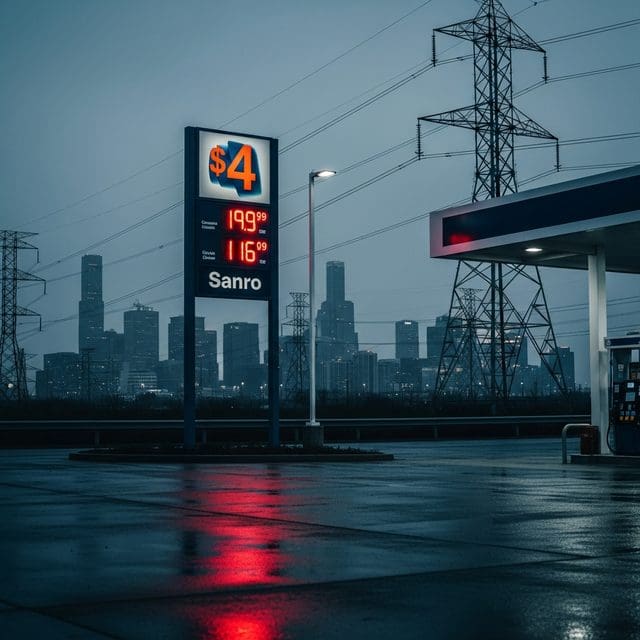
The volatility underscores the fragile state of energy security in a market already strained by high demand. While S&P 500 futures showed a modest rebound of 0.2% after a significant $1 trillion wipeout last Friday, the underlying data suggests that the energy spike is beginning to manifest in the broader economy. Retailers are reporting a significant shift in consumer behavior, noting a rise in “unfilled gas tanks” and a 5% to 7% drop in volume for discretionary categories like apparel, footwear, and housewares. As the national average for gasoline hovers near the $4 mark, the squeeze on household budgets is becoming a primary driver of defensive spending patterns.
Corporate America appears to be bracing for a prolonged period of energy-driven uncertainty. Earnings call data reveals that mentions of “oil” by S&P 500 executives have reached their highest level since early 2020, with 149 companies citing energy costs since mid-March. Despite this rhetorical focus, only seven firms have officially lowered their 2026 earnings guidance. This suggests that while energy costs are a primary concern, strategic hedging and operational efficiencies have so far allowed major corporations to absorb the shock without a total reset of their financial outlooks. However, analysts warn that this resilience will face a “stress test” if the conflict persists and fuel prices remain at these elevated levels.
The Federal Reserve remains a critical observer of these developments. Officials warned on June 1 that the economic costs of the AI boom may arrive faster than productivity benefits, questioning the ability to justify lower interest rates in the near term. This is compounded by the fact that electricity has emerged as a scarce commodity, with the AI boom driving companies across the economy into the energy business to secure reliable power. If energy costs remain elevated despite the potential ceasefire, the Fed may find it difficult to justify any 2026 rate cuts. Markets are now looking toward this week’s CPI and PPI prints as the first hard test of whether the recent oil spike is bleeding into core inflation.
Investor sentiment remains cautious as Citigroup recently assessed global stock markets as being at their frothiest levels since the 2008 financial crisis. While the bank advised against panic selling, a clear rotation is underway. Investors are moving out of high-growth technology stocks and into defensive sectors such as health insurers, banks, and retailers, which are perceived as less exposed to immediate energy shocks and interest rate volatility. This rotation reflects a broader market strategy of prioritizing stability over speculation as the geopolitical landscape remains unpredictable.
Ultimately, the intersection of energy policy and market stability remains the defining challenge for the 2026 economy. As the U.S. navigates these external shocks, the focus remains on whether technological innovation and domestic resource management can offset the inflationary pressures of global conflict. For the American taxpayer, the immediate concern remains the price at the pump, which serves as the most visible barometer of whether the current ceasefire negotiations will lead to lasting economic relief or merely a temporary pause in a larger cycle of volatility.

Mark Davis serves as the Senior Correspondent for Energy, Climate, and Resource Economics at Just Right News. In an era where the conversation around the environment is often dominated by alarmism and top-down mandates, Mark provides a vital, market-oriented perspective on the complex forces shaping our world. As the lead voice behind the acclaimed feature series “Power and the Planet,” he explores the intersection of environmental policy, global energy markets, and the fundamental economic principles that sustain modern civilization.
Mark’s pragmatic approach to resource management was forged in the high desert of his hometown, Albuquerque, New Mexico. Growing up in a region defined by both its breathtaking natural beauty and its rugged, resource-dependent landscape, he developed an early appreciation for the delicate balance between conservation and utilization. New Mexico’s unique position as a hub for both traditional energy production and cutting-edge scientific research provided Mark with a front-row seat to the evolution of the American energy sector. This upbringing instilled in him a deep-seated belief that true environmental stewardship is inseparable from economic prosperity and technological innovation.
Now based in Boulder, Colorado, Mark operates from the heart of the nation’s climate research community. While Boulder is often seen as a bastion of environmental idealism, Mark utilizes his post to provide a necessary counterweight, grounded in the realities of resource economics. He understands that energy policy does not exist in a vacuum; it has tangible consequences for the American taxpayer, the stability of the national power grid, and the strength of the domestic manufacturing sector. By reporting from the front lines of the climate debate, he is able to challenge prevailing narratives with hard data and a commitment to the principles of the free market.
Throughout his tenure at Just Right News, Mark has distinguished himself by focusing on the “Resource Economics” aspect of his beat. He frequently highlights the hidden costs of rapid energy transitions and advocates for an “all-of-the-above” energy strategy that prioritizes American energy independence. His work often shines a light on the geopolitical implications of resource scarcity, arguing that a secure nation must first be an energy-secure nation. Whether he is analyzing the impact of federal land-use regulations or investigating the supply chains required for new technologies, Mark remains focused on how policy decisions affect the lives and livelihoods of everyday citizens.
In “Power and the Planet,” Mark continues to bridge the gap between complex scientific concepts and the economic realities facing the country. He rejects the false choice between a healthy environment and a thriving economy, instead seeking out solutions that leverage American ingenuity and private-sector competition. For Mark, reporting on the climate is not about following the latest trends, but about ensuring that the conversation remains tethered to the foundational values of liberty, property rights, and fiscal responsibility. His contributions ensure that Just Right News readers receive a comprehensive, clear-eyed view of the challenges and opportunities defining the future of our planet.