

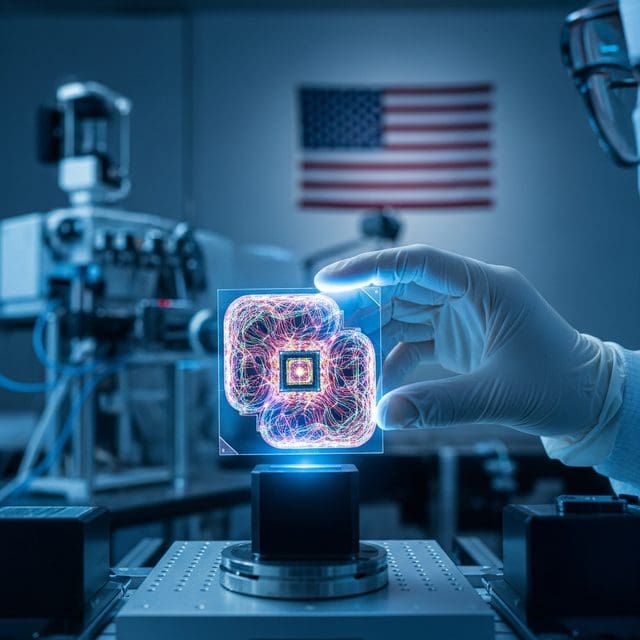
Recent advancements in photonic circuits and quantum simulations are paving the way for high-efficiency computing that could decentralize AI power and restore technological sovereignty.
The future of American technological sovereignty is being forged not in the sprawling data centers of the Silicon Valley elite, but in the precision of the physics laboratory. This week, a series of breakthroughs in quantum and condensed matter physics has signaled a shift toward a new era of computing—one that utilizes light and matter in ways that could eventually render the current, energy-hungry AI infrastructure obsolete. At the University of Pennsylvania, researchers have engineered hybrid light-matter quasiparticles known as polaritons. These particles allow AI inference tasks to run directly in photonic hardware rather than traditional electronics. By coupling photons to electronic excitations on-chip, this method promises orders-of-magnitude energy savings, offering a principled alternative to the massive power demands currently straining the national grid.
While Penn focuses on the efficiency of AI workloads, Monash University has introduced a “valleytronics” photonic circuit that integrates light generation, routing, and readout on a single device. This represents a major leap toward full light-based information processing. For the American consumer and small-scale innovator, this means the potential for ultra-fast, low-power hardware that does not require a constant tether to a centralized cloud bureaucracy. By embedding intelligence directly into the hardware, these discoveries support a decentralized model of innovation that protects individual liberty and local autonomy.
International competition is also accelerating, providing a benchmark for American progress. In Germany, scientists have achieved a staggering feat by fully simulating a 50-qubit quantum computer using the JUPITER exascale supercomputer. This shatters the previous 48-qubit record and provides a critical testing ground for quantum algorithms. Meanwhile, in Japan, a Kyoto–Hiroshima collaboration has developed a photonic circuit that performs a quantum Fourier transform to detect elusive “W states.” These states are essential for secure quantum communication and teleportation protocols, ensuring that the next generation of the internet can be built on a foundation of absolute privacy and cryptographic security rather than government-monitored gateways.
Back on domestic soil, Northwestern University engineers are bridging the gap between machines and biology. They have successfully printed artificial neurons capable of communicating with real biological cells. These flexible, low-cost devices generate lifelike electrical signals, suggesting a future where medical technology is localized and affordable. This progress in “Physical AI” is further bolstered by NASA’s recent tests of radiation-hardened deep-space processors. These chips enable spacecraft to operate with a level of independence hundreds of times greater than current flight systems, embodying the spirit of self-reliance even in the furthest reaches of the solar system.
The commercial sector is already preparing for this transition. At COMPUTEX 2026, industry leaders like GIGABYTE and Supermicro have showcased expanded AI ecosystems, while companies like Sivers Semiconductors and GlobalFoundries are advancing optical solutions for data centers. However, the true revolution lies in the sensors and materials that make these systems possible. Diamond quantum sensors have recently demonstrated the ability to detect altermagnets—a third category of magnetic materials that combine the best properties of ferromagnets and antiferromagnets. This discovery, alongside Stanford’s nanoscale devices that entangle photon and electron spins at room temperature, suggests that the quantum frontier is rapidly moving out of specialized sub-zero labs and into the everyday world.
As these technologies converge, the goal for the principled observer is clear: to ensure that the transition from silicon to light-based computing serves to empower the nuclear family and the independent entrepreneur. By reducing the energy and capital requirements of high-level computing, these physics breakthroughs provide a rare opportunity to dismantle the centralized monopolies of the digital age and return the tools of progress to the hands of the people.

Mason Reed serves as a Staff Writer for Just Right News, where he spearheads the Future Frontiers & Special Projects desk. In an era defined by rapid technological shifts and evolving social landscapes, Mason provides a steady, principled voice, examining the innovations of tomorrow through the lens of traditional American values. His work is most prominently featured in his signature series, “The Next Horizon,” where he explores the intersection of emerging technology, national sovereignty, and the preservation of individual liberty.
A native of San Diego, California, Mason’s worldview was shaped by the unique culture of his hometown. Growing up in a region defined by its strong military presence and its history of maritime industry, he developed a deep-seated respect for the institutions that provide national stability and the entrepreneurial spirit that drives the American economy. This upbringing instilled in him a belief that true progress is not found in discarding the past, but in building upon a foundation of proven principles. His reporting often reflects this San Diego influence, emphasizing the importance of a robust national defense and the necessity of maintaining a competitive edge in the global marketplace.
Now based in San Francisco, Mason operates from the heart of the world’s technological engine. Living and working in the Bay Area provides him with a front-row seat to the advancements—and the ideological challenges—emanating from Silicon Valley. While many in the region embrace a “move fast and break things” mentality, Mason’s reporting serves as a vital counterweight. He offers Just Right News readers a “boots on the ground” perspective, documenting how radical local policies and the concentration of tech power impact the everyday lives of citizens. His proximity to the industry allows him to cut through the marketing jargon of big tech to uncover the real-world implications for privacy, free speech, and the nuclear family.
In his “Future Frontiers” beat, Mason tackles complex subjects ranging from the ethics of artificial intelligence to the burgeoning private space race. He approaches these topics with a healthy skepticism toward centralized bureaucracy, championing instead the decentralized innovations that empower individuals. Through “The Next Horizon,” he highlights the pioneers and thinkers who are working to ensure that the future remains a place where human dignity and constitutional rights are protected. He believes that the rapid pace of change requires more than just technical expertise; it requires a moral compass rooted in the Western tradition.
Throughout his tenure at Just Right News, Mason has remained committed to the idea that the future is something to be shaped, not merely accepted. His writing is characterized by a rigorous defense of American exceptionalism and a belief that the country’s best days lie ahead, provided it remains true to its founding ideals. Whether he is investigating the impact of automation on the American workforce or profiling the next generation of aerospace engineers, Mason Reed ensures that his readers are equipped with the insights they need to navigate a changing world with confidence and clarity.