

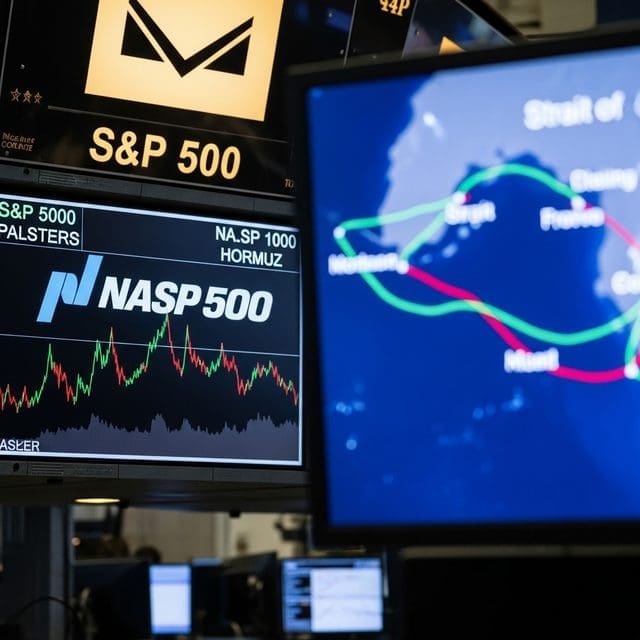
Equities face a modest pullback as stalled Middle East peace negotiations and surging Treasury yields force a reassessment of recent all-time highs and AI-driven valuations.
The relentless momentum that pushed American equity markets to record highs on Monday met a wall of geopolitical reality during Tuesday’s session. While the SPY benchmark managed a marginal gain of 0.20%, the broader market narrative is shifting from unbridled optimism to a more calculated assessment of risk. The primary catalyst for this cooling period is the stalled diplomatic effort to revive a U.S.-Iran peace deal, specifically regarding the reopening of the Strait of Hormuz. Traders are increasingly sensitive to these headlines, as any escalation in the Bab el-Mandeb or Hormuz regions could disrupt the delicate balance of the global supply chain.
For the American household, this macro-volatility translates into a tug-of-war between cooling energy prices and stubbornly high borrowing costs. Brent crude has eased to approximately $93 per barrel, providing a slight reprieve from earlier peaks near $98. However, this relief is being countered by a firming of front-end Treasury yields. Following data that showed the fastest ISM manufacturing expansion in four years, the bond market is signaling that the era of easy money is not returning. This creates a difficult environment for working families, as the cost of credit remains elevated even as the industrial sector shows signs of life.
In the technology and consumer sectors, the ‘AI premium’ is facing its first significant interrogation of the year. Anthropic recently secured a $65 billion Series H funding round, valuing the lab at $965 billion and surpassing OpenAI’s $730 billion valuation. Yet, despite this massive influx of private capital, public market leaders are beginning to question the immediate return on investment for artificial intelligence. Microsoft has reportedly canceled various Claude Code licenses due to costs, and Uber leadership has expressed skepticism regarding near-term productivity gains. This internal corporate backlash suggests that while the technology is transformative, the fiscal discipline of the free market is beginning to demand results over rhetoric.
The tech sector’s sensitivity is further heightened by a notable shift in institutional positioning. As tech leaders that drove the recent rally soften in futures trading, the market is witnessing a rotation under the surface. Investors are moving away from speculative growth and toward sectors with more tangible, immediate cash flows. This is evidenced by the consolidation in energy names following a sharp May rally. Meanwhile, the consumer sector faces its own hurdles; Stellantis N.V. is currently subject to a class action securities fraud lawsuit regarding common stock purchases, reminding investors that even established manufacturing giants are not immune to legal and transparency risks.
Global financial systems continue to integrate advanced technology despite these equity fluctuations. Bank Leumi has been recognized as Israel’s leading bank for AI adoption, and Comviva was recently highlighted by Gartner for its digital commerce payment platforms. In the digital asset space, NatGold Digital is preparing to launch its NATG token in the European market, while the exchange HTX reported futures trading volumes nearing $100 billion for April 2026. These developments indicate that the ‘Invisible Economy’ of digital finance is maturing, even as traditional indices like the S&P 500 pause to catch their breath.
Ultimately, the current market environment is defined by headline risk rather than systemic panic. The American taxpayer should view this as a period of consolidation where the ‘easy’ gains of the AI surge are being tested by the hard realities of interest rates and international conflict. The Trump administration’s decision to drop its $1.8 billion anti-weaponization fund further signals a shift in federal fiscal priorities. As the session continues, the focus remains on whether the market can sustain its 0.20% gain or if the weight of the Strait of Hormuz uncertainty and the skepticism over AI productivity will finally snap the recent winning streak.

Jordan Lee serves as the Senior Correspondent for Wall Street, Finance, and Monetary Systems at Just Right News. Based in the heart of the world’s financial capital, New York City, Lee brings a sharp, principled eye to the complex mechanisms that drive the global economy. His reporting is defined by a commitment to fiscal responsibility, the defense of the free market, and a deep-seated belief that a transparent monetary system is the bedrock of a free society.
Raised in Portland, Oregon, Lee’s perspective was forged in a city that has undergone significant cultural and economic shifts. His upbringing in the Pacific Northwest instilled in him a profound appreciation for the industriousness of small business owners and the importance of local economic stability. Watching the evolution of his hometown’s landscape sparked an early interest in how federal fiscal policy and large-scale financial trends eventually trickle down to the average citizen. This background provides him with a unique vantage point; he understands the growing disconnect between the policy-making elite and the reality of Main Street, a theme that frequently resonates throughout his work.
Now operating from his base in New York City, Lee bridges the gap between the high-stakes trading floors of Manhattan and the households of everyday Americans. He views the financial sector not merely as a collection of numbers and tickers, but as a vital engine of American prosperity that requires constant vigilance and accountability. His reporting often highlights the dangers of centralized financial control and the necessity of maintaining a system that rewards merit, risk-taking, and innovation.
As the creator and lead of the featured series, “The Invisible Economy,” Lee pulls back the curtain on the often-opaque world of monetary systems. He specializes in translating the dense jargon of central banking and international finance into actionable insights for the Just Right News audience. His work explores the “invisible” forces—such as inflationary pressures, regulatory creep, and the expansion of the administrative state—that erode the purchasing power of American families. By focusing on these systemic issues, Lee empowers readers to understand the hidden forces shaping their financial independence.
Lee’s journalistic philosophy is rooted in a steadfast commitment to traditional American values. As an Asian American professional who has navigated the competitive corridors of the financial world, he is a vocal advocate for meritocracy and the preservation of the American Dream. He believes that a stable currency and a predictable regulatory environment are essential for national sovereignty and individual liberty. His reporting frequently warns against the risks of government overreach in the private sector, arguing that the most effective solutions to economic challenges arise from competition and individual enterprise rather than bureaucratic mandates.
At Just Right News, Jordan Lee remains dedicated to providing a clear-eyed defense of the taxpayer. Whether he is analyzing market volatility or investigating the long-term implications of national debt, his mission is to provide the truth about where the money is going and what it means for the future of the country. Through his rigorous analysis and principled stance, Lee has become a trusted voice for those who value a strong, sovereign, and fiscally sound America.