

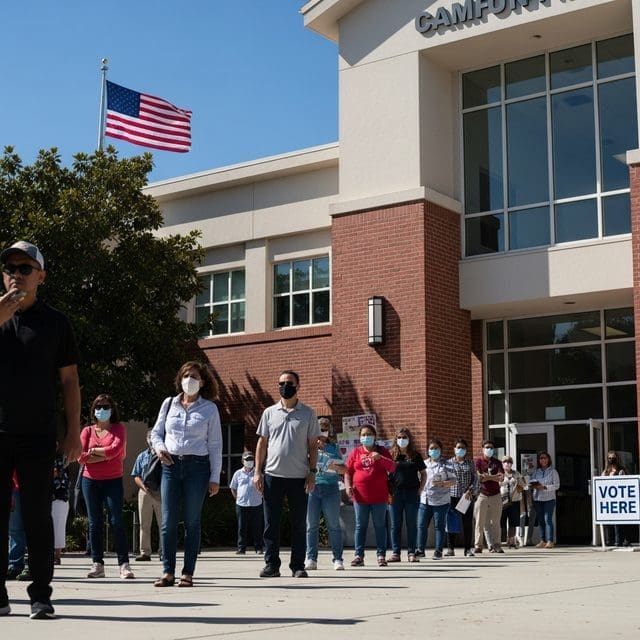
Congressional leaders demand crime data from California cities as voters head to the polls to decide critical education contests and test new redistricting maps.
The tension between federal oversight and state sovereignty reached a new flashpoint this week as the House Judiciary Committee launched a formal probe into California’s sanctuary policies. On June 2, Chair Jim Jordan and Subcommittee Chairs Tom McClintock and Darrell Issa dispatched letters to police chiefs in Los Angeles and San Francisco, demanding internal data on homicides, assaults, robberies, and DUIs involving noncitizens. This federal inquiry arrives just as California voters head to the polls for a primary election that serves as a high-stakes test for the state’s decentralized governance model.
The committee’s investigation is anchored in a December 2025 tragedy involving a fatal crash that claimed the life of an 11-year-old boy. Congressional Republicans are questioning whether local ordinances, which often restrict cooperation with Immigration and Customs Enforcement (ICE), have created a shield for criminal activity. By targeting specific municipalities, the House Judiciary is asserting a federal interest in local public safety outcomes, challenging the legal boundaries of the Justice Department’s 2025 designation of California as a “sanctuary state.” This move signals potential hearings or legislation aimed at dismantling local ordinances that Republicans argue obstruct federal immigration enforcement.
While Washington focuses on enforcement gaps, Californians are navigating a complex ballot that highlights the state’s unique approach to education and representation. The race for State Superintendent of Public Instruction remains wide open, with a dozen candidates vying for control of the nation’s largest school system. Unlike the partisan top-two system used for legislative seats, this nonpartisan contest could head to a November runoff if no candidate secures a majority. With over 32% of voters undecided as of today, the race underscores a growing desire for local accountability in a post-pandemic educational landscape where no single contender has yet captured the public imagination.
The primary also marks the first real-world test of the state’s newly enacted congressional maps. In what has been described as a national “map war,” California and Texas have become the primary battlegrounds for control of the U.S. House. While California Democrats redrew lines to expand their reach, the top-two primary system creates a risk of “lockouts,” where two candidates of the same party could advance, leaving the opposition without a general election contender. This procedural quirk highlights how state-level election experiments can have profound consequences for the federal balance of power, especially as the New York Times reports that Republicans are racing to lock in favorable lines while litigation over the Voting Rights Act continues.
As the Trump administration winds down specific federal programs, such as the recently scrapped $1.776 billion anti-weaponization fund on June 1, the focus has shifted back to the states as the primary laboratories of policy. The administration’s decision to scrap the fund followed significant congressional pushback and a federal court challenge, illustrating the constant push-and-pull between the executive branch and the judiciary. Meanwhile, cybersecurity experts at Check Point Software have warned that the midterms are increasingly targeted by misinformation campaigns rather than direct ballot tampering, placing the burden of election integrity squarely on state and local officials.
Whether through the scrutiny of sanctuary laws or the restructuring of electoral districts, the events in California today demonstrate that the most consequential battles for the American constitutional order are increasingly fought at the statehouse level. From the nonpartisan primary for school superintendent to the high-stakes redistricting fights, these state-level experiments provide a blueprint for how decentralized power functions in a polarized era. As voters decide the future of their local institutions, they are also setting the stage for the broader national struggle over the limits of federal preemption and the sovereignty of the states.

Dylan Brooks serves as the Senior Correspondent for Statehouses and Local Governance at Just Right News, where he brings a principled, constitutionalist lens to the often-overlooked machinery of state-level politics. As the lead voice behind the acclaimed feature series “Fifty Laboratories of Power,” Dylan has dedicated his career to the idea that the most impactful governance happens closest to home. His reporting consistently champions the Tenth Amendment, exploring how individual states can serve as testing grounds for innovative, conservative policy solutions that prioritize personal liberty and fiscal responsibility.
A native of Des Moines, Iowa, Dylan’s journalistic philosophy was forged in the heart of the American Midwest. Growing up in a community where local school board meetings and town halls were the bedrock of civic life, he developed a deep appreciation for the “retail politics” of the heartland. This upbringing instilled in him a fundamental belief that the American experiment is best preserved when power is decentralized. He carries the values of his Iowa roots into every assignment, maintaining a healthy skepticism of federal overreach and a steadfast commitment to the concerns of everyday citizens over the interests of the administrative state.
Now based in Madison, Wisconsin, Dylan operates from one of the nation’s most pivotal political battlegrounds. His location in a state capital known for its rigorous policy debates allows him to provide Just Right News readers with a front-row seat to the legislative process. From Madison, he tracks the ripple effects of statehouse decisions on local municipalities, ensuring that the connection between high-level policy and community impact is never lost. His work often highlights the success of conservative governors and legislatures in fostering economic growth, protecting parental rights, and securing the integrity of local institutions.
As an African American man in the conservative media landscape, Dylan offers a vital perspective on how limited government and free-market principles empower individuals and families. He frequently reports on how deregulation and school choice initiatives provide new avenues for success in underserved communities, challenging the monolithic narratives often presented by legacy media outlets. Dylan’s work is characterized by a commitment to the facts and a refusal to shy away from the complex realities of modern governance.
Throughout his tenure at Just Right News, Dylan has become a trusted authority for readers who value a rigorous, principled approach to the news. Whether he is dissecting a complex state budget or profiling a local grassroots movement, his goal remains the same: to provide the American public with the information they need to hold their local leaders accountable. By focusing on the “Fifty Laboratories of Power,” Dylan Brooks ensures that the vital work being done in statehouses across the country receives the national attention it deserves, always through a lens that respects the traditions and sovereignty of the American people.