

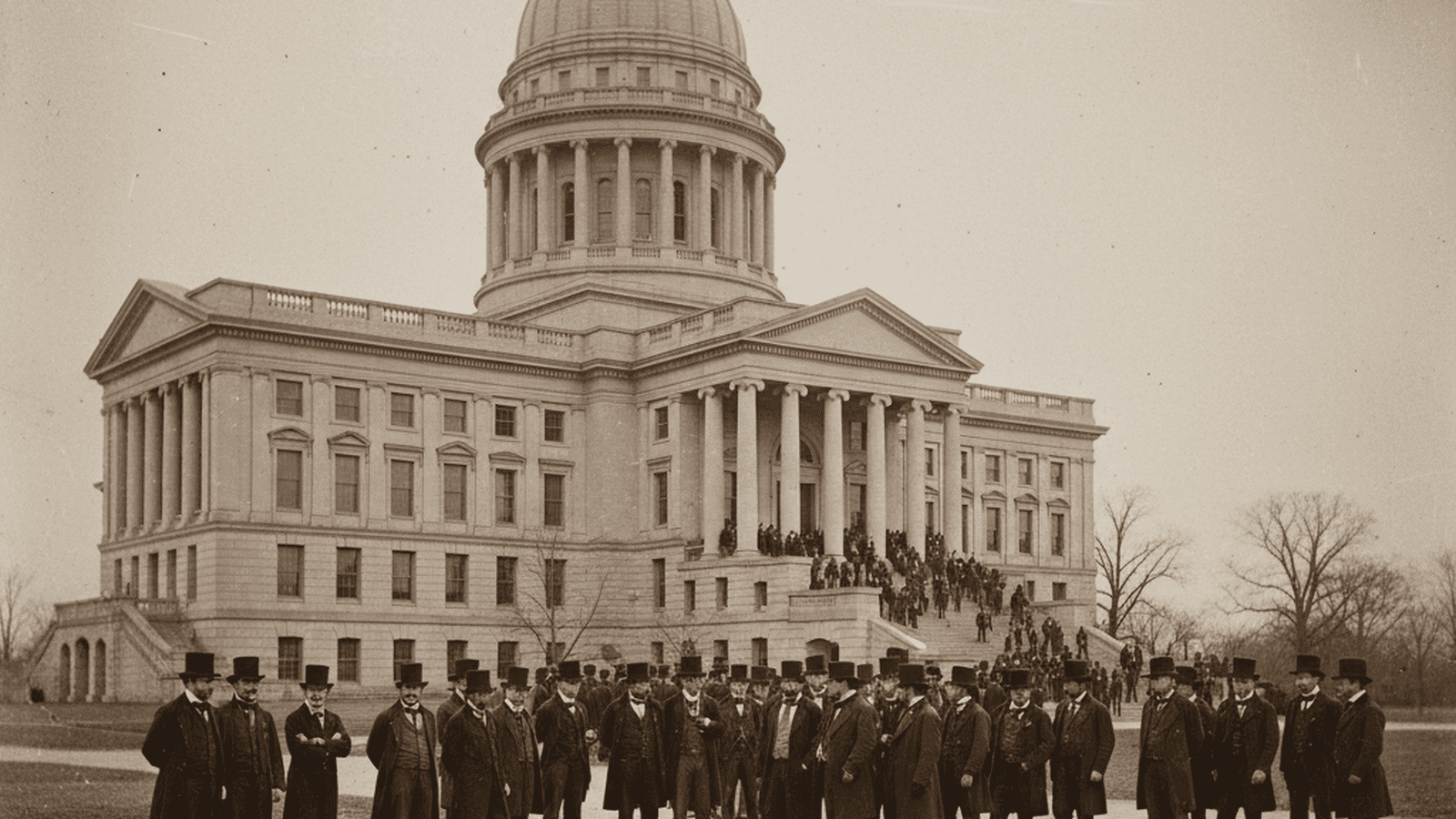
In 1841, Mississippi became the first U.S. state to formally repudiate its sovereign debt, citing corruption in the issuance of bonds for the Union Bank. This move, led by Governor Alexander McNutt, sparked a national debate over state credit and legislative oversight in the United States.
TLDR: Following the Panic of 1837, Mississippi Governor Alexander McNutt led a successful campaign to repudiate $5 million in state bonds. Citing illegalities and corruption in the Union Bank’s charter, the state’s refusal to pay international creditors reshaped American fiscal policy and state-level anti-corruption efforts for decades.
In the late 1830s, Mississippi was the epicenter of a speculative frenzy known as the “Flush Times.” High cotton prices and easy credit led to a massive expansion of the plantation economy, fueled by a proliferation of state-chartered banks. In 1838, the Mississippi Legislature chartered the Union Bank, authorizing 15.5 million dollars in state bonds to provide capital. This institution was designed to be the crown jewel of the state’s financial system, intended to provide low-interest loans to planters. However, the bank’s foundation was shaky from the start, as it became a vehicle for political patronage and reckless lending.
The Panic of 1837 soon brought this era of easy money to a crashing halt. As cotton prices plummeted and banks across the nation suspended specie payments, the Union Bank’s mismanagement became impossible to ignore. Governor Alexander McNutt, a complex figure who had initially supported the bank but turned into its fiercest critic, began an anti-corruption crusade. McNutt focused on the “Supplemental Act” passed in 1838, which allowed the state to subscribe for shares immediately rather than waiting for private subscriptions. He argued that because this act had not been passed by two successive sessions of the legislature—a constitutional requirement for state debt—the resulting 5 million dollars in bonds were null and void.
McNutt’s arguments were not merely technical; they were deeply moralistic. He accused the bank’s directors and the agents of Nicholas Biddle’s Bank of the United States of conspiring to defraud the people of Mississippi. The bonds had been sold to Biddle on credit and at a discount, which McNutt claimed violated the charter’s requirement that they be sold at par value for cash. To McNutt and his supporters, the bondholders were not innocent investors but “shylocks” and “stockjobbers” who had knowingly participated in an illegal transaction. This rhetoric resonated with a public struggling under the weight of a collapsed economy and high taxes.
The political battle reached a fever pitch during the 1841 elections. The Democratic Party, adopting a hardline “anti-bond” stance, framed the issue as a choice between the sovereignty of the people and the greed of foreign and domestic capitalists. The Whig Party, conversely, argued that repudiation would be a stain on the state’s honor and would lead to permanent financial ruin. They insisted that the state was legally and morally bound to honor its signatures. Despite these warnings, the voters of Mississippi, feeling betrayed by the banking elite, delivered a decisive victory to the repudiationist candidates.
Following the election, the legislature formally repudiated the 5 million dollars in Union Bank bonds. The international reaction was swift and severe. British investors, who held a significant portion of the debt, were outraged. The London Times and major banking houses like Baring Brothers denounced Mississippi as a “rogue state.” This move effectively blacklisted Mississippi from international capital markets for decades. The state’s credit rating vanished, and the “Mississippi stain” became a cautionary tale for European investors considering American state securities.
The legal saga continued for years. In the 1853 case of State of Mississippi v. Johnson, the state’s own High Court of Errors and Appeals ruled that the bonds were indeed a valid legal obligation. However, the legislature, backed by public sentiment, refused to appropriate a single cent for repayment. The defiance was eventually codified; in the post-Reconstruction Constitution of 1875, an amendment was added specifically prohibiting the payment of the Union Bank and Planters’ Bank bonds. This episode fundamentally reshaped American fiscal policy, leading many states to adopt strict constitutional limits on the issuance of debt to prevent similar crises of corruption and default.

Dylan Brooks serves as the Senior Correspondent for Statehouses and Local Governance at Just Right News, where he brings a principled, constitutionalist lens to the often-overlooked machinery of state-level politics. As the lead voice behind the acclaimed feature series “Fifty Laboratories of Power,” Dylan has dedicated his career to the idea that the most impactful governance happens closest to home. His reporting consistently champions the Tenth Amendment, exploring how individual states can serve as testing grounds for innovative, conservative policy solutions that prioritize personal liberty and fiscal responsibility.
A native of Des Moines, Iowa, Dylan’s journalistic philosophy was forged in the heart of the American Midwest. Growing up in a community where local school board meetings and town halls were the bedrock of civic life, he developed a deep appreciation for the “retail politics” of the heartland. This upbringing instilled in him a fundamental belief that the American experiment is best preserved when power is decentralized. He carries the values of his Iowa roots into every assignment, maintaining a healthy skepticism of federal overreach and a steadfast commitment to the concerns of everyday citizens over the interests of the administrative state.
Now based in Madison, Wisconsin, Dylan operates from one of the nation’s most pivotal political battlegrounds. His location in a state capital known for its rigorous policy debates allows him to provide Just Right News readers with a front-row seat to the legislative process. From Madison, he tracks the ripple effects of statehouse decisions on local municipalities, ensuring that the connection between high-level policy and community impact is never lost. His work often highlights the success of conservative governors and legislatures in fostering economic growth, protecting parental rights, and securing the integrity of local institutions.
As an African American man in the conservative media landscape, Dylan offers a vital perspective on how limited government and free-market principles empower individuals and families. He frequently reports on how deregulation and school choice initiatives provide new avenues for success in underserved communities, challenging the monolithic narratives often presented by legacy media outlets. Dylan’s work is characterized by a commitment to the facts and a refusal to shy away from the complex realities of modern governance.
Throughout his tenure at Just Right News, Dylan has become a trusted authority for readers who value a rigorous, principled approach to the news. Whether he is dissecting a complex state budget or profiling a local grassroots movement, his goal remains the same: to provide the American public with the information they need to hold their local leaders accountable. By focusing on the “Fifty Laboratories of Power,” Dylan Brooks ensures that the vital work being done in statehouses across the country receives the national attention it deserves, always through a lens that respects the traditions and sovereignty of the American people.