

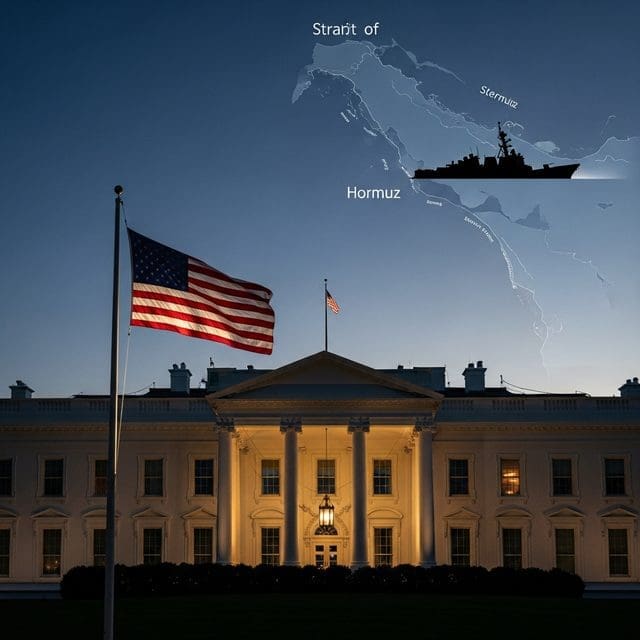
President Trump reversed a controversial shipping fee in the Strait of Hormuz while formally notifying Congress that the United States is once again at war with Iran.
President Donald Trump has abruptly rescinded a previously announced 20 percent toll on cargo transiting the Strait of Hormuz, pivoting toward a strategy of bilateral trade and investment agreements with Gulf states. The reversal, confirmed during a White House media availability between July 14 and 15, follows what the President described as significant pressure from international leaders, kings, and emirs. The proposed fee, which was intended to reimburse the United States for serving as the waterway’s self-appointed ‘guardian,’ had drawn sharp criticism from global markets and diplomatic allies who viewed the toll as an unprecedented disruption to maritime law.
Despite this economic pivot, the military posture toward Tehran has reached its highest level of intensity since the ceasefire collapsed. The White House formally notified Congress that the United States is once again at war with Iran, effectively restarting the 60-day clock under the War Powers framework. This notification follows three consecutive days of U.S. Central Command airstrikes, which utilized seaborne drones for the first time in combat operations to target the Bandar Abbas Naval Base and other strategic locations. The administration has also reimposed a full naval blockade of Iranian ports, threatening to target power plants and bridges next week if Tehran refuses to return to the negotiating table.
On Capitol Hill, the sudden shift in foreign policy arrives as lawmakers grapple with a significant leadership vacuum following the death of Senator Lindsey Graham. As a primary liaison between the executive branch and Senate Republicans, Graham’s absence complicates the administration’s ability to coordinate on war powers oversight and defense appropriations. While his sister, Darline Graham Nordone, has been appointed to serve the remainder of his term, the loss of Graham’s veteran influence leaves the GOP caucus without its most effective conduit to the Oval Office during a period of active hostilities.
While the House moved forward with domestic measures this week—including a 308-117 vote to pass the Sunshine Protection Act of 2025 to make daylight saving time permanent—the formal war notification ensures that the constitutional debate over executive war-making authority will dominate the legislative calendar. The President has already signaled further escalation, mentioning potential strikes on the ‘Pickaxe Mountain’ nuclear site during a recent radio appearance. This rhetoric has placed the Pentagon and Congress on a collision course regarding the Authorization for Use of Military Force, as the 60-day window for congressional approval is now legally ticking.
Further complicating the administration’s domestic standing, a federal judge recently voided a $1.776 billion IRS settlement involving the President, citing collusion between the executive and the Department of Justice. Acting Attorney General Todd Blanche characterized the fund as a ‘mistake’ in communications with the Senate Judiciary Committee, a rare admission of administrative error. Additionally, the President faces continued legal pressure from a $5.8 million damages order related to the E. Jean Carroll verdict, and a Wisconsin elections panel’s finding that associate Elon Musk likely violated bribery laws during a state Supreme Court election.
These legal and legislative hurdles set a tense backdrop for the President’s scheduled national address at 9 p.m. ET on Thursday, July 16, 2026. While the White House has not yet disclosed the specific topic of the speech, observers expect a focus on the rules of engagement for the renewed conflict and the impact of the blockade on global energy security. With Iran-linked vessels still attempting to transit the Strait ahead of full blockade enforcement, the address will likely serve as the definitive statement on whether the U.S. intends to pursue a total maritime shutdown or a negotiated de-escalation through its new Gulf trade strategy.

Miles Harrington serves as the Senior Correspondent for Federal Systems & Executive Power at Just Right News, where he brings a disciplined, constitutionalist lens to the inner workings of the American government. With a focus on the mechanics of the federal bureaucracy and the limits of executive authority, Harrington has established himself as a vital voice for readers who value transparency, accountability, and the preservation of the separation of powers.
A native of Richmond, Virginia, Harrington’s perspective is deeply rooted in the traditions of the Old Dominion. Growing up in a city defined by its historical significance and its role as a center of American jurisprudence, he developed an early appreciation for the foundational principles of the Republic. His upbringing in Richmond—a place where the legacy of the Founding Fathers is woven into the landscape—instilled in him a belief that the federal government should remain within its constitutional bounds. This background informs his skepticism of centralized overreach and his commitment to reporting on the ways in which the administrative state impacts the lives of everyday citizens.
In his current role, Harrington specializes in the complexities of federal systems. He doesn’t just report on the headlines of the day; he digs into the structural shifts within the executive branch that often go unnoticed by the mainstream press. Whether he is analyzing the implications of a new federal regulation or investigating the expansion of agency jurisdiction, his work is characterized by a rigorous adherence to the facts and a dedication to the rule of law.
Harrington is perhaps best known for his signature feature series, “How Washington Works.” Through this ongoing project, he demystifies the often-opaque processes of the nation’s capital, pulling back the curtain on the “Deep State” and the unelected officials who wield significant influence over national policy. By breaking down complex legislative maneuvers and executive orders, he empowers Just Right News readers to understand the true levers of power in Washington. His reporting serves as a necessary check on the federal government, ensuring that the actions of those in power are held up to the light of public scrutiny.
Now based in Washington, D.C., Harrington operates at the epicenter of the political world, yet he remains intentionally distanced from the “Beltway bubble.” His proximity to the halls of power allows him to maintain a robust network of sources across the federal landscape, but his heart remains in the principled conservatism of his Virginia roots. He views his role not merely as a reporter, but as a steward of the public trust, dedicated to providing the clarity and context that conservative voters need to navigate an increasingly complex political environment.
Through his sharp analysis and unwavering commitment to the truth, Miles Harrington continues to be a cornerstone of the Just Right News team. His work ensures that the principles of limited government and executive restraint remain at the forefront of the national conversation, providing a crucial service to those who believe in a government that is truly of, by, and for the people.