

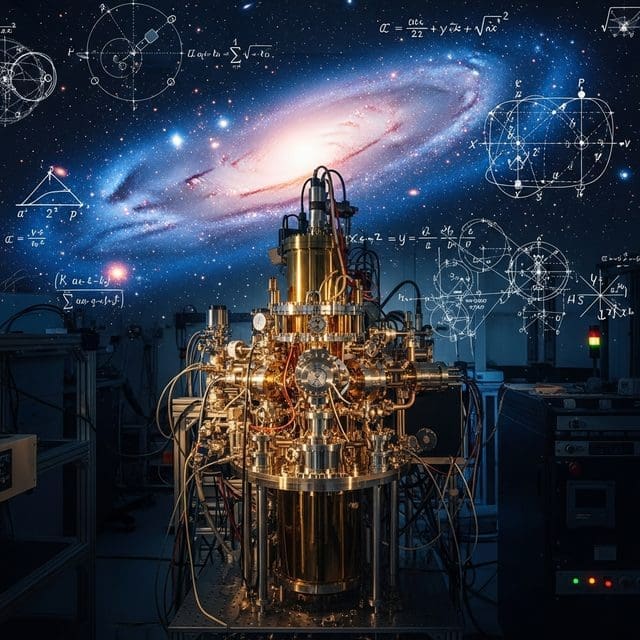
Physicists have successfully reformulated quantum mechanics without imaginary numbers and upgraded Stephen Hawking’s black hole laws, marking a major week for fundamental science and American-led cosmological research.
The bedrock of modern physics is undergoing a profound renovation as researchers challenge long-held assumptions about the mathematical nature of reality and the thermodynamic life of black holes. This week, a significant breakthrough from Heinrich Heine University Düsseldorf and the German Aerospace Center has upended the traditional view of the quantum world. For nearly a century, the imaginary unit ‘i’ was considered an indispensable component of the Schrödinger equation. However, new findings published in Physical Review Letters demonstrate that quantum mechanics can be formulated entirely with real numbers while remaining experimentally indistinguishable from standard theory. This shift is not merely academic; by removing the requirement for complex-number mathematics, engineers may find more efficient paths to designing quantum algorithms and securing decentralized digital infrastructure.
While quantum theorists are simplifying the math of the microscopic, astrophysicists are finally tackling the complexity of the macroscopic. For decades, Stephen Hawking’s legendary laws of black hole thermodynamics were limited to idealized, perfectly steady models that did not reflect the chaotic nature of the actual cosmos. A new framework released this week has successfully upgraded these laws to account for real, evolving black holes—those that grow by consuming matter, merge with others, or evaporate over time. This upgrade allows scientists to better describe gravitational-wave events observed by detectors like LIGO, bringing us closer to a unified theory that respects both the laws of gravity and the principles of quantum mechanics without the contradictions of the past.
On the domestic front, the United States continues to assert its leadership in mapping the heavens and understanding the large-scale structure of the universe. An Argonne National Laboratory team has released a massive new catalog containing over 7,000 confirmed galaxy clusters, compiled from five years of South Pole Telescope data. This dataset provides a vital blueprint for investigating the mysteries of dark energy and dark matter. By observing how these massive clusters have evolved over billions of years, American researchers can test structure formation models with unprecedented precision, ensuring that our understanding of the cosmos remains grounded in empirical observation rather than bureaucratic conjecture. This catalog represents a monumental achievement in data-driven cosmology, offering a powerful new window into the evolution of the universe.
In the realm of condensed matter physics, the push for decentralized technological power received a boost from the development of a new superconducting diode. Created using two-dimensional oxide interface superconductors, this device allows for the precise control of electron flow, acting as a superconducting version of a standard electronic diode. Notably, the device can be ‘edited’ at the nanoscale using atomic force microscope lithography. This level of local patterning suggests a future where high-performance, energy-efficient quantum components can be manufactured and customized with extreme precision, potentially reducing reliance on centralized, high-heat silicon architectures. Furthermore, researchers have discovered that electric fields can boost heat conduction in ceramics by nearly 300%, leading to the creation of “programmable heat” materials that could revolutionize thermal management in advanced computing hardware.
Furthering the reach of quantum technology, researchers at the Institute of Science and Technology Austria have realized an autonomous method for distributed entanglement. By using a ‘quantum bath’ of correlated light particles, they have found a way to link quantum systems across distances without the need for constant external intervention. This development, alongside breakthroughs in using magnetic waves known as magnons as information carriers, points toward a future of robust, decentralized quantum networks. These advancements represent more than just academic milestones; they provide the tools necessary for the next generation of American innovation, ensuring that the frontier of technology remains a space for individual liberty and scientific truth. As the global edge computing market is projected to reach over $317 billion by 2031, these fundamental physics discoveries provide the essential hardware foundations for a future where data processing is localized, secure, and free from the constraints of legacy infrastructure.

Mason Reed serves as a Staff Writer for Just Right News, where he spearheads the Future Frontiers & Special Projects desk. In an era defined by rapid technological shifts and evolving social landscapes, Mason provides a steady, principled voice, examining the innovations of tomorrow through the lens of traditional American values. His work is most prominently featured in his signature series, “The Next Horizon,” where he explores the intersection of emerging technology, national sovereignty, and the preservation of individual liberty.
A native of San Diego, California, Mason’s worldview was shaped by the unique culture of his hometown. Growing up in a region defined by its strong military presence and its history of maritime industry, he developed a deep-seated respect for the institutions that provide national stability and the entrepreneurial spirit that drives the American economy. This upbringing instilled in him a belief that true progress is not found in discarding the past, but in building upon a foundation of proven principles. His reporting often reflects this San Diego influence, emphasizing the importance of a robust national defense and the necessity of maintaining a competitive edge in the global marketplace.
Now based in San Francisco, Mason operates from the heart of the world’s technological engine. Living and working in the Bay Area provides him with a front-row seat to the advancements—and the ideological challenges—emanating from Silicon Valley. While many in the region embrace a “move fast and break things” mentality, Mason’s reporting serves as a vital counterweight. He offers Just Right News readers a “boots on the ground” perspective, documenting how radical local policies and the concentration of tech power impact the everyday lives of citizens. His proximity to the industry allows him to cut through the marketing jargon of big tech to uncover the real-world implications for privacy, free speech, and the nuclear family.
In his “Future Frontiers” beat, Mason tackles complex subjects ranging from the ethics of artificial intelligence to the burgeoning private space race. He approaches these topics with a healthy skepticism toward centralized bureaucracy, championing instead the decentralized innovations that empower individuals. Through “The Next Horizon,” he highlights the pioneers and thinkers who are working to ensure that the future remains a place where human dignity and constitutional rights are protected. He believes that the rapid pace of change requires more than just technical expertise; it requires a moral compass rooted in the Western tradition.
Throughout his tenure at Just Right News, Mason has remained committed to the idea that the future is something to be shaped, not merely accepted. His writing is characterized by a rigorous defense of American exceptionalism and a belief that the country’s best days lie ahead, provided it remains true to its founding ideals. Whether he is investigating the impact of automation on the American workforce or profiling the next generation of aerospace engineers, Mason Reed ensures that his readers are equipped with the insights they need to navigate a changing world with confidence and clarity.