

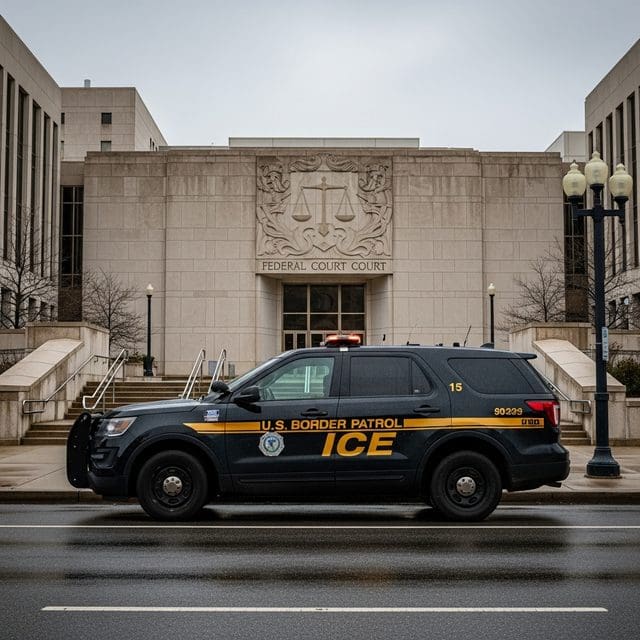
A fatal ICE shooting in Maine and ongoing federal court stays regarding asylum restrictions highlight the current friction between operational enforcement and the U.S. legal framework.
The landscape of American immigration enforcement and policy entered a volatile phase this week, marked by a fatal confrontation in New England and ongoing procedural battles in the federal judiciary. These developments arrive as the State Department formalizes its visa allocations for the remainder of the fiscal year, highlighting the persistent tension between administrative order and the realities of field enforcement. As the nation moves through the summer of 2026, the intersection of local stability and federal mandate remains under intense scrutiny.
In Biddeford, Maine, an enforcement operation by U.S. Immigration and Customs Enforcement (ICE) resulted in a fatal shooting on the morning of Monday, July 13. According to reports from the Department of Homeland Security, the incident occurred during a vehicle stop when the driver reportedly attempted to flee the scene. ICE officers discharged their weapons during the encounter, resulting in the man’s death. While the specific identity and immigration status of the individual have not been formally released, the event has drawn immediate attention to the risks inherent in interior enforcement operations and the protocols governing the use of force by federal agents in residential communities.
On the legal front, the D.C. Circuit Court of Appeals continues to grapple with the legacy of Trump-era border policies. Although the court moved in April 2026 to invalidate specific asylum restrictions at the southern border, that decision has not yet taken effect. A temporary stay remains in place, keeping the restrictive processing rules operative while the government pursues further proceedings. This judicial limbo is mirrored in the Ninth Circuit, where arguments scheduled for this week will address the expansion of expedited removal and other asylum limitations. Advocacy groups have filed numerous amicus briefs documenting the potential impacts of these procedural rules, yet the courts have maintained a cautious pace in altering the current enforcement posture.
For those navigating the legal immigration system, the State Department’s July 2026 Visa Bulletin provides a definitive framework for the months ahead. The agency has set the fiscal year limits at 226,000 family-sponsored and 140,000 employment-based immigrant visas. Adhering to the statutory 7% per-country cap, no more than 25,620 visas will be issued to any single nation. Additionally, the department noted that all DV-2026 diversity visas must be issued before the September 30 deadline, after which they expire. These figures represent the rigid ceiling of the American social contract, balancing the demand for labor and family reunification against the preservation of community character and resource management.
Status updates for the Deferred Action for Childhood Arrivals (DACA) program remain stagnant, leaving hundreds of thousands in a state of legal suspension. Current U.S. Citizenship and Immigration Services (USCIS) guidance confirms that while initial requests are being accepted, they are not being processed. This is due to a standing injunction from a Texas federal court and subsequent Fifth Circuit rulings that bar the granting of new DACA status. Renewals and work authorizations for existing recipients continue, maintaining a precarious status quo that has persisted for years without a legislative resolution.
Public sentiment regarding these policies appears nuanced and occasionally at odds with current enforcement trends. A July 14 global poll by Ipsos and the UNHCR indicates that approximately two-thirds of respondents across 29 countries, including the United States, support the principle of providing refuge to those fleeing war or persecution. However, the practical application of this support remains a point of contention as the U.S. court system weighs the legality of rapid removals against humanitarian obligations. The data suggests a public that favors the rule of law and border integrity, yet remains open to the plight of those genuinely displaced by global conflict.

Julie Harris serves as a Staff Writer for Just Right News, where she tackles some of the most pressing and complex issues facing the nation today. As the lead reporter for the Migration, Demographics & Cultural Shifts beat, Julie provides a grounded, principled perspective on how the movement of people and the changing makeup of communities are reshaping the American landscape. Her work is defined by a commitment to exploring the long-term consequences of social change, prioritizing the stability of local institutions and the preservation of national identity.
Her deep understanding of these issues is rooted in her upbringing in Tucson, Arizona. Growing up in a prominent border state, Julie witnessed firsthand the intricate realities of migration and the profound impact it has on local infrastructure, law enforcement, and the social fabric. This early exposure instilled in her a respect for the rule of law and a keen awareness of the challenges that arise when federal policies fail to align with the needs of border communities. Her reporting often reflects this lived experience, bringing a necessary level of nuance to topics that are often treated with abstraction in coastal newsrooms.
Now based in Santa Fe, New Mexico, Julie continues to report from the heart of the American Southwest. Her location provides a unique vantage point to observe the intersection of traditional regional cultures and the modern shifts brought about by both internal and external migration. In Santa Fe, a city defined by its rich history and distinct cultural heritage, she finds a perfect environment to explore how communities strive to maintain their character while navigating the pressures of a rapidly changing world. This perspective allows her to bridge the gap between policy debates in Washington and the reality of life in the high desert.
At Just Right News, Julie’s work is characterized by a dedication to examining the data and the human stories that define the “New Mosaic” of America. Her signature feature series, “The New Mosaic,” has become a cornerstone of her reporting. Through this series, Julie explores the evolving social architecture of the United States, documenting how shifts in population affect everything from local economies to the political landscape. She brings a critical eye to the narrative of demographic inevitability, instead asking how these shifts impact the average citizen’s sense of belonging and the integrity of the American social contract.
Julie’s background and her dedication to conservative principles make her a vital voice in contemporary journalism. She understands that demographics are more than just numbers on a spreadsheet; they represent the future of the American family and the nation’s enduring legacy. Through her diligent reporting and insightful analysis, Julie Harris ensures that her readers are informed about the forces shaping their world, providing a perspective that is as thoughtful as it is necessary for the modern era.