

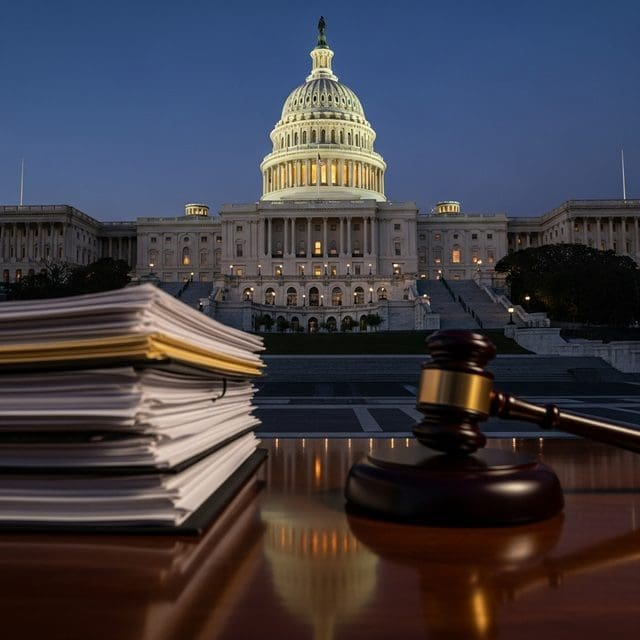
The Senate Parliamentarian ruled that a $1 billion White House security proposal violates reconciliation rules, forcing Republicans to redraft the measure or seek a 60-vote threshold.
The Senate’s non-partisan arbiter of procedural law has dealt a significant blow to the executive branch’s infrastructure ambitions. Senate Parliamentarian Elizabeth MacDonough ruled late Saturday that the $1 billion White House security package, embedded within a broader $72 billion immigration enforcement bill, violates the strictures of the Byrd Rule. This ruling effectively strips the provision of its protected status under the reconciliation process, which allows for passage by a simple majority, and subjects it to the standard 60-vote filibuster threshold. The decision marks a critical moment in the ongoing battle over the administrative state’s reach and the transparency of federal earmarks.
At the heart of the dispute is the scope and complexity of the proposed funding. While the Secret Service requested the capital following an attempted assassination incident during a media event this spring, the package includes roughly $220 million specifically earmarked for security surrounding a new East Wing ballroom. The remainder of the $1 billion was designated for campus-wide upgrades, including a new visitor screening center, additional training for agents, and reinforcements for large-scale events. MacDonough’s ruling suggests that such broad, multi-faceted projects do not meet the narrow fiscal requirements necessary to bypass the filibuster, as they lack a primary budgetary impact that is not merely incidental to the policy goals.
Senate Minority Leader Chuck Schumer and his caucus have seized upon the ruling as a victory for fiscal oversight and a check on executive overreach. Democrats have framed the expenditure as a “gilded palace” project being funded by taxpayers while the administration ignores cost-of-living pressures facing American families. Beyond the fiscal argument, Democrats raised jurisdictional objections, noting that the ballroom and East Wing security provisions were placed under the Judiciary Committee’s section of the bill. They argue this constitutes a committee-turf violation, as the project falls outside that committee’s specific reconciliation instructions, adding a procedural layer to their substantive challenge during the “Byrd bath” process.
Republicans, led by Senate Majority Leader John Thune, have signaled they are not abandoning the request. Ryan Wrasse, a spokesman for Thune, characterized the setback as a standard part of the complicated budget process, stating the GOP would “redraft, refine, and resubmit” the language. The White House maintains a clear distinction between the construction of the ballroom—which President Trump estimated at $400 million and claims is covered by private donations—and the $1 billion in federal dollars required for the Secret Service to secure the expanded footprint. Republicans insist these are much-needed security enhancements rather than a vanity project, pointing to the heightened threat environment following recent security breaches.
The procedural setback comes at a delicate time for the administration’s legislative agenda. The underlying $72 billion package is intended to fund Immigration and Customs Enforcement (ICE) and Customs and Border Protection (CBP) through the end of the President’s term in 2029. While the Parliamentarian left the majority of the immigration funding intact, she did block minor provisions including CBP funds for hiring and training agents, which Republicans dismissed as technical fixes. However, the disqualification of the security provision creates a political opening for Democrats to link the fight to a broader critique of GOP priorities, arguing that the majority is fast-tracking money for border agencies and ballrooms while ignoring direct relief for groceries and housing.
As the Senate prepares for the contentious “vote-a-rama” on the broader reconciliation package, the focus remains on whether Republicans can craft a narrower, more technically compliant version of the security funding. Even if the language is successfully reworked to satisfy the Parliamentarian, several GOP senators remain publicly undecided about supporting the $1 billion line item given the optics of the expenditure. Senator Jeff Merkley, the top Democrat on the Budget Committee, has already signaled that his party is prepared to challenge any revised language “every way we can” on the Senate floor. Without a unified Republican front or bipartisan support, the administration may find its plans for a modernized, high-security East Wing stalled by the very procedural rules designed to protect the Senate’s deliberative nature and the public trust.

Miles Harrington serves as the Senior Correspondent for Federal Systems & Executive Power at Just Right News, where he brings a disciplined, constitutionalist lens to the inner workings of the American government. With a focus on the mechanics of the federal bureaucracy and the limits of executive authority, Harrington has established himself as a vital voice for readers who value transparency, accountability, and the preservation of the separation of powers.
A native of Richmond, Virginia, Harrington’s perspective is deeply rooted in the traditions of the Old Dominion. Growing up in a city defined by its historical significance and its role as a center of American jurisprudence, he developed an early appreciation for the foundational principles of the Republic. His upbringing in Richmond—a place where the legacy of the Founding Fathers is woven into the landscape—instilled in him a belief that the federal government should remain within its constitutional bounds. This background informs his skepticism of centralized overreach and his commitment to reporting on the ways in which the administrative state impacts the lives of everyday citizens.
In his current role, Harrington specializes in the complexities of federal systems. He doesn’t just report on the headlines of the day; he digs into the structural shifts within the executive branch that often go unnoticed by the mainstream press. Whether he is analyzing the implications of a new federal regulation or investigating the expansion of agency jurisdiction, his work is characterized by a rigorous adherence to the facts and a dedication to the rule of law.
Harrington is perhaps best known for his signature feature series, “How Washington Works.” Through this ongoing project, he demystifies the often-opaque processes of the nation’s capital, pulling back the curtain on the “Deep State” and the unelected officials who wield significant influence over national policy. By breaking down complex legislative maneuvers and executive orders, he empowers Just Right News readers to understand the true levers of power in Washington. His reporting serves as a necessary check on the federal government, ensuring that the actions of those in power are held up to the light of public scrutiny.
Now based in Washington, D.C., Harrington operates at the epicenter of the political world, yet he remains intentionally distanced from the “Beltway bubble.” His proximity to the halls of power allows him to maintain a robust network of sources across the federal landscape, but his heart remains in the principled conservatism of his Virginia roots. He views his role not merely as a reporter, but as a steward of the public trust, dedicated to providing the clarity and context that conservative voters need to navigate an increasingly complex political environment.
Through his sharp analysis and unwavering commitment to the truth, Miles Harrington continues to be a cornerstone of the Just Right News team. His work ensures that the principles of limited government and executive restraint remain at the forefront of the national conversation, providing a crucial service to those who believe in a government that is truly of, by, and for the people.