

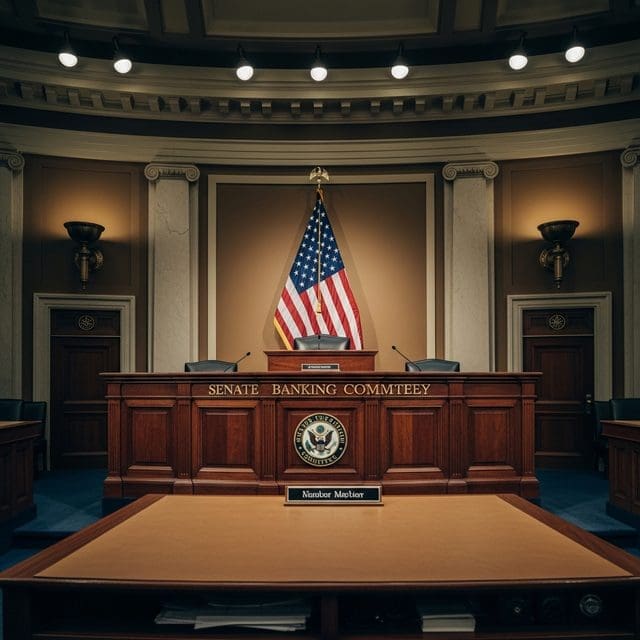
The Senate Banking Committee approved the Clarity Act, establishing a ‘mature blockchain’ test and a CFTC-led regulatory regime for digital assets despite intense opposition from the legacy banking lobby.
The American digital asset landscape reached a critical juncture this week as the Senate Banking Committee voted 15-9 to advance the Clarity Act. This legislative milestone represents a concerted effort to move blockchain infrastructure out of a regulatory gray zone and into a formalized framework that prioritizes American digital sovereignty. By establishing a ‘mature blockchain’ test, the bill provides a technical standard for when a protocol has achieved sufficient decentralization to be classified as a digital commodity rather than a security. This shift moves primary oversight from the SEC to the CFTC, a structural change necessary to foster a competitive innovation environment.
At the heart of the debate is the structural integrity of stablecoin protocols and their integration with the financial system. A compromise between Senators Thom Tillis and Angela Alsobrooks introduced a nuanced approach to stablecoin rewards. While banks retain exclusive rights to offer traditional interest-like returns on passive balances, the current draft allows for ‘activity-based’ rewards. This distinction is vital for developers focused on incentivizing protocol utility without mimicking the fractional reserve architecture of legacy banking. Market reaction was swift, with Circle investors cheering the news as shares jumped nearly 20% following the announcement.
However, the path to decentralized engineering remains fraught with institutional resistance. The American Bankers Association has launched an aggressive campaign against the compromise, sending more than 8,000 letters to Senate offices. They argue that the current language creates loopholes that allow crypto exchanges to mimic deposit accounts and undercut traditional lenders. This tension underscores a broader struggle between the incumbent financial elite and the emerging decentralized frontier. While industry leaders like Coinbase, Circle, and Ripple have rallied behind the bill to prevent the offshoring of American innovation, labor groups like the AFL-CIO warn of potential risks to financial stability.
Beyond stablecoin provisions, the legislation addresses the fundamental rights of noncustodial software developers. Protecting those who write and maintain open-source code is essential for ensuring that the United States remains the global leader in cryptographic advancement. Current negotiations are also focused on defining the limits of the SEC’s ‘innovation’ waivers and how decentralized finance (DeFi) protocols are treated under federal law. Senator Mark Warner, who described his recent work on the bill as ‘crypto purgatory,’ emphasized the need to refine the text to ensure bad actors are caught while still allowing the industry to reach a stable regulatory ‘heaven.’
National security and ethics remain significant points of contention as the bill moves toward a full Senate vote. Democratic lawmakers have signaled they will not support a final version that lacks stringent ethics provisions aimed at preventing government officials from profiting from digital asset holdings. This is particularly sensitive given President Trump’s involvement with World Liberty Financial. Meanwhile, the geopolitical stakes are rising. As the Trump administration maintains strategic ambiguity regarding Taiwan and navigates a worsening humanitarian crisis in Cuba, the need for a robust, independent American digital infrastructure has never been more apparent.
While the committee’s approval is a victory for the crypto industry, the road to enactment is long. The bill must still reconcile with a version passed by the House in July 2025 and overcome entrenched opposition in the Senate. For those focused on the long-term health of the Bitcoin protocol and the preservation of individual liberties through cryptography, the Clarity Act represents the first major step toward a legal framework that respects the unique nature of decentralized technology. Analysts warn that final enactment is unlikely before at least one more Congress due to the complexity of the ethics fights and banking opposition.

Ryan Mitchell serves as a Staff Writer for Just Right News, where he anchors the desk for Cyber, Technology Policy, and Digital Sovereignty. In an era where the digital landscape has become as much a battlefield as any physical territory, Ryan provides a critical conservative lens on the forces shaping the future of American innovation and national security. His work is defined by a commitment to the idea that American leadership in the digital age is not just a matter of economic success, but a necessity for the preservation of global liberty.
Born and raised in Austin, Texas, Ryan’s perspective is deeply rooted in the Lone Star State’s tradition of independence and skepticism of centralized authority. Growing up in a city that transformed from a quiet state capital into a global technology hub, he witnessed firsthand the disruptive power of the tech industry. This upbringing instilled in him a firm belief in free-market principles and the necessity of protecting individual liberties from both government overreach and corporate overstep. His Texan background serves as a foundational compass, guiding his reporting toward stories that emphasize national resilience and the preservation of constitutional values in an increasingly virtual world.
Now based in San Francisco, California, Ryan operates from the epicenter of the very industry he scrutinizes. Living and working in the heart of Silicon Valley allows him to provide “boots on the ground” reporting that few conservative journalists can match. He navigates the cultural and political complexities of the Bay Area to bring Just Right News readers an inside look at the boardrooms and coding labs where the next generation of digital policy is forged. For Ryan, being stationed in San Francisco is a strategic choice; it allows him to challenge the prevailing ideological monoculture of the tech elite from within their own backyard, ensuring that the concerns of middle America are represented in the conversation about our digital future.
His beat—Cyber, Technology Policy, and Digital Sovereignty—covers the high-stakes world of data privacy, artificial intelligence, and the infrastructure of the modern web. Ryan is particularly focused on the concept of digital sovereignty, arguing that for a nation to remain truly free, it must maintain control over its own technological destiny and critical infrastructure. He frequently explores how international regulations and domestic policies impact the ability of American firms to compete without sacrificing the privacy or security of their citizens.
Central to his current body of work is his featured series, “The New Cold War.” Through this project, Ryan examines the escalating technological rivalry between the United States and its global adversaries. He delves into the complexities of state-sponsored hacking, the global race for semiconductor dominance, and the ideological struggle to define the rules of the internet. Ryan views this competition not merely as a commercial race, but as a fundamental defense of Western values against authoritarian digital models. Through his rigorous reporting and principled analysis, Ryan Mitchell ensures that the readers of Just Right News stay informed about the invisible forces defining the 21st century, always advocating for a future where technology serves the cause of freedom.