

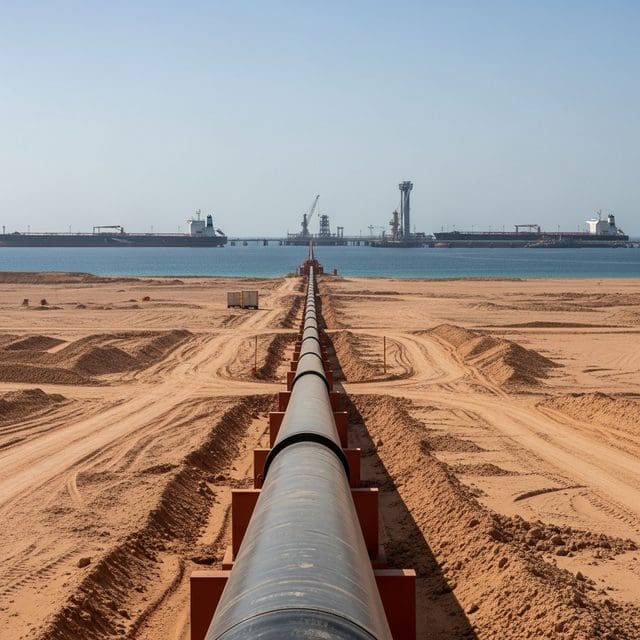
The UAE is fast-tracking a new pipeline to bypass the Strait of Hormuz, offering a market-driven solution to Iranian maritime threats while securing critical crude supplies for India.
The geopolitical chess match over the world’s most critical energy chokepoint has entered a new phase. The United Arab Emirates has ordered the Abu Dhabi National Oil Company (ADNOC) to fast-track a second West-East pipeline to Fujairah. This project aims to double the nation’s export capacity outside the Strait of Hormuz by 2027, systematically eroding Iran’s ability to hold global energy markets hostage. By routing crude directly to the Gulf of Oman, Abu Dhabi is positioning Fujairah as the primary hub for Asian energy security, bypassing the volatility of the narrow waterway entirely.
This infrastructure play comes as the Strait of Hormuz remains under an effective blockade, leaving approximately 50 India-bound oil and LPG vessels stranded. While diplomats in New Delhi use the BRICS summit to petition for safe passage, the UAE is pursuing a permanent engineering solution. The existing Habshan-Fujairah line already moves 1.8 million barrels per day; the new build-out will sit alongside it, creating a massive corridor that fundamentally alters Middle Eastern logistics. Analysts warn this strategy could permanently re-route a significant share of Gulf exports, shifting long-term pricing power and security partnerships toward UAE-aligned infrastructure hubs.
India has emerged as the primary beneficiary. New Delhi is deepening its interdependence with the UAE through new strategic reserves and long-term supply deals. For India, the 2026 BRICS chair, the UAE pipeline represents a vital hedge against supply shocks that have recently spiked fuel costs. Despite the ongoing crisis, the deepening New Delhi-Abu Dhabi hydrocarbon link demonstrates how market-oriented nations prioritize reliability over ideological alignment. While Russia and Iran use BRICS meetings to blame Western actions for regional instability, India has remained focused on the pragmatics of “safe and unimpeded” maritime flows.
The market’s reaction remains sensitive to broader trade dynamics. Oil prices rose on May 15 following signals from the Trump administration regarding increased pressure on Iran and a new agreement for China to purchase American oil. However, the broader economic picture is complicated by the conclusion of President Trump’s state visit to Beijing. While China agreed to purchase 200 Boeing jets, the figure fell short of the 500-aircraft expectation, contributing to a broader sell signal for the S&P 500. This shortfall, combined with the resignation of Federal Reserve Board member Stephen I. Miran, has injected fresh uncertainty into the American economic outlook even as energy markets scramble to adapt.
Domestically, the push for energy security faces different hurdles. Recent North American Electric Reliability Corporation (NERC) assessments highlight tension between policy-driven transitions and grid stability. As fossil fuel capacity fell by 21 GW over the last year, replaced by 23 GW of intermittent renewables, reliability margins have tightened. The lack of essential grid-stability services from many new solar and wind installations mirrors challenges seen in India and California, where oversupply leads to massive curtailment while the grid remains vulnerable during peak demand. California now faces springtime net-load swings of 24 GW in just eight hours, a volatility that mirrors the unpredictability of global oil transit routes.
The UAE’s pipeline strategy offers a clear lesson: reliability is a function of redundancy and physical infrastructure. While Western markets grapple with the technical integration of renewables and resulting price volatility, the Gulf is doubling down on hard infrastructure to ensure the flow of hydrocarbons remains unimpeded. This shift doesn’t just bypass a geographic chokepoint; it reconfigures the long-term pricing power of the global energy trade, ensuring that immediate economic needs are met through secure, market-driven alternatives.

Mark Davis serves as the Senior Correspondent for Energy, Climate, and Resource Economics at Just Right News. In an era where the conversation around the environment is often dominated by alarmism and top-down mandates, Mark provides a vital, market-oriented perspective on the complex forces shaping our world. As the lead voice behind the acclaimed feature series “Power and the Planet,” he explores the intersection of environmental policy, global energy markets, and the fundamental economic principles that sustain modern civilization.
Mark’s pragmatic approach to resource management was forged in the high desert of his hometown, Albuquerque, New Mexico. Growing up in a region defined by both its breathtaking natural beauty and its rugged, resource-dependent landscape, he developed an early appreciation for the delicate balance between conservation and utilization. New Mexico’s unique position as a hub for both traditional energy production and cutting-edge scientific research provided Mark with a front-row seat to the evolution of the American energy sector. This upbringing instilled in him a deep-seated belief that true environmental stewardship is inseparable from economic prosperity and technological innovation.
Now based in Boulder, Colorado, Mark operates from the heart of the nation’s climate research community. While Boulder is often seen as a bastion of environmental idealism, Mark utilizes his post to provide a necessary counterweight, grounded in the realities of resource economics. He understands that energy policy does not exist in a vacuum; it has tangible consequences for the American taxpayer, the stability of the national power grid, and the strength of the domestic manufacturing sector. By reporting from the front lines of the climate debate, he is able to challenge prevailing narratives with hard data and a commitment to the principles of the free market.
Throughout his tenure at Just Right News, Mark has distinguished himself by focusing on the “Resource Economics” aspect of his beat. He frequently highlights the hidden costs of rapid energy transitions and advocates for an “all-of-the-above” energy strategy that prioritizes American energy independence. His work often shines a light on the geopolitical implications of resource scarcity, arguing that a secure nation must first be an energy-secure nation. Whether he is analyzing the impact of federal land-use regulations or investigating the supply chains required for new technologies, Mark remains focused on how policy decisions affect the lives and livelihoods of everyday citizens.
In “Power and the Planet,” Mark continues to bridge the gap between complex scientific concepts and the economic realities facing the country. He rejects the false choice between a healthy environment and a thriving economy, instead seeking out solutions that leverage American ingenuity and private-sector competition. For Mark, reporting on the climate is not about following the latest trends, but about ensuring that the conversation remains tethered to the foundational values of liberty, property rights, and fiscal responsibility. His contributions ensure that Just Right News readers receive a comprehensive, clear-eyed view of the challenges and opportunities defining the future of our planet.