

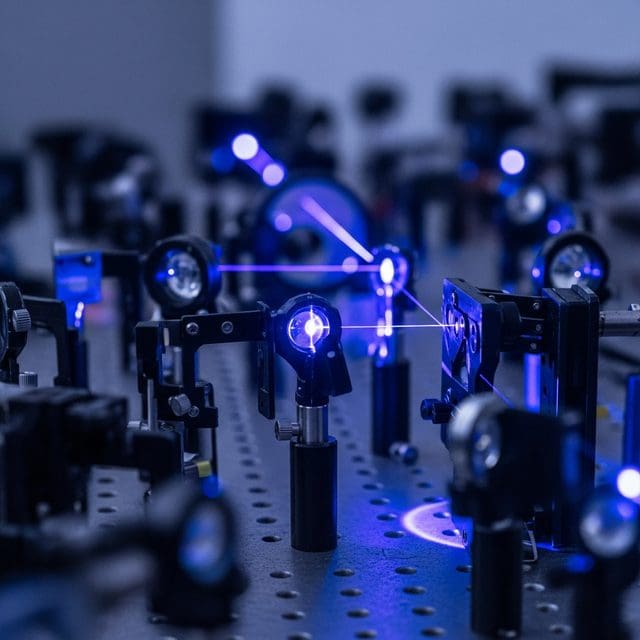
Scientists at Kyoto and Hiroshima Universities have developed a photonic circuit capable of measuring elusive W states, closing a 25-year gap in quantum control and advancing secure teleportation networks.
A long-standing bottleneck in the race for a functional quantum internet has been cleared by a research team in Japan. Led by Shigeki Takeuchi of Kyoto University, in collaboration with Hiroshima University, scientists have experimentally realized an entangled measurement for the three-photon “W state.” This achievement provides a vital missing piece for quantum communication, offering a way to identify complex multiparticle links that were previously impossible to detect without destroying the information they carried.
Entanglement is the phenomenon where particles become so deeply linked that the state of one cannot be described independently of the others. While scientists have long been able to measure the Greenberger-Horne-Zeilinger (GHZ) state—a type of entanglement that is highly fragile—the W state remained elusive. Unlike its counterparts, the W state is remarkably robust; if one particle in the group is lost, the remaining particles stay entangled. This resilience makes it the ideal candidate for real-world quantum networks where signal loss is a constant threat, yet researchers lacked a direct way to “read” these states in a single shot.
The team’s success, published in Science Advances, utilized a discrete Fourier transform photonic circuit to achieve a discrimination fidelity of 0.871. By exploiting a special feature known as cyclic shift symmetry, the researchers proposed a circuit that performs a quantum Fourier transformation for W states with any number of photons. In practical terms, this turned the hidden structure of the W state into a measurable signal, allowing the device to distinguish different kinds of three-photon correlations.
This development comes at a pivotal moment for global quantum competition. As the University of Science and Technology of China recently deployed a multi-mode quantum relay network over 14.5 kilometers, the Japanese breakthrough provides the necessary readout tools to handle more complex data structures. The Kyoto device proved exceptionally stable, running for extended periods without active control. This stability signals a shift toward rugged, deployable hardware that can function in real-world environments rather than delicate laboratory settings.
To test the validity of their method, the researchers inserted three single photons into the device in carefully chosen polarization states. The device identified the specific entangled state of the photons with high accuracy. This capability is essential for quantum teleportation, which involves transferring quantum information rather than moving physical matter. By perfecting the measurement of W states, the researchers are enabling a more reliable form of teleportation that can survive the photon loss inherent in long-distance fiber optic cables.
For the American observer, these advancements underscore a shift toward decentralized, secure innovation. While centralized bureaucracies struggle with the rapid pace of emerging tech, the ability to teleport quantum information across lossy channels ensures that individual privacy can be protected through unhackable communication. The researchers now plan to scale this method to larger multi-photon states and integrate the technology into compact, on-chip photonic circuits, making these measurements faster and more practical for commercial use.
As quantum geometry and ultra-sensitive energy measurements expand the toolkit of modern physics, the ability to reliably measure W states ensures that the next generation of computing will be built on a foundation of stable entanglement. This discovery effectively closes a quarter-century gap in quantum control, providing the essential primitives for the future of the digital frontier and ensuring that the strange properties of the quantum world can finally be harnessed for a free and connected society.

Mason Reed serves as a Staff Writer for Just Right News, where he spearheads the Future Frontiers & Special Projects desk. In an era defined by rapid technological shifts and evolving social landscapes, Mason provides a steady, principled voice, examining the innovations of tomorrow through the lens of traditional American values. His work is most prominently featured in his signature series, “The Next Horizon,” where he explores the intersection of emerging technology, national sovereignty, and the preservation of individual liberty.
A native of San Diego, California, Mason’s worldview was shaped by the unique culture of his hometown. Growing up in a region defined by its strong military presence and its history of maritime industry, he developed a deep-seated respect for the institutions that provide national stability and the entrepreneurial spirit that drives the American economy. This upbringing instilled in him a belief that true progress is not found in discarding the past, but in building upon a foundation of proven principles. His reporting often reflects this San Diego influence, emphasizing the importance of a robust national defense and the necessity of maintaining a competitive edge in the global marketplace.
Now based in San Francisco, Mason operates from the heart of the world’s technological engine. Living and working in the Bay Area provides him with a front-row seat to the advancements—and the ideological challenges—emanating from Silicon Valley. While many in the region embrace a “move fast and break things” mentality, Mason’s reporting serves as a vital counterweight. He offers Just Right News readers a “boots on the ground” perspective, documenting how radical local policies and the concentration of tech power impact the everyday lives of citizens. His proximity to the industry allows him to cut through the marketing jargon of big tech to uncover the real-world implications for privacy, free speech, and the nuclear family.
In his “Future Frontiers” beat, Mason tackles complex subjects ranging from the ethics of artificial intelligence to the burgeoning private space race. He approaches these topics with a healthy skepticism toward centralized bureaucracy, championing instead the decentralized innovations that empower individuals. Through “The Next Horizon,” he highlights the pioneers and thinkers who are working to ensure that the future remains a place where human dignity and constitutional rights are protected. He believes that the rapid pace of change requires more than just technical expertise; it requires a moral compass rooted in the Western tradition.
Throughout his tenure at Just Right News, Mason has remained committed to the idea that the future is something to be shaped, not merely accepted. His writing is characterized by a rigorous defense of American exceptionalism and a belief that the country’s best days lie ahead, provided it remains true to its founding ideals. Whether he is investigating the impact of automation on the American workforce or profiling the next generation of aerospace engineers, Mason Reed ensures that his readers are equipped with the insights they need to navigate a changing world with confidence and clarity.