

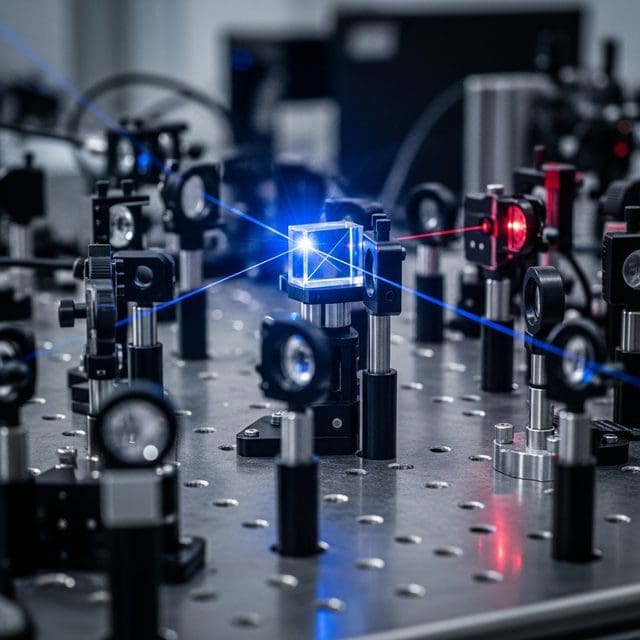
Scientists at Kyoto and Hiroshima Universities have demonstrated a stable method for identifying elusive three-photon W states, a breakthrough that could secure future quantum communication and decentralized computing networks.
The quest for a secure, decentralized quantum internet reached a significant milestone as researchers in Japan demonstrated a method to instantly verify one of the most elusive forms of quantum entanglement. A team from Kyoto University and Hiroshima University has cracked the code on the “W state,” a multi-particle link that has baffled physicists for over a quarter-century. While entanglement famously troubled Albert Einstein, today it serves as the essential architecture for a future where data privacy is protected by the laws of physics rather than centralized bureaucracy.
Quantum entanglement describes a situation in which particles, such as photons, are so deeply linked that their properties cannot be understood individually. To build next-generation quantum computers and secure networks, scientists must do more than create these states; they must possess reliable ways to identify them. This is where the W state became a bottleneck. Unlike the simpler Greenberger-Horne-Zeilinger (GHZ) state mastered decades ago, the W state is notoriously difficult to read in a single shot.
Traditionally, scientists relied on quantum tomography to estimate these states. However, tomography is a grueling process where the number of measurements grows explosively as more photons are added. For a nation looking to scale infrastructure, such a slow method is a non-starter. The breakthrough from Japan, led by Shigeki Takeuchi, introduces an “entangled measurement” that identifies W states in a single shot, bypassing the measurement bottleneck that has stalled progress since the late 1990s.
The team’s success hinged on a property known as cyclic shift symmetry. By exploiting this, they designed a photonic quantum circuit that performs a quantum Fourier transformation. This allows the device to translate the hidden correlations of the W state into a measurable signal. In their demonstration, researchers inserted three single photons into a stable optical circuit. The device successfully distinguished between different three-photon W states, achieving a fidelity of 0.871—a high degree of accuracy proving the method’s viability for real-world applications.
What makes this discovery relevant to the practical deployment of technology is the stability of the hardware. The team built a device that operated for extended periods without active control or constant manual recalibration. In the world of emerging tech, where fragile laboratory setups often fail outside sterile environments, this level of mechanical stability is a prerequisite for any technology intended to support private enterprise. The researchers are now looking to scale this method to larger multi-photon states and shrink the apparatus onto on-chip photonic circuits.
This achievement follows a series of rapid-fire developments this May, including the University of Science and Technology of China’s deployment of a 14.5-kilometer quantum relay network and Columbia University’s observation of coherent ferrons for telecom. As the global race for quantum supremacy intensifies, the ability to rapidly verify and teleport quantum information becomes a matter of sovereign importance. By mastering the W state, these researchers have provided a new toolkit for measurement-based quantum computing, ensuring that the future of information remains decentralized and rooted in verifiable physical reality.

Mason Reed serves as a Staff Writer for Just Right News, where he spearheads the Future Frontiers & Special Projects desk. In an era defined by rapid technological shifts and evolving social landscapes, Mason provides a steady, principled voice, examining the innovations of tomorrow through the lens of traditional American values. His work is most prominently featured in his signature series, “The Next Horizon,” where he explores the intersection of emerging technology, national sovereignty, and the preservation of individual liberty.
A native of San Diego, California, Mason’s worldview was shaped by the unique culture of his hometown. Growing up in a region defined by its strong military presence and its history of maritime industry, he developed a deep-seated respect for the institutions that provide national stability and the entrepreneurial spirit that drives the American economy. This upbringing instilled in him a belief that true progress is not found in discarding the past, but in building upon a foundation of proven principles. His reporting often reflects this San Diego influence, emphasizing the importance of a robust national defense and the necessity of maintaining a competitive edge in the global marketplace.
Now based in San Francisco, Mason operates from the heart of the world’s technological engine. Living and working in the Bay Area provides him with a front-row seat to the advancements—and the ideological challenges—emanating from Silicon Valley. While many in the region embrace a “move fast and break things” mentality, Mason’s reporting serves as a vital counterweight. He offers Just Right News readers a “boots on the ground” perspective, documenting how radical local policies and the concentration of tech power impact the everyday lives of citizens. His proximity to the industry allows him to cut through the marketing jargon of big tech to uncover the real-world implications for privacy, free speech, and the nuclear family.
In his “Future Frontiers” beat, Mason tackles complex subjects ranging from the ethics of artificial intelligence to the burgeoning private space race. He approaches these topics with a healthy skepticism toward centralized bureaucracy, championing instead the decentralized innovations that empower individuals. Through “The Next Horizon,” he highlights the pioneers and thinkers who are working to ensure that the future remains a place where human dignity and constitutional rights are protected. He believes that the rapid pace of change requires more than just technical expertise; it requires a moral compass rooted in the Western tradition.
Throughout his tenure at Just Right News, Mason has remained committed to the idea that the future is something to be shaped, not merely accepted. His writing is characterized by a rigorous defense of American exceptionalism and a belief that the country’s best days lie ahead, provided it remains true to its founding ideals. Whether he is investigating the impact of automation on the American workforce or profiling the next generation of aerospace engineers, Mason Reed ensures that his readers are equipped with the insights they need to navigate a changing world with confidence and clarity.