

Researchers at OIST and the University of Oklahoma have discovered that one-dimensional systems can support ‘anyons,’ strange particles that bridge the gap between matter and force-carrying particles.
For decades, the scientific community has accepted a binary view of the subatomic world. Every known particle was categorized as either a boson, which carries forces like light, or a fermion, the building blocks of matter like electrons and protons. However, new research published in Physical Review A suggests this fundamental divide is not as absolute as once believed.
Physicists from the Okinawa Institute of Science and Technology (OIST) and the University of Oklahoma have identified a third category of particle behavior in one-dimensional systems. These particles, known as anyons, exist in a state between the two traditional families. While anyons were observed in two-dimensional semiconductors in 2020, this latest work by Professor Thomas Busch and Dr. Doerte Blume demonstrates that they can also exist in one dimension, where their properties become uniquely adjustable.
The distinction between traditional particles relies on how they behave when they swap places. In our three-dimensional reality, swapping two identical particles either leaves the system unchanged or flips its mathematical sign. In the restricted geometry of one dimension, however, particles cannot simply move around each other; they must pass through one another. This constraint allows for an ‘exchange factor’ that can be tuned across a continuous range, rather than being stuck at the fixed values of plus or minus one.
This tunability is what excites researchers. By adjusting the strength of short-range interactions between particles, scientists believe they can control the very nature of the quantum statistics involved. This suggests a future where quantum behavior is not just a fixed law of nature to be observed, but a variable that can be engineered for specific outcomes. The ability to manipulate these ‘exchange statistics’ means that researchers are no longer limited by the rigid categories that have defined physics since the mid-20th century.
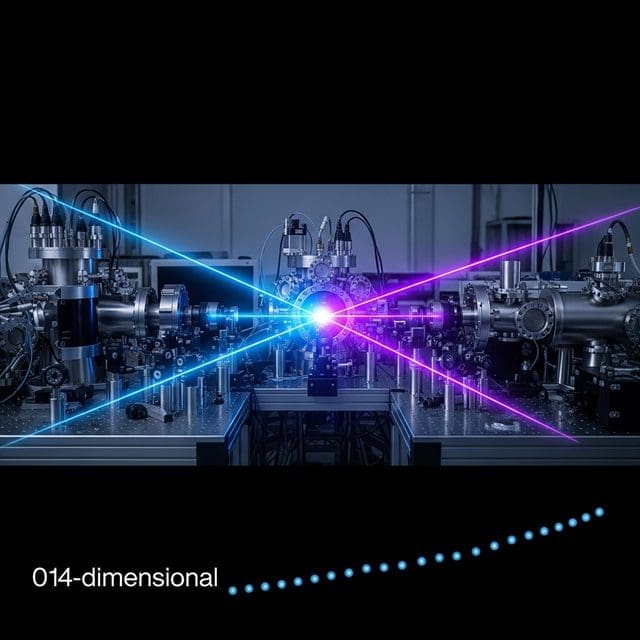
According to the research team, the experimental setups required to test these theories already exist in the form of ultracold atomic systems. By cooling atoms to near absolute zero, physicists can simulate these one-dimensional environments and observe the momentum distribution of anyons. This provides a practical path to verifying the theoretical models and potentially unlocking new methods for decentralized quantum innovation. The researchers emphasize that these observations can be made through the ‘momentum tail’ of the particles, a measurable signature that confirms their identity.
While the discovery remains within the realm of high-level physics, it challenges the centralized assumptions of how the universe is constructed. If the fundamental rules governing particles are more flexible than previously thought, the potential for new technologies that respect the laws of physics while pushing their boundaries is significant. The next step for the international team is to move from theoretical mapping to laboratory confirmation, potentially opening a new frontier in how we understand the building blocks of the physical world.

Mason Reed serves as a Staff Writer for Just Right News, where he spearheads the Future Frontiers & Special Projects desk. In an era defined by rapid technological shifts and evolving social landscapes, Mason provides a steady, principled voice, examining the innovations of tomorrow through the lens of traditional American values. His work is most prominently featured in his signature series, “The Next Horizon,” where he explores the intersection of emerging technology, national sovereignty, and the preservation of individual liberty.
A native of San Diego, California, Mason’s worldview was shaped by the unique culture of his hometown. Growing up in a region defined by its strong military presence and its history of maritime industry, he developed a deep-seated respect for the institutions that provide national stability and the entrepreneurial spirit that drives the American economy. This upbringing instilled in him a belief that true progress is not found in discarding the past, but in building upon a foundation of proven principles. His reporting often reflects this San Diego influence, emphasizing the importance of a robust national defense and the necessity of maintaining a competitive edge in the global marketplace.
Now based in San Francisco, Mason operates from the heart of the world’s technological engine. Living and working in the Bay Area provides him with a front-row seat to the advancements—and the ideological challenges—emanating from Silicon Valley. While many in the region embrace a “move fast and break things” mentality, Mason’s reporting serves as a vital counterweight. He offers Just Right News readers a “boots on the ground” perspective, documenting how radical local policies and the concentration of tech power impact the everyday lives of citizens. His proximity to the industry allows him to cut through the marketing jargon of big tech to uncover the real-world implications for privacy, free speech, and the nuclear family.
In his “Future Frontiers” beat, Mason tackles complex subjects ranging from the ethics of artificial intelligence to the burgeoning private space race. He approaches these topics with a healthy skepticism toward centralized bureaucracy, championing instead the decentralized innovations that empower individuals. Through “The Next Horizon,” he highlights the pioneers and thinkers who are working to ensure that the future remains a place where human dignity and constitutional rights are protected. He believes that the rapid pace of change requires more than just technical expertise; it requires a moral compass rooted in the Western tradition.
Throughout his tenure at Just Right News, Mason has remained committed to the idea that the future is something to be shaped, not merely accepted. His writing is characterized by a rigorous defense of American exceptionalism and a belief that the country’s best days lie ahead, provided it remains true to its founding ideals. Whether he is investigating the impact of automation on the American workforce or profiling the next generation of aerospace engineers, Mason Reed ensures that his readers are equipped with the insights they need to navigate a changing world with confidence and clarity.