

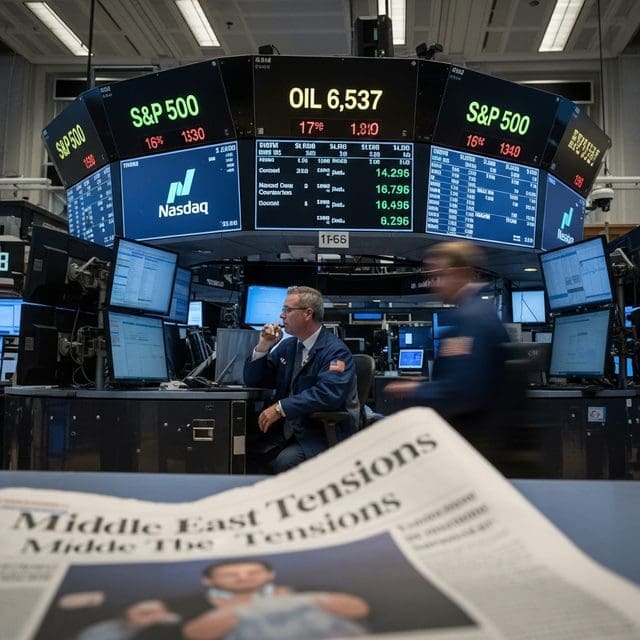
The S&P 500 and Nasdaq rose while the Dow remained flat as geopolitical tensions in the Middle East drove oil prices toward $100 per barrel following a sharp rejection of Iranian terms.
Wall Street displayed a divided front on Monday as the S&P 500 and Nasdaq Composite edged higher by approximately 0.3%, while the Dow Jones Industrial Average remained largely flat. The market action followed a record-breaking Friday, yet the momentum was tempered by escalating geopolitical friction. President Trump sharply rejected a revised peace proposal from Tehran, characterizing the terms as “totally unacceptable” in a move that immediately impacted energy markets.
Crude oil prices surged in response to the diplomatic impasse. West Texas Intermediate futures climbed over 3% to trade near $98 per barrel, while the international benchmark Brent crude rose to approximately $104. The ongoing conflict has resulted in a near-complete stoppage of commercial traffic through the Strait of Hormuz. Analysts from Goldman Sachs and JPMorgan noted that the loss of 10 million barrels per day in supply has driven global inventories to near-record lows, placing significant pressure on the domestic economy. Goldman Sachs economists noted the global economy is currently “bending, not breaking,” though they warned that the likelihood of a U.S. recession remains 5% above pre-war levels.
Working households face a critical week as the focus shifts toward inflation metrics. The April Consumer Price Index and Producer Price Index, scheduled for release Tuesday and Wednesday, are expected to reflect how these elevated energy costs are permeating the broader economy. Economists anticipate headline price growth could jump from 3.3% to 3.8% due to the sustained oil shock, potentially complicating the path for future monetary policy. This comes as the Cleveland Federal Reserve’s low-tech forecasting models continue to outperform generative AI in predicting these inflationary shifts.
In the technology sector, the artificial intelligence trade continues to provide a floor for the major indices. Shares of AMD and Micron saw gains driven by data-center optimism, while the Roundhill Memory ETF (DRAM) reached $6.5 billion in assets in just 36 days, outpacing the growth of early-2024 Bitcoin ETFs. Intel also maintained its upward trajectory, having recently surpassed Oracle in market capitalization following reports of a potential partnership with Apple and new technology collaborations with South Korea’s SK Hynix. Despite these gains, market breadth remains a concern; strategists pointed out that while the S&P 500 hit record highs, only 52% of its components closed above their own 50-day moving averages.
Corporate earnings provided some bright spots amid the geopolitical uncertainty. Fox Corporation, Barrick Mining, and Constellation Energy all reported results that exceeded analyst expectations for both revenue and net income. Meanwhile, the White House has reportedly invited major CEOs, including Tesla’s Elon Musk and Apple’s Tim Cook, to join an upcoming summit in China. This diplomatic outreach occurs alongside domestic policy shifts, as President Trump recently endorsed a suspension of the federal gasoline tax to provide relief to consumers facing rising costs at the pump. As the war in Iran enters its fourth month, the intersection of high-stakes diplomacy and market volatility remains the primary driver for the American taxpayer’s bottom line.

Jordan Lee serves as the Senior Correspondent for Wall Street, Finance, and Monetary Systems at Just Right News. Based in the heart of the world’s financial capital, New York City, Lee brings a sharp, principled eye to the complex mechanisms that drive the global economy. His reporting is defined by a commitment to fiscal responsibility, the defense of the free market, and a deep-seated belief that a transparent monetary system is the bedrock of a free society.
Raised in Portland, Oregon, Lee’s perspective was forged in a city that has undergone significant cultural and economic shifts. His upbringing in the Pacific Northwest instilled in him a profound appreciation for the industriousness of small business owners and the importance of local economic stability. Watching the evolution of his hometown’s landscape sparked an early interest in how federal fiscal policy and large-scale financial trends eventually trickle down to the average citizen. This background provides him with a unique vantage point; he understands the growing disconnect between the policy-making elite and the reality of Main Street, a theme that frequently resonates throughout his work.
Now operating from his base in New York City, Lee bridges the gap between the high-stakes trading floors of Manhattan and the households of everyday Americans. He views the financial sector not merely as a collection of numbers and tickers, but as a vital engine of American prosperity that requires constant vigilance and accountability. His reporting often highlights the dangers of centralized financial control and the necessity of maintaining a system that rewards merit, risk-taking, and innovation.
As the creator and lead of the featured series, “The Invisible Economy,” Lee pulls back the curtain on the often-opaque world of monetary systems. He specializes in translating the dense jargon of central banking and international finance into actionable insights for the Just Right News audience. His work explores the “invisible” forces—such as inflationary pressures, regulatory creep, and the expansion of the administrative state—that erode the purchasing power of American families. By focusing on these systemic issues, Lee empowers readers to understand the hidden forces shaping their financial independence.
Lee’s journalistic philosophy is rooted in a steadfast commitment to traditional American values. As an Asian American professional who has navigated the competitive corridors of the financial world, he is a vocal advocate for meritocracy and the preservation of the American Dream. He believes that a stable currency and a predictable regulatory environment are essential for national sovereignty and individual liberty. His reporting frequently warns against the risks of government overreach in the private sector, arguing that the most effective solutions to economic challenges arise from competition and individual enterprise rather than bureaucratic mandates.
At Just Right News, Jordan Lee remains dedicated to providing a clear-eyed defense of the taxpayer. Whether he is analyzing market volatility or investigating the long-term implications of national debt, his mission is to provide the truth about where the money is going and what it means for the future of the country. Through his rigorous analysis and principled stance, Lee has become a trusted voice for those who value a strong, sovereign, and fiscally sound America.