

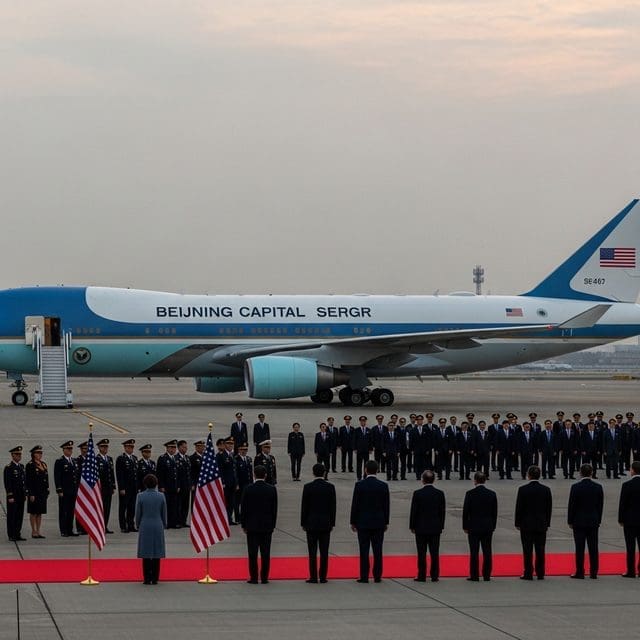
Acting Pentagon Comptroller Jules Hurst III testified that military expenditures have reached $29 billion as President Trump arrives in Beijing for high-stakes talks with Xi Jinping.
The fiscal and geopolitical stakes of the conflict with Iran intensified this week as the Pentagon revised its war expenditure estimates upward and President Donald Trump arrived in Beijing for a high-stakes summit. Acting Pentagon Comptroller Jules W. Hurst III testified before a House Appropriations hearing that the cost of the war has reached $29 billion, a $4 billion increase from figures provided to Congress just two weeks ago. This surge is attributed to rising costs for equipment repair, munitions replacement, and operational overhead in the Middle East. Defense Secretary Pete Hegseth has notably declined to disclose to lawmakers the specific timeline for future emergency funding requests.
While the Pentagon focuses on immediate outlays, external analysts warn of a much larger long-term burden. Linda Bilmes of the Harvard Kennedy School projects the total cost could eventually reach $1 trillion when accounting for veterans’ care and economic disruptions. Bilmes characterized the current daily burn rate of approximately $2 billion as the tip of the iceberg. Representative Ro Khanna has further estimated the broader economic impact at $631 billion, or roughly $5,000 per American household, when factoring in rising food and energy prices. Recent Labor Department data supports these concerns, showing a 3.8 percent surge in the Consumer Price Index since April 2025, driven by a 5.4 percent spike in gasoline costs.
In response to domestic pressure, President Trump confirmed plans to pause the federal gas tax starting May 11, 2026. This move comes as the International Energy Agency warns that global oil reserves are shrinking due to supply disruptions in the Persian Gulf. Despite economic volatility and IMF warnings of a global recession, the President maintains a firm stance on the primary objective. He told reporters that he does not prioritize the immediate financial situation of Americans when negotiating with Tehran, asserting that preventing a nuclear-armed Iran is the singular, non-negotiable goal of the military campaign.
Diplomatic efforts are now shifting to the Pacific. President Trump arrived in China on May 12 for a summit with Xi Jinping, scheduled for May 14-15. The President is accompanied by a delegation of industry titans, including Elon Musk, Tim Cook, and Nvidia CEO Jensen Huang. The inclusion of Huang has interested market analysts, who suggest it may signal shifts in semiconductor export licenses as part of a broader deal to stabilize global trade. Traders interpreted the move as a signal of potential favorable news, which temporarily buoyed tech stocks despite broader market nervousness.
Beijing remains a critical player as the primary importer of Iranian oil. While the President has publicly downplayed the necessity of Chinese intervention to end the war, the presence of a Chinese-flagged supertanker in the Strait of Hormuz underscores the interconnected nature of the crisis. As the administration projects strength abroad, the mounting $29 billion price tag and the $11.3 million cost overrun on domestic projects, such as the Lincoln Memorial Reflecting Pool repairs, continue to test the endurance of the American economy. The Beijing summit represents a pivotal moment to reconcile the peace through strength doctrine with the reality of a global economy on the brink of recession.

Olivia Kendall serves as the Senior Correspondent for Geopolitics, Defense, and Foreign Policy at Just Right News, where she provides a principled, conservative perspective on the complex forces shaping the global stage. With a career dedicated to deconstructing the intricacies of international relations, Kendall has become a trusted voice for readers who value national sovereignty, a robust military, and a foreign policy that prioritizes American interests above all else.
A native of Washington, D.C., Kendall’s professional journey is deeply rooted in her upbringing within the nation’s capital. Growing up in the epicenter of American political life, she developed an early and profound understanding of how policy is crafted and, more importantly, how it often fails to account for the values of the American heartland. This unique vantage point allowed her to witness firsthand the rise of globalist bureaucracies, fueling her commitment to reporting that champions the constitutional foundations of the United States. Her background as a British White American further informs her worldview, providing her with a keen appreciation for the Western tradition and the enduring importance of the “Special Relationship” in maintaining global stability.
Now based in Arlington, Virginia, Kendall operates from the doorstep of the Pentagon and the heart of the nation’s defense establishment. Her proximity to the decision-makers in the military and intelligence communities allows her to provide boots-on-the-ground reporting that is both timely and deeply informed. For Kendall, Arlington is more than just a base of operations; it is a daily reminder of the sacrifices made by the men and women in uniform. This connection to the defense community drives her rigorous coverage of military readiness and her advocacy for a “peace through strength” approach to diplomacy.
At Just Right News, Kendall is perhaps best known for her acclaimed feature series, “The World’s Shadow on America.” In this ongoing project, she explores the direct correlation between international developments and the daily lives of American citizens. Whether she is analyzing the encroachment of foreign adversaries in domestic supply chains or the impact of international treaties on local economies, Kendall’s work serves as a vital bridge between distant geopolitical shifts and their consequences at home. She rejects the notion that foreign policy is an abstract concern for elites, instead proving that what happens in the corridors of power in Brussels or Beijing has a tangible “shadow” that falls across every American doorstep.
Throughout her tenure, Kendall has remained a steadfast critic of international overreach and a vocal proponent of a clear-eyed, realistic foreign policy. She brings a sharp analytical mind to her beat, often challenging the prevailing narratives of the mainstream media to uncover the underlying truths that affect national security. Her reporting is characterized by a refusal to compromise on the truth and a dedication to the idea that a strong, secure America is the world’s best hope for liberty. As a Senior Correspondent, Olivia Kendall continues to lead the charge in providing the essential context and conservative insight necessary to navigate an increasingly volatile world.