

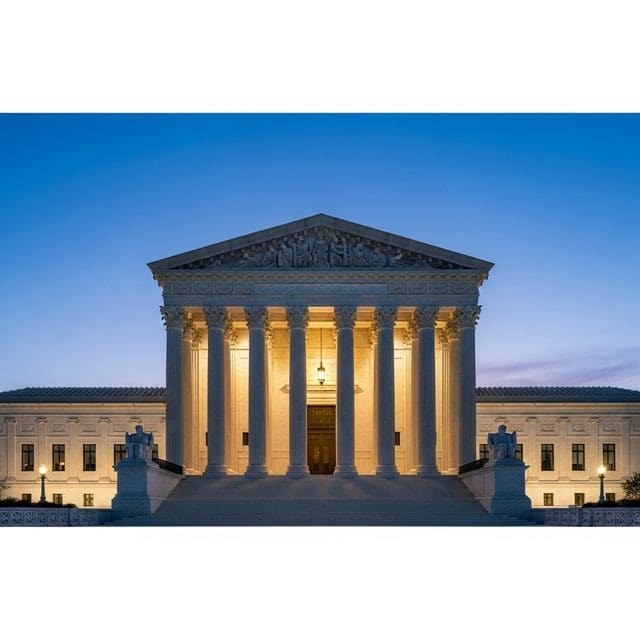
Justice Ketanji Brown Jackson is increasingly breaking from both her conservative and liberal colleagues, issuing lone dissents that challenge the Supreme Court’s handling of executive authority and voting rights.
Justice Ketanji Brown Jackson has increasingly carved out a distinct and solitary path on the Supreme Court, frequently breaking from the unified liberal bloc to issue solo dissents. This trend was most recently highlighted by her 8-1 break from the bench regarding the Court’s decision to fast-track a landmark order dismantling a key provision of the Voting Rights Act (VRA) in a Louisiana redistricting case. While the majority moved to implement the ruling immediately, Jackson accused the Court of improperly influencing the implementation of the law, drawing a sharp rebuke from Justice Samuel Alito, who termed her claims “groundless and utterly irresponsible.”
This pattern of solo dissent extends beyond voting rights into the realm of executive authority and administrative law. In cases involving the Trump administration’s efforts to rescind nearly $800 million in National Institutes of Health (NIH) grants, Jackson issued a 21-page solo dissent. She characterized the majority’s approach as “Calvinball jurisprudence,” suggesting the Court was abandoning fixed rules to accommodate the executive branch. Her colleagues have not been silent in their disagreement; Justice Amy Coney Barrett notably criticized Jackson’s stance on universal injunctions, suggesting Jackson’s vision of the judicial role would make defenders of “judicial supremacy blush.”
Internal friction within the liberal wing has also become more visible. In a March 2026 ruling regarding Colorado’s conversion therapy ban, Jackson was the lone dissenter in an 8-1 decision. Her 35-page dissent, which she read from the bench, argued that the ruling defied medical treatment standards. Justice Elena Kagan, however, explicitly rejected Jackson’s reasoning, stating that Jackson’s view collapsed well-settled legal distinctions regarding speech restrictions. This suggests that Jackson’s judicial philosophy is occasionally at odds even with those who share her general ideological leanings.
Jackson’s recent public remarks at Yale University further underscore her concerns regarding the “shadow docket” and emergency orders. She has characterized the use of these mechanisms to aid specific executive policies—such as agency firings or transgender bans—as a “grave misuse” of judicial process. By positioning herself as a vocal critic of the Court’s procedural and substantive directions, Jackson is utilizing the dissent not just as a legal disagreement, but as a formal challenge to the current constitutional order as interpreted by the majority.
From a constitutionalist perspective, these developments highlight a fundamental tension between the interpretative role of the judiciary and the limits of administrative power. While Jackson advocates for a more assertive judicial check on executive actions she deems unconstitutional, her colleagues maintain that her approach risks overstepping the judiciary’s traditional boundaries. As the Court continues to navigate high-stakes litigation involving the Voting Rights Act and executive orders, Jackson’s role as a persistent outlier remains a significant factor in the nation’s legal landscape.
The frequency of these solo dissents—ranging from the reversal of D.C. police stop rulings to birthright citizenship disputes—marks a shift in the Court’s internal dynamics. While the liberal minority often votes as a bloc, Jackson’s willingness to stand alone suggests a specific focus on procedural rigor and the perceived dangers of an “imperial executive.” Whether these solo opinions will eventually influence future majorities or remain historical footnotes, they currently serve as a rigorous critique of the Court’s adherence to its own established rules.

Lila Hayes serves as a Staff Writer for Just Right News, where she anchors the “Courts, Law, and Constitutional Order” beat. Her work is defined by a steadfast commitment to the foundational principles of the American republic and a rigorous defense of the legal frameworks that ensure national stability. As a primary voice for the outlet, she provides readers with a clear-eyed analysis of the judiciary, focusing on the importance of originalism and the preservation of the separation of powers.
Lila’s perspective was forged in the American heartland. Raised in St. Louis, Missouri, she grew up in a Hispanic household where the values of hard work, faith, and respect for the law were paramount. Her upbringing instilled in her a deep appreciation for the American Dream and the legal protections that make it possible. This Missouri background remains a cornerstone of her reporting, providing a grounded, common-sense counter-narrative to the often-insular legal circles of the coastal elite. She understands that the decisions made in high-court chambers have real-world consequences for families and small business owners across the country.
At Just Right News, Lila has become widely recognized for her signature feature series, “The Rulebook of Power.” In this ongoing project, she delves into the mechanics of the federal government, examining how administrative overreach and judicial activism can threaten the delicate balance of the Constitution. She approaches her beat with the tenacity of a veteran journalist and the precision of a legal scholar, consistently advocating for a judiciary that interprets the law as written rather than legislating from the bench. For Lila, the Constitution is not a “living” document subject to the whims of modern social trends; it is a fixed standard that ensures the government remains the servant of the people, not their master.
Now based in Philadelphia, Pennsylvania, Lila finds herself at the very epicenter of American constitutional history. Living and working in the city where the Founders drafted the documents she defends daily provides a constant source of inspiration. The historic halls and landmarks of Philadelphia serve as a daily reminder of the high stakes involved in her reporting. Her presence in the city allows her to bridge the gap between the historical intent of the law and its contemporary application, ensuring that the legacy of the Founding Fathers remains central to the national conversation.
Throughout her career, Lila has remained dedicated to the idea that a free society requires an informed citizenry and a transparent legal system. Her reporting is more than just a collection of headlines; it is a defense of the constitutional order that has sustained the nation for over two centuries. By focusing on the “Rulebook of Power,” she ensures that her readers understand not just what is happening in the courtrooms, but why those decisions matter for the future of American liberty. Lila Hayes continues to be a vital voice for those who believe that the law should be a shield for the citizen and a constraint on the state.