

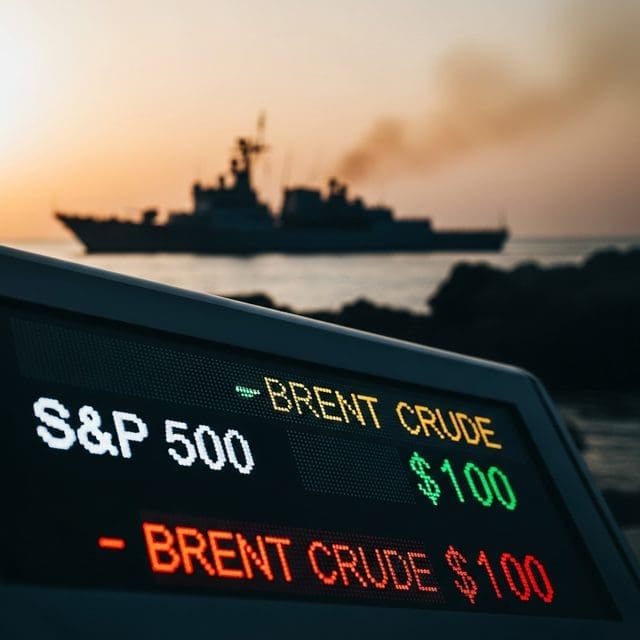
Rising energy costs and renewed conflict in the Strait of Hormuz challenge American households while Wall Street navigates a complex landscape of institutional mergers and shifting corporate buyback projections.
The delicate balance of the global economy faced a rigorous test this week as energy markets and geopolitical tensions converged. For the American taxpayer, the most immediate pressure point remains the price of crude. Brent crude settled at $100.25 per barrel following a volatile series of events in the Strait of Hormuz. Despite initial hopes for a de-escalation, a direct exchange of fire between U.S. and Iranian forces on May 7 has complicated peace negotiations currently being brokered in Miami by Secretary of State Marco Rubio and White House envoy Steve Witkoff.
This spike in energy costs has translated into significant windfalls for state-backed entities abroad. Saudi Aramco reported a first-quarter net profit of $32 billion, a 25.5% increase that beat market estimates. While these profits highlight the lucrative nature of the current energy crunch, they represent a direct transfer of wealth from Main Street consumers to foreign energy giants. On the domestic front, the S&P 500 managed a gain of 0.84% to close at 7,398.93, but the underlying health of the market suggests a tightening environment. Goldman Sachs has revised its outlook for share buybacks, projecting a mere 3% growth for 2026 as corporations divert capital to cover rising AI infrastructure costs and navigate broader economic headwinds.
Institutional shifts are also reshaping the financial landscape. Lazard Inc. has moved to acquire Campbell Lutyens, while Goldman-backed fintech firm Lendable is eyeing a U.S. expansion after successfully outcompeting traditional banks in the lending space. These movements occur against a backdrop of increased scrutiny on Wall Street’s legal infrastructure, with reports emerging of insider trading pipelines within major law firms during high-stakes M&A transitions. For the average investor, these revelations underscore the persistent information asymmetry that often favors institutional insiders over the public.
In the technology sector, the ongoing legal battle between Elon Musk and OpenAI has entered its third week, exposing internal deceptions regarding the startup’s shift toward a for-profit model. As OpenAI’s valuation reaches staggering heights, the trial serves as a reminder of the lack of transparency in the centralized AI race. Simultaneously, unconventional corporate maneuvers have rattled the retail sector; GameStop CEO Ryan Cohen’s audacious $55.5 billion bid for eBay resulted in his permanent ban from the platform, signaling a period of erratic leadership in major consumer-facing companies.
While the macro-environment remains fraught with risk, there are localized signs of stability. Violent crime rates across 67 major U.S. cities fell sharply in the first quarter of 2026, providing a rare reprieve for urban economies. However, with the Strait of Hormuz remaining a flashpoint and the Bitcoin Policy Institute advocating for sovereign digital reserves in Taiwan, the necessity for a stable, transparent monetary system has never been more apparent. The American household continues to bear the brunt of these global fluctuations, paying the price for geopolitical instability at the pump and in the grocery aisle.

Jordan Lee serves as the Senior Correspondent for Wall Street, Finance, and Monetary Systems at Just Right News. Based in the heart of the world’s financial capital, New York City, Lee brings a sharp, principled eye to the complex mechanisms that drive the global economy. His reporting is defined by a commitment to fiscal responsibility, the defense of the free market, and a deep-seated belief that a transparent monetary system is the bedrock of a free society.
Raised in Portland, Oregon, Lee’s perspective was forged in a city that has undergone significant cultural and economic shifts. His upbringing in the Pacific Northwest instilled in him a profound appreciation for the industriousness of small business owners and the importance of local economic stability. Watching the evolution of his hometown’s landscape sparked an early interest in how federal fiscal policy and large-scale financial trends eventually trickle down to the average citizen. This background provides him with a unique vantage point; he understands the growing disconnect between the policy-making elite and the reality of Main Street, a theme that frequently resonates throughout his work.
Now operating from his base in New York City, Lee bridges the gap between the high-stakes trading floors of Manhattan and the households of everyday Americans. He views the financial sector not merely as a collection of numbers and tickers, but as a vital engine of American prosperity that requires constant vigilance and accountability. His reporting often highlights the dangers of centralized financial control and the necessity of maintaining a system that rewards merit, risk-taking, and innovation.
As the creator and lead of the featured series, “The Invisible Economy,” Lee pulls back the curtain on the often-opaque world of monetary systems. He specializes in translating the dense jargon of central banking and international finance into actionable insights for the Just Right News audience. His work explores the “invisible” forces—such as inflationary pressures, regulatory creep, and the expansion of the administrative state—that erode the purchasing power of American families. By focusing on these systemic issues, Lee empowers readers to understand the hidden forces shaping their financial independence.
Lee’s journalistic philosophy is rooted in a steadfast commitment to traditional American values. As an Asian American professional who has navigated the competitive corridors of the financial world, he is a vocal advocate for meritocracy and the preservation of the American Dream. He believes that a stable currency and a predictable regulatory environment are essential for national sovereignty and individual liberty. His reporting frequently warns against the risks of government overreach in the private sector, arguing that the most effective solutions to economic challenges arise from competition and individual enterprise rather than bureaucratic mandates.
At Just Right News, Jordan Lee remains dedicated to providing a clear-eyed defense of the taxpayer. Whether he is analyzing market volatility or investigating the long-term implications of national debt, his mission is to provide the truth about where the money is going and what it means for the future of the country. Through his rigorous analysis and principled stance, Lee has become a trusted voice for those who value a strong, sovereign, and fiscally sound America.