

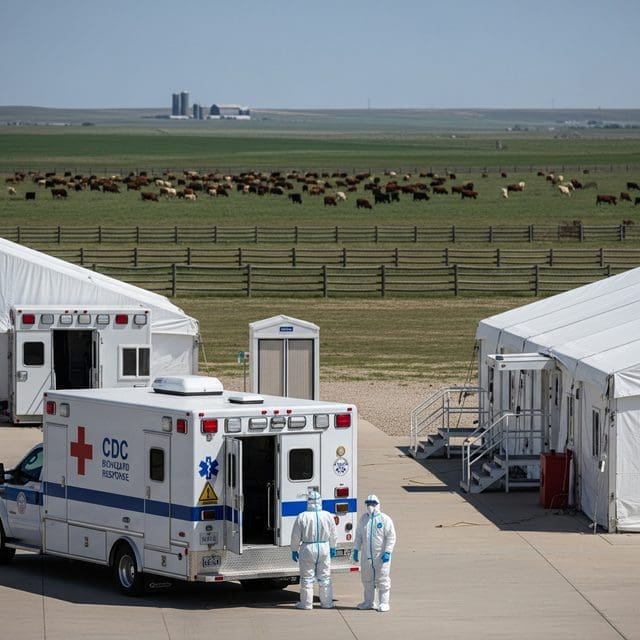
As the CDC scrambles to contain a deadly hantavirus outbreak from a cruise ship, ethics disclosures at the Interior Department highlight the ongoing tension between federal regulation and private ranching interests.
The federal government is currently juggling a high-stakes public health crisis at sea and a burgeoning ethics scandal at home, highlighting the delicate balance between regulatory vigilance and institutional integrity. On May 10, the Centers for Disease Control and Prevention (CDC) activated a Level 3 response to a hantavirus outbreak originating on the MV Hondius cruise ship. The move comes as seventeen Americans are being repatriated to a specialized quarantine facility in Nebraska for observation.
The outbreak, which has already claimed three lives and maintains a staggering 38 percent fatality rate, involves the Andes virus—a strain known for its potential for human-to-human transmission. While the CDC is issuing urgent alerts to American physicians, the agency has faced criticism for a perceived delay in its initial response. Public health advocates point to recent staffing reductions as a potential bottleneck, though teams are now deploying to Spain and Nebraska to manage the risk to domestic soil.
Closer to the ground, the Department of the Interior is navigating its own storm. Financial disclosure documents revealed on May 10 indicate that Karen Budd-Falen, a senior official within the department, was involved in policy shifts that directly benefited her family’s multi-million-dollar cattle and ranching operations. For those in the San Joaquin Valley and across the rural West, this development underscores a perennial frustration: the suspicion that federal land management and agricultural policies are often steered by those with the closest ties to the levers of power rather than by objective stewardship.
On the food safety front, the Food and Drug Administration (FDA) remains on high alert following a significant recall by California Dairies involving powdered milk due to potential Salmonella contamination. While no new recalls were issued specifically on May 10, the agency is under pressure to ensure that the domestic supply chain remains resilient as global health threats like the hantavirus dominate the headlines.
These concurrent events—a viral outbreak, an ethics probe into ranching policy, and ongoing food safety monitoring—reveal a federal apparatus stretched thin. For the American farmer and the local consumer, the message is clear: while federal agencies provide a necessary safety net, the most reliable oversight often begins with local transparency and the protection of private-sector standards against bureaucratic drift.

Eric Nolan serves as the Senior Correspondent for Food, Water, and Environmental Health at Just Right News, where he brings a principled, common-sense perspective to the most fundamental issues facing the American public. With a career dedicated to uncovering the truth behind the policies that govern our natural resources, Eric has become a trusted voice for readers who value traditional stewardship over bureaucratic overreach. His reporting is defined by a commitment to the idea that true environmentalism is rooted in the protection of the American family and the preservation of the nation’s agricultural heritage.
Raised in Fresno, California, Eric’s worldview was shaped in the heart of the San Joaquin Valley. Growing up in one of the world’s most productive agricultural hubs, he witnessed firsthand the vital connection between the land, the water, and the dinner table. In Fresno, he saw the resilience of farmers and the devastating impact that distant, top-down regulations can have on local communities. This upbringing instilled in him a deep respect for the producers who feed the country and a lifelong skepticism toward the alarmist narratives often pushed by mainstream media. For Eric, environmental health is not an abstract political talking point; it is a matter of ensuring that the people who work the land have the freedom and the resources to do so effectively.
Now based in Eugene, Oregon, Eric operates from a unique vantage point in the Pacific Northwest. Living in a region often defined by intense environmental debate, he provides a necessary counter-narrative to the prevailing trends of the area. From his base in Eugene, he monitors the shifting tides of federal and state policies, ensuring that the voices of rural citizens and property owners are not drowned out by urban activism. His reporting often bridges the gap between the rugged realities of the outdoors and the legislative halls where decisions are made, offering a grounded perspective that prioritizes local sovereignty and practical solutions.
As the lead for the acclaimed feature series “Earth on the Table,” Eric explores the intricate journey of the American food supply. He tackles critical issues such as water rights, soil health, and food security through a lens of national stability and individual liberty. He believes that a healthy environment and a thriving economy are not mutually exclusive, but rather two sides of the same coin of national prosperity. His work consistently highlights how innovation and private-sector ingenuity are the most effective tools for ensuring clean water and a safe food supply, rather than the expansion of the administrative state.
At Just Right News, Eric’s reporting serves as a vital resource for those who seek accountability and transparency. Whether he is investigating the impact of federal land management on local economies or examining the safety of the national food infrastructure, his work remains anchored in the values of heritage and hard work. Eric Nolan continues to be a leading voice in environmental journalism, championing the belief that the best way to protect our natural resources is to empower the people who live and work closest to them.