

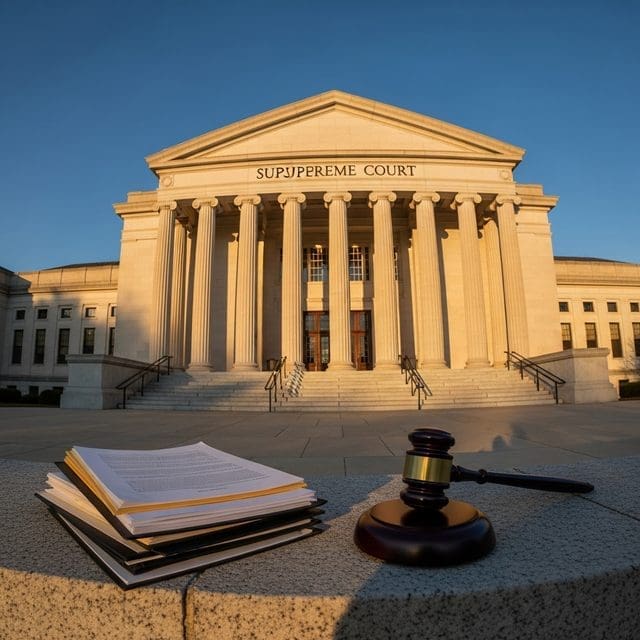
President Trump secures a three-day Ukraine ceasefire and prepares for a Beijing trade summit while court rulings in Virginia solidify Republican redistricting advantages.
The month of May 2026 has ushered in a series of rapid-fire developments across the executive and judicial branches, signaling a pivot toward high-stakes diplomacy and a consolidation of domestic political boundaries. President Trump announced a three-day ceasefire in the Russia-Ukraine war on May 9, 2026, a deal that includes a prisoner swap and has received public support from Ukrainian President Volodymyr Zelenskyy. While past ceasefires have proven fragile, this agreement serves as a precursor to a significant diplomatic mission; the President is scheduled to depart for Beijing on May 17, accompanied by a delegation of American CEOs seeking new trade deals with China.
On the domestic front, the administrative state and the judiciary are recalibrating. A pivotal 4-3 ruling by the Virginia Supreme Court on May 8 struck down a Democratic-led redistricting referendum, citing procedural failures. This decision maintains the existing 6-5 congressional map, contributing to a broader national trend where Republican-led redistricting efforts in states like Texas, Alabama, and Louisiana are projected to net the party additional seats. These shifts occur as a Politico poll reveals that 72 percent of Americans believe excessive money continues to exert too much influence over the political process.
In Washington, the “Make America Healthy Again” (MAHA) movement, founded by Robert F. Kennedy Jr., is gaining quiet traction among environmental groups that had previously distanced themselves from his presidential campaign. This alignment suggests a pragmatic shift in environmental advocacy, focusing on health-centric policy rather than traditional partisan alliances. Meanwhile, within the federal bureaucracy, the Federal Student Aid office is moving forward with plans to hire over 300 full-time employees by 2027, despite previous staffing cuts and efforts to decentralize the department’s functions.
Regulatory tensions are also surfacing at the Federal Communications Commission. Chairman Brendan Carr is currently engaged in a public dispute with major broadcast networks over TV station licenses, reflecting the administration’s broader scrutiny of media consolidation. In the legislative sphere, former Senator Mitt Romney has re-emerged in the national spotlight to host a fundraiser for Senator Susan Collins, highlighting a persistent, if quiet, moderate coalition within the party.
Finally, the conflict with Iran remains a primary focus for defense officials. While the U.S. and Iran are reportedly nearing a one-page memorandum to end two months of hostilities, the administration continues to utilize digital messaging to maintain pressure. On May 9, the President shared an AI-generated composite image of sunken Iranian vessels, a move that coincides with Tehran’s ongoing review of a U.S. peace proposal. As these international and domestic threads converge, the administrative state’s transparency remains a focal point for those monitoring the actual mechanics of governance beyond the headlines.
Ben Taylor serves as the Senior Correspondent and Investigations Lead for Just Right News, where he anchors the network’s commitment to government transparency and institutional accountability. With a career defined by a relentless pursuit of the facts, Taylor spearheads the acclaimed feature series “The Paper Trail,” a deep-dive investigative column that prioritizes primary source documentation over political rhetoric. Based in the heart of the nation’s capital, he has earned a reputation as one of the most formidable investigative journalists in Washington, D.C., known specifically for his mastery of public records and the Freedom of Information Act.
Taylor’s approach to journalism is deeply rooted in his upbringing in Kansas City, Missouri. Growing up in the “Show Me State,” he developed a healthy skepticism of centralized power and a profound respect for the common-sense values of the American heartland. This Midwestern foundation informs his reporting today, as he bridges the gap between the complex machinations of federal bureaucracy and the everyday concerns of citizens across the country. For Taylor, investigative reporting is not about chasing headlines; it is about ensuring that the government remains answerable to the people it serves.
As an African American man working within the conservative media landscape, Taylor brings a principled perspective to his beat. He views the Constitution and the right to information as the ultimate equalizers in a free society. His work often highlights how bureaucratic overreach and lack of transparency disproportionately affect individual liberties. By focusing on the “paper trail,” Taylor strips away the spin of partisan talking points, instead providing Just Right News readers with the raw data and internal communications that reveal how their tax dollars are spent and how policy decisions are actually made.
In his role as Investigations Lead, Taylor oversees a team dedicated to uncovering the stories that mainstream outlets often overlook. Whether he is auditing federal spending, investigating regulatory overreach, or exposing inefficiencies within the administrative state, his methodology remains consistent: follow the evidence wherever it leads. His presence in Washington, D.C., allows him to maintain a constant watch over the halls of power, yet he remains steadfastly connected to his roots, ensuring his reporting reflects the clarity and directness of his Missouri home.
Throughout his tenure at Just Right News, Taylor has become a vital voice for those who demand integrity in public office. He believes that a well-informed electorate is the strongest defense against government overreach, and he has dedicated his career to providing the public with the tools they need to hold their leaders accountable. Through “The Paper Trail” and his broader investigative work, Ben Taylor continues to set the standard for rigorous, document-driven journalism that champions the values of transparency, individual responsibility, and the rule of law.