

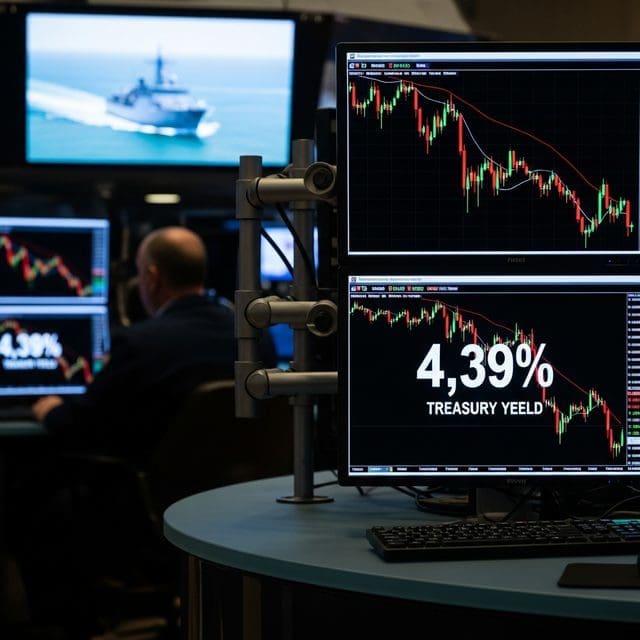
American households face a complex economic landscape as rising Treasury yields and renewed Middle East skirmishes pressure major stock indices despite resilient labor data.
The American financial landscape shifted toward caution on May 8, as a confluence of geopolitical friction and rising sovereign bond yields weighed on major indices. The Dow Jones Industrial Average fell 0.63% to 49,596, while the S&P 500 and Nasdaq Composite also retreated. For the working household, this volatility serves as a reminder that the ‘Invisible Economy’ remains sensitive to both the cost of government debt and the stability of global trade routes.
Market sentiment soured following reports of exchanged fire between U.S. and Iranian forces in the Strait of Hormuz on May 7. This escalation occurred despite earlier attempts by the Trump administration to suspend escort operations in hopes of diplomatic progress. While Saudi Arabia and Kuwait have eased hurdles for U.S. military access to bases and airspace, the threat to energy corridors remains a primary concern for fiscal stability. Surprisingly, oil and gas prices ended the session lower as early losses narrowed, suggesting that commodity markets are currently prioritizing global demand signals over immediate supply disruptions.
In the fixed-income market, the 10-year U.S. Treasury yield rose to 4.39%. This upward movement is driven by a labor market that refuses to cool, complicating the path for interest rate relief. When yields rise, the cost of borrowing for the average American—from mortgages to small business loans—inevitably follows. This pressure was most visible in the Russell 2000, which plummeted 1.6%, highlighting the struggle of smaller, domestic-focused companies to navigate high-interest environments.
On the regulatory front, the Court of International Trade ruled that the administration’s 10% universal tariffs were illegal. While duties continue to be collected during the appeal process, the ruling introduces significant uncertainty for retailers and manufacturers who have already adjusted their supply chains. This judicial pushback against executive trade policy comes at a time when the dollar is strengthening against the euro and yen, further complicating the outlook for American exporters.
Corporate America is also grappling with the dual-edged sword of innovation. While JPMorgan Chase CEO Jamie Dimon recently endorsed a trillion-dollar AI capital expenditure boom, the human cost is becoming apparent. Cloudflare announced a 20% workforce reduction this week, citing a strategic pivot toward AI. Conversely, Nvidia continues its aggressive expansion, taking a major stake in Iren to build a 5-gigawatt global footprint for AI infrastructure. For the taxpayer, these moves signal a massive reallocation of capital toward automation, which may drive long-term efficiency but presents immediate challenges for the traditional workforce.
As the week closes, the resilience of the U.S. economy is being tested by external shocks and internal policy debates. While German factory orders and Eurozone retail sales showed unexpected strength, the domestic focus remains on whether the Federal Reserve can manage a stable monetary system in the face of persistent labor strength and a volatile geopolitical map. For those on Main Street, the message is clear: the era of cheap money is firmly in the rearview mirror, and meritocracy in the markets will be defined by those who can weather these rising costs.

Jordan Lee serves as the Senior Correspondent for Wall Street, Finance, and Monetary Systems at Just Right News. Based in the heart of the world’s financial capital, New York City, Lee brings a sharp, principled eye to the complex mechanisms that drive the global economy. His reporting is defined by a commitment to fiscal responsibility, the defense of the free market, and a deep-seated belief that a transparent monetary system is the bedrock of a free society.
Raised in Portland, Oregon, Lee’s perspective was forged in a city that has undergone significant cultural and economic shifts. His upbringing in the Pacific Northwest instilled in him a profound appreciation for the industriousness of small business owners and the importance of local economic stability. Watching the evolution of his hometown’s landscape sparked an early interest in how federal fiscal policy and large-scale financial trends eventually trickle down to the average citizen. This background provides him with a unique vantage point; he understands the growing disconnect between the policy-making elite and the reality of Main Street, a theme that frequently resonates throughout his work.
Now operating from his base in New York City, Lee bridges the gap between the high-stakes trading floors of Manhattan and the households of everyday Americans. He views the financial sector not merely as a collection of numbers and tickers, but as a vital engine of American prosperity that requires constant vigilance and accountability. His reporting often highlights the dangers of centralized financial control and the necessity of maintaining a system that rewards merit, risk-taking, and innovation.
As the creator and lead of the featured series, “The Invisible Economy,” Lee pulls back the curtain on the often-opaque world of monetary systems. He specializes in translating the dense jargon of central banking and international finance into actionable insights for the Just Right News audience. His work explores the “invisible” forces—such as inflationary pressures, regulatory creep, and the expansion of the administrative state—that erode the purchasing power of American families. By focusing on these systemic issues, Lee empowers readers to understand the hidden forces shaping their financial independence.
Lee’s journalistic philosophy is rooted in a steadfast commitment to traditional American values. As an Asian American professional who has navigated the competitive corridors of the financial world, he is a vocal advocate for meritocracy and the preservation of the American Dream. He believes that a stable currency and a predictable regulatory environment are essential for national sovereignty and individual liberty. His reporting frequently warns against the risks of government overreach in the private sector, arguing that the most effective solutions to economic challenges arise from competition and individual enterprise rather than bureaucratic mandates.
At Just Right News, Jordan Lee remains dedicated to providing a clear-eyed defense of the taxpayer. Whether he is analyzing market volatility or investigating the long-term implications of national debt, his mission is to provide the truth about where the money is going and what it means for the future of the country. Through his rigorous analysis and principled stance, Lee has become a trusted voice for those who value a strong, sovereign, and fiscally sound America.